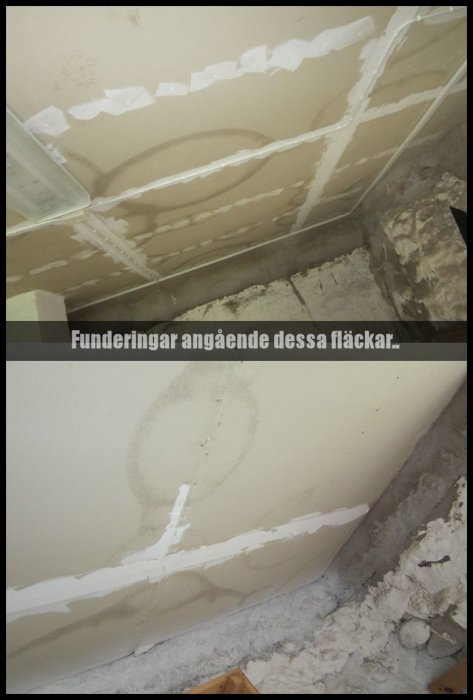
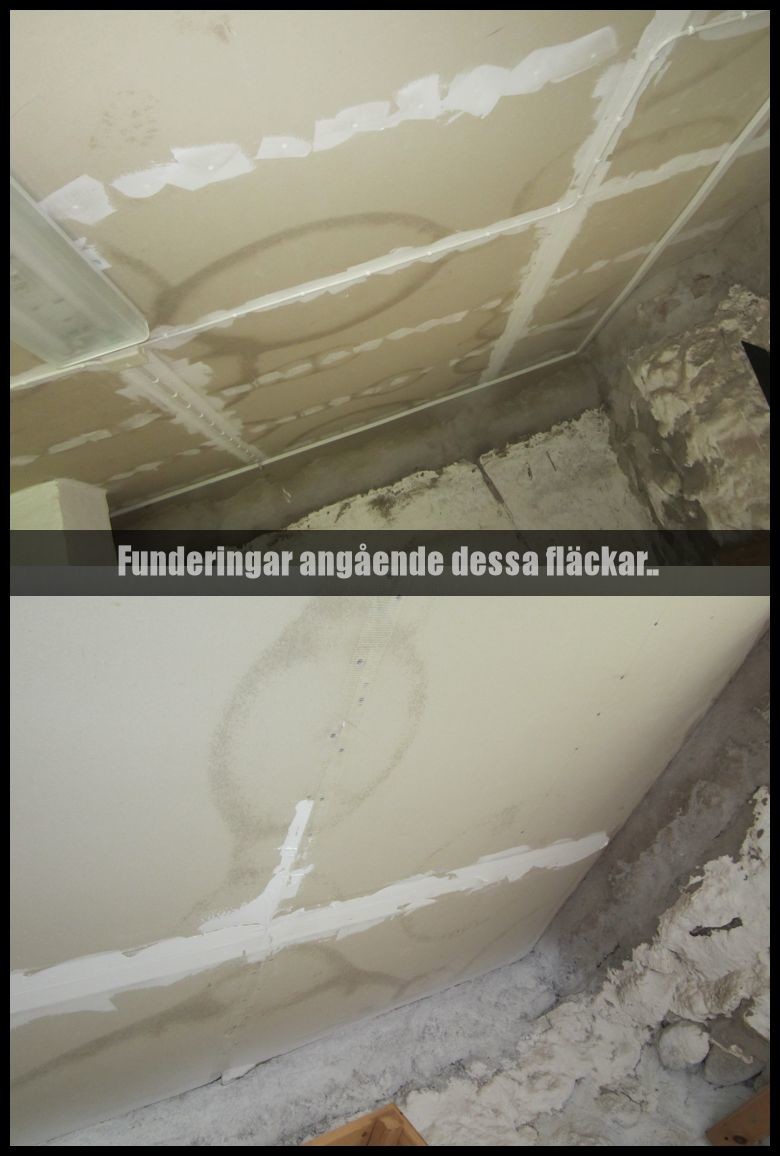
I really don't know if this is the right area, I could imagine quite a few others where it would fit as well... but I'm taking a chance here, and if it's wrong, please feel free to move the thread!
In the picture(s), you can glimpse some "damp spots" (?) on the relatively new plasterboard on the ceiling, which I'm wondering about the cause of... if you have any thoughts, tips are gratefully received... if you have questions, I probably can't answer them, but I'm happy to try!
A bit about the place where the ceiling is:
It's a "future bathroom" in a split-level part of an outbuilding (it's practically a basement really, but almost everything is above ground!).. it seems to be stone as the walls... mortared together... half-plastered on the inside and smooth-plastered on the outside (hard to explain, hope you understand).. that is, not a smooth wall - and the person who started the bathroom has poured a new floor... installed water and sewage, etc... and started screwing in metal studs for new walls inside...
Otherwise, there's not much else in the room... a corner with an accumulator tank (solar heating), a connected small stove, and a lot of building materials... the floor looks dry and nice... the plasterboard lying on the floor is dry and nice (even when you lift the sheets and look further down in the stack)... it doesn't feel more humid in the air than anywhere else (doesn't smell strange)... and yet these spots have somehow appeared...
I assume they weren't there from the beginning (on the sheet when they put it up), because the "rings" go across joints here and there...
Likewise, it doesn't seem to be "a water damage" in a local place... as there are damp spots on different sides of the room...
Above the room is an apartment with a small kitchen (with water)... but it doesn't seem to leak there (and if it did, the stain area in the ceiling should be more local, right... in one and the same place?)
The only thing I perceived was that it felt like the spots in large numbers were tied to the joints (which you can also see in the pictures) between the plasterboards... where they have spackled... this could be relevant... but don't really know how... :x
What the heck could it be (rather how and why have they appeared)? just pure moisture that got trapped between the "new" ceiling and possibly old ceiling (condensation or something)?... wrong material? wrong spackle?
If the stains are on the ceiling and you have a kitchen above, you must suspect that it is water coming from above that caused this. Can't you tear down a bit of drywall and check the top side of the drywall and any insulation in the joist structure....
How do you know the stains aren't coming from the kitchen?
If the stains are on the ceiling and you have a kitchen above, one would suspect that water coming from above has caused this. Can't you tear down some drywall and check the upper side of the drywall and any insulation in the beam layer.... How do you know the stains aren't coming from the kitchen?
I don't know that, of course!
But the kitchen itself is the size of a small kitchenette (and there were no visible damages or leaks on the outside, so to speak... but that doesn't mean the pipes underneath are intact!).. which made it feel like IF it was indeed leaking a little from there.. the stains should primarily be under the kitchen (at least have slightly larger stains right there).. but the stains have appeared all over in varying degrees (as I mentioned, mostly following seams and screw holes).. where there shouldn't be any pipes.. but indeed - water can run in strange and long paths before it finds its way out.. so it could be anything.. :/
..but as I said, I was just trying to be logical haha.. and THAT doesn't always work
The house where that room is located.. is not quite in my possession yet.. so I can't really tear anything down.. yet.. but of course, it will be investigated more thoroughly! Right now, I'm mostly wondering how and why.. and seeing if anyone else has any ideas..
Thanks for the input!
Have a nice evening,
Regards Sandra
Yes, I would look into that, in my opinion, it looks too much to just be condensation, for example. Unfortunately, it probably means quite a bit of demolition.
The reason it's visible at the seams might be because the water more easily finds its way down the gap between the boards (as it is on the top side) than through the gypsum itself.
Yes, I would check that out, it looks like too much to be just condensation for example. Unfortunately, that probably means some demolition.
The reason it appears at the seams might be because the water more easily finds its way down the gap between the boards (like it is on the top side) than through the plasterboard itself.
Yes, we think so too, we find them suspicious in general hehe.. Don't like unexplained things.. Itching to find out what it is..
What we know is that there aren't any waterborne radiators in the apartment above.. So there aren't any such pipes there.. The only ones that should go there are drainage and cold/hot water to the apartment above.. And some cables to the solar panels.. (I don't know how those work.. Is there water in those? Do you heat water.. Or do you collect electricity to heat water somewhere else?)
It didn't seem wet when we pressed there.. No stickiness anywhere.. And the owners haven't lived there for a while (more like a summer house for them). - But it's heated year-round!
As I said.. When we have the opportunity.. we'll demolish..
But still wondering..
Thanks for the input, have a nice evening!
Best regards, Sandra
We have now inspected the house, and in connection with that, we asked the owners for permission to saw into the ceiling (or take down a drywall panel, whichever was easiest), and we got it!
The inspector had his suspicions (just like us) beforehand, but I wonder if we aren't all just as puzzled afterward too, haha.. hm..
We chose the most intense spot and cut a hole... the drywall was in great condition... no stains on the "back" or in the middle... looked completely normal... we also cut through the insulation and the plastic... no discoloration... no moisture... no dampness... nada... all the wood we saw was fine (no stains whatsoever)... in other words, everything was just as it should be on the "other side"..
Just bizarre...
But the question is whether it could just be the moisture in the room... when we stepped in this time, it felt like entering a sauna! and there's no ventilation (yet!)... do you think that moisture over a long period can discolor the surface of the drywall like that?
We also took the opportunity to ask when they did the drywall ceiling (it looked newly done), but it turned out it had been like that for several years... (that is, in that humid environment)
Click here to reply
Vi vill skicka notiser för ämnen du bevakar och händelser som berör dig.