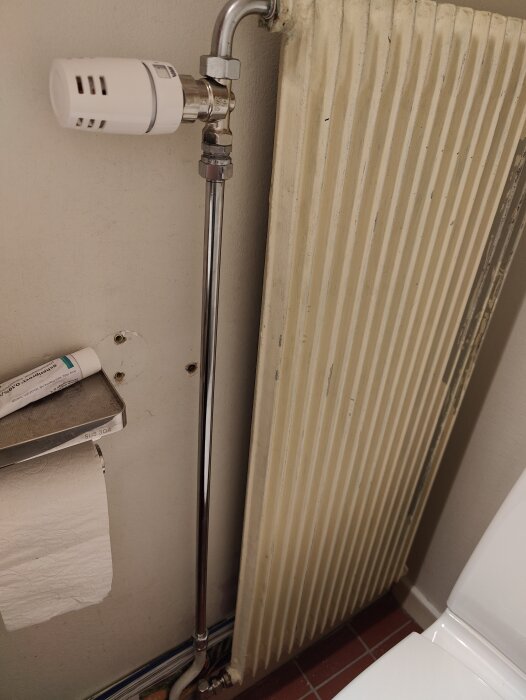
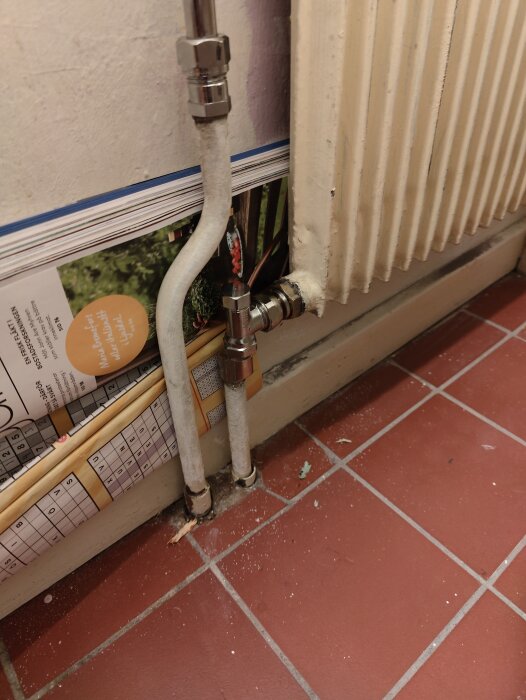
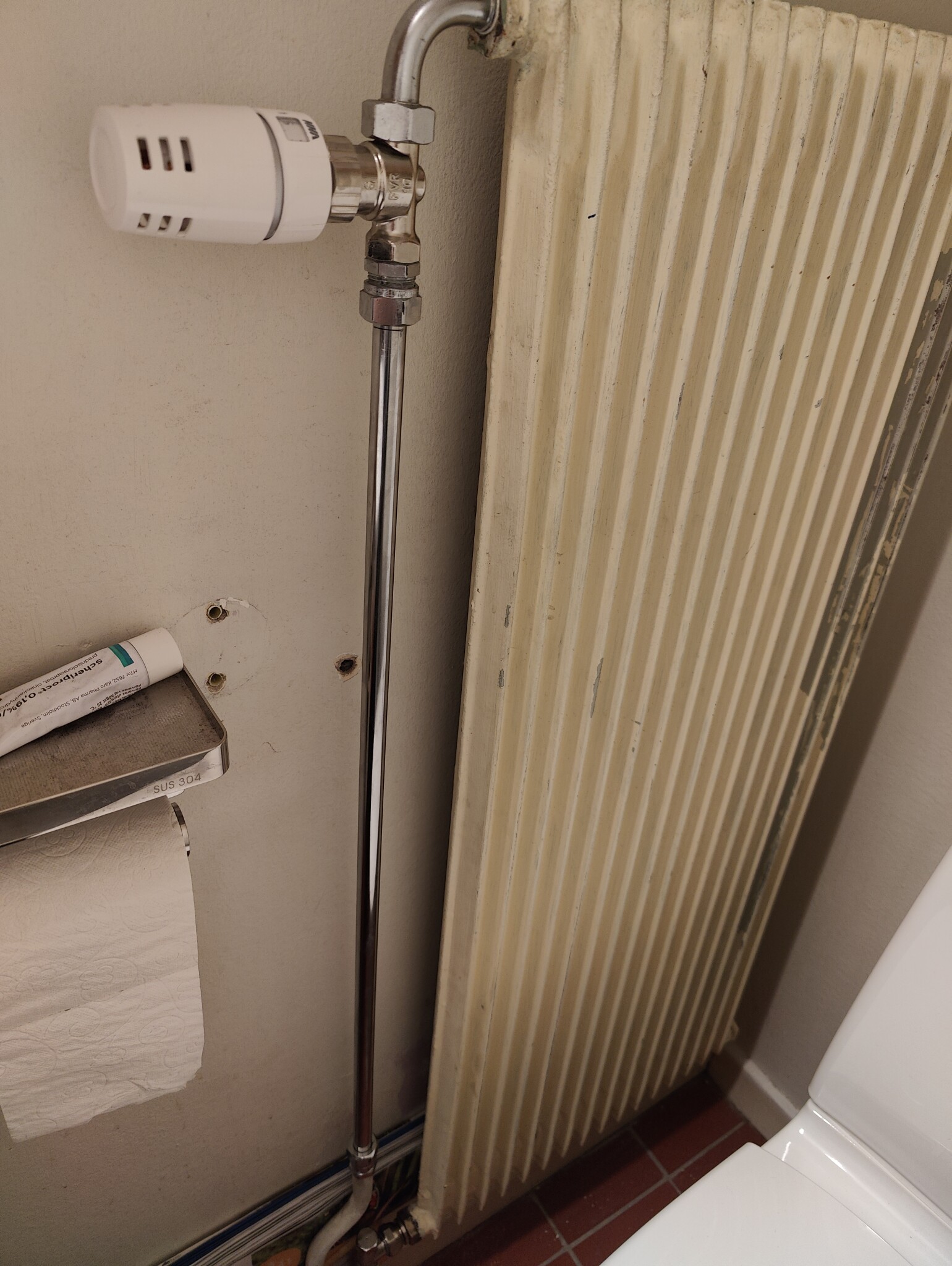
I'm considering replacing two loops with old steel pipes to the radiators. I want to have 15mm copper pipes instead, routed in the ceiling of the basement and holes drilled straight up at the existing steel pipes.
How would you do it? The steel pipes are routed in the joists with a basement underneath. It's not accessible from below.
Cut the existing steel pipes just above the floor and then try drilling with a 16mm metal drill straight down into the steel pipes?
No, but there are completely crazy installations in the basement in both the basement walls and floors! There's a radiator in the basement that's not used anyway, and otherwise, it's only two radiators that are affected as mentioned. It would be better if I could get rid of these old loops and install new ones that can be easily traced, I thought.
It is likely not possible to drill or attempt anything else. The basement wall underneath is probably about 10 cm further out under the floor structure than the wall you have there. It is thicker, and if pipes are to be installed from the basement, they must be drilled at an angle upwards from underneath. It is very difficult to hit the right spot from below. The only thing that usually works is to chisel a hole in the basement wall. The basement wall is likely 25 cm thick, and the wall above sits on the outer edge and is thinner.
Thank you, that was very valuable information. What you say sounds reasonable.
This won't be easy!
Another reason why I want to replace the pipes is that I plan to replace the radiators, which are somewhat undersized. The one in the picture is the newest of the two, with one panel and a convection plate. I was thinking of C22 or C21. The other is of the type with two panels only. I'm not quite sure how I would attach new elements to the existing pipes.
Have not used these but should be usable. Cut the pipes about 10 cm up, sand with very fine emery cloth, which is wrapped around and pulled so that any scratches go around the pipe. Now there might be a bit of a problem with the left pipe, as it seems to start bending almost down at the floor, and it probably should be a straight end that it's attached to—And continue with copper to the radiator. Copper pipes can be bent and possibly go between the radiator and the wall. Here is some info on the connection, and search for compression fitting steel to see more of what's available https://www.vatette.se/produkter/kopplingar/vatette-stal
If you are considering keeping the old pipes, you can probably achieve a good solution by using Purmo's Flexfördelare with Purmo Termopanel V4. The Flexfördelare raises the connections from the bottom of the radiator to the back of the radiator about 20 cm above the lower edge of the radiator with the connections pointing horizontally towards the opposite short side of the radiator.
I have used Flexfördelare to connect to old prisolrör that come up from the floors closer to the walls compared to what modern radiators are designed for. You can probably make a transition from the old pipes to 12 or 15 mm copper pipes that connect to the flexfördelare. The transition will be hidden behind the radiator except for the parts that end up under the radiator, which are quite well hidden by the depth of the radiator. The radiator brackets need to be supplemented with spacers that move the radiator away from the wall to make room for a transition fitting on the back. Ready-made plastic spacers are available up to 31 mm, which in total gives a 61 mm air gap behind the radiator.
This is how I did it yesterday, and it turned out well.
Use existing threads on the pipes?
I'm not quite sure I follow how you mean by drilling straight down into the pipes if you can't access them from underneath anyway? They're probably running off in some direction in the beam structure.
Unless you want copper purely for aesthetic reasons, I would skip that and perhaps just settle for unscrewing and plugging what isn't used - steel pipes last extremely long in a normal indoor environment under usual circumstances.
I think you'll have to come back with more pictures if we're going to be able to help you further.
Click here to reply
Vi vill skicka notiser för ämnen du bevakar och händelser som berör dig.