
Hello
I am planning to build an outdoor table from square steel that will be welded into a frame, then for the tabletop, I am thinking of using some form of deck hardwood, like teak which is available at Bauhaus.
To the question
If the table is going to be 3m long, with legs only at the ends. What dimension of square steel do you recommend?
Is it possible to weld joints or do I need to find long profiles?
Thanks
I am planning to build an outdoor table from square steel that will be welded into a frame, then for the tabletop, I am thinking of using some form of deck hardwood, like teak which is available at Bauhaus.
To the question
If the table is going to be 3m long, with legs only at the ends. What dimension of square steel do you recommend?
Is it possible to weld joints or do I need to find long profiles?
Thanks

Know-It-All
· Västra götaland
· 11 038 posts
Make a simple sketch so you can see roughly how you envision the whole thing...
If you want to get a feel for the material, you can go to Biltema and test how much a 2-meter long pipe flexes; I believe they have up to 40x40x1.5...
If you want to get a feel for the material, you can go to Biltema and test how much a 2-meter long pipe flexes; I believe they have up to 40x40x1.5...
I built a similar solution, a dining table with a surface of 1.2x3m. The tabletop was a custom-made 40mm laminate top from IKEA, and the base was KKR 40x40x3. In hindsight, I would have chosen stronger KKR pipes, such as 40x40x5, or alternatively, double rows with 40x40x3. Despite the top being mounted lying completely flat (table flipped upside down) and despite the top being both glued and screwed to the steel frame (to achieve extra cooperation between the materials), the tabletop sags about 5mm in the middle.
It is quite possible to splice such pipe profiles by welding. However, it can be challenging to get a spliced pipe completely straight without needing to align it, and additionally, it can be difficult to achieve a perfect surface (invisible seam) after welding and grinding.
It is quite possible to splice such pipe profiles by welding. However, it can be challenging to get a spliced pipe completely straight without needing to align it, and additionally, it can be difficult to achieve a perfect surface (invisible seam) after welding and grinding.
ok, thanks, valuable info.G Gabbe1 said:I have built a similar solution, a dining table with the surface 1.2x3m. The tabletop was a custom-ordered 40mm laminate top from IKEA and the frame was KKR 40x40x3. In hindsight, I would have chosen stronger KKR pipes, such as 40x40x5. Alternatively, double rows with 40x40x3. Despite the top being mounted lying completely flat (the table turned upside down) and despite the top being both glued and screwed to the steel frame (to get extra collaboration between the materials), the tabletop bends down about 5mm in the middle.
It is perfectly possible to splice such pipe profiles by welding. However, it can be difficult to get a spliced pipe completely straight without having to adjust it, and it can also be difficult to get the surface perfect (invisible splice) after welding and grinding.G Gabbe1 said:I have built a similar solution, a dining table with the surface 1.2x3m. The tabletop was a custom-ordered 40mm laminate top from IKEA and the frame was KKR 40x40x3. In hindsight, I would have chosen stronger KKR pipes, such as 40x40x5. Alternatively, double rows with 40x40x3. Despite the top being mounted lying completely flat (the table turned upside down) and despite the top being both glued and screwed to the steel frame (to get extra collaboration between the materials), the tabletop bends down about 5mm in the middle.
It is perfectly possible to splice such pipe profiles by welding. However, it can be difficult to get a spliced pipe completely straight without having to adjust it, and it can also be difficult to get the surface perfect (invisible splice) after welding and grinding.
I was prepared to go thinner but with your experience, I will probably rethink.
I might lay 3 longitudinal with "steel blocking" in between as my top will consist of planks.
If I splice, one could go overlap if laying double rows.
What did you make the legs from?
I'm considering a square.
The legs I made from KKR 50x50. Aesthetically, it looked better when the legs were a bit thicker than the frame. You can also build the frame in, for example, 60x40, which makes it much stronger. I didn't want it thicker than 40mm under the table because I was afraid it would interfere, but I think that fear is unfounded. Many factory-built tables tend to have a significantly high edge/skirt around the underside.
nice thanksG Gabbe1 said:I made the legs from KKR 50x50. Aesthetically, it looked better when the legs were a bit thicker than the frame.
You could also build the frame in, for example, 60x40, which becomes much stronger. I didn't want it thicker than 40mm under the table because I was afraid it would interfere, but I think that fear is unfounded. Many factory-built tables usually have a substantially high edge/skirt around the underside.
I myself want a visually light construction.
What do you think about 30x30 square legs, i.e., a cross at the bottom and the frame on top, seen from the side, a square.
Then 60x40 for the upper frame?
Know-It-All
· Västra götaland
· 11 038 posts
As I said, if you draw what you have in mind, it's easier to give good advice..J Jonas Blom said:
I think 30x30 with a three-meter span will look flimsy rather than neat... If you have the opportunity to draw in something like Sketchup, it's easy to get a sense of how the dimensions will look...
Ok, thanksJ Jonas Blom said:
I'll try to make a sketch, will get back
Like this.
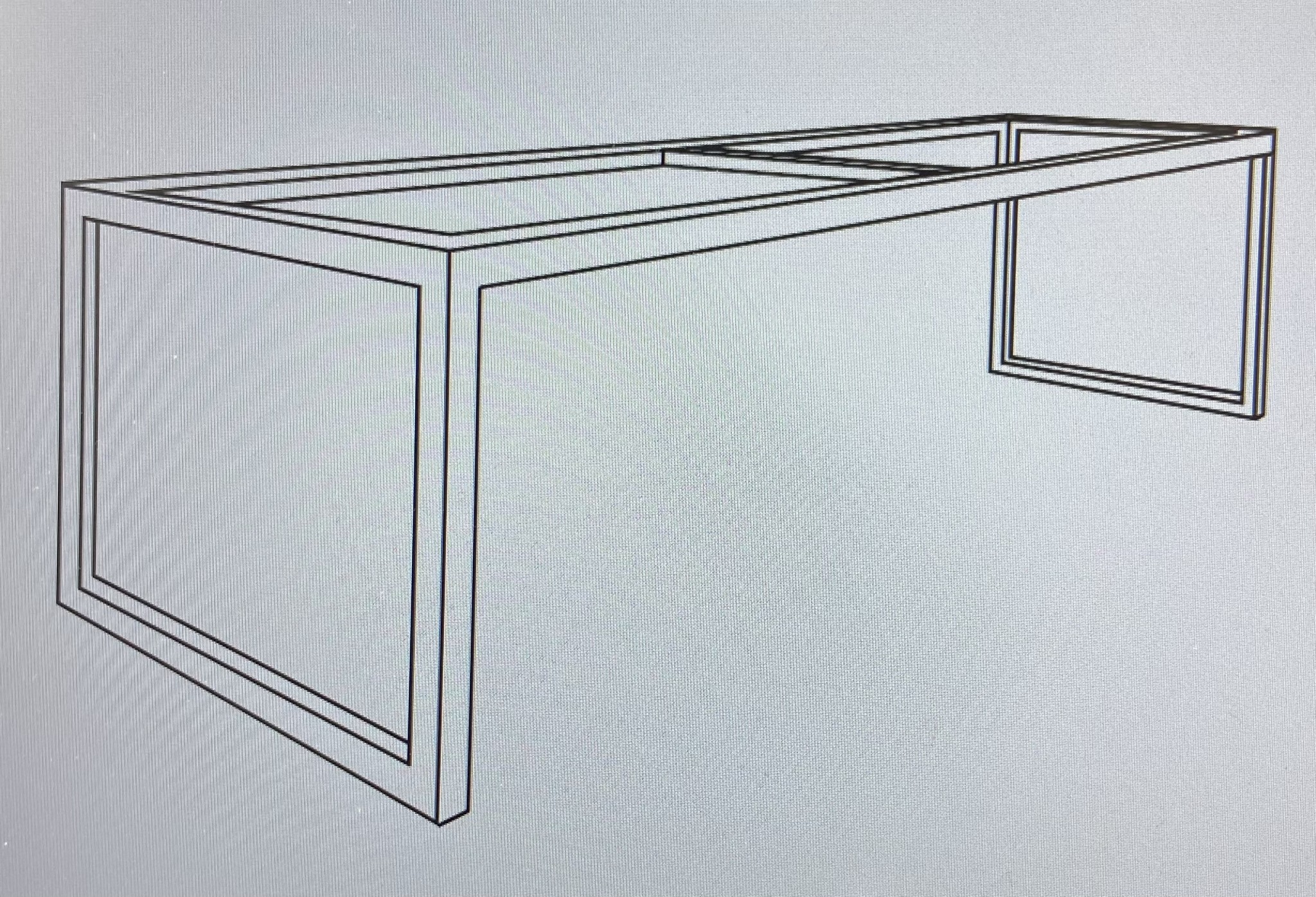
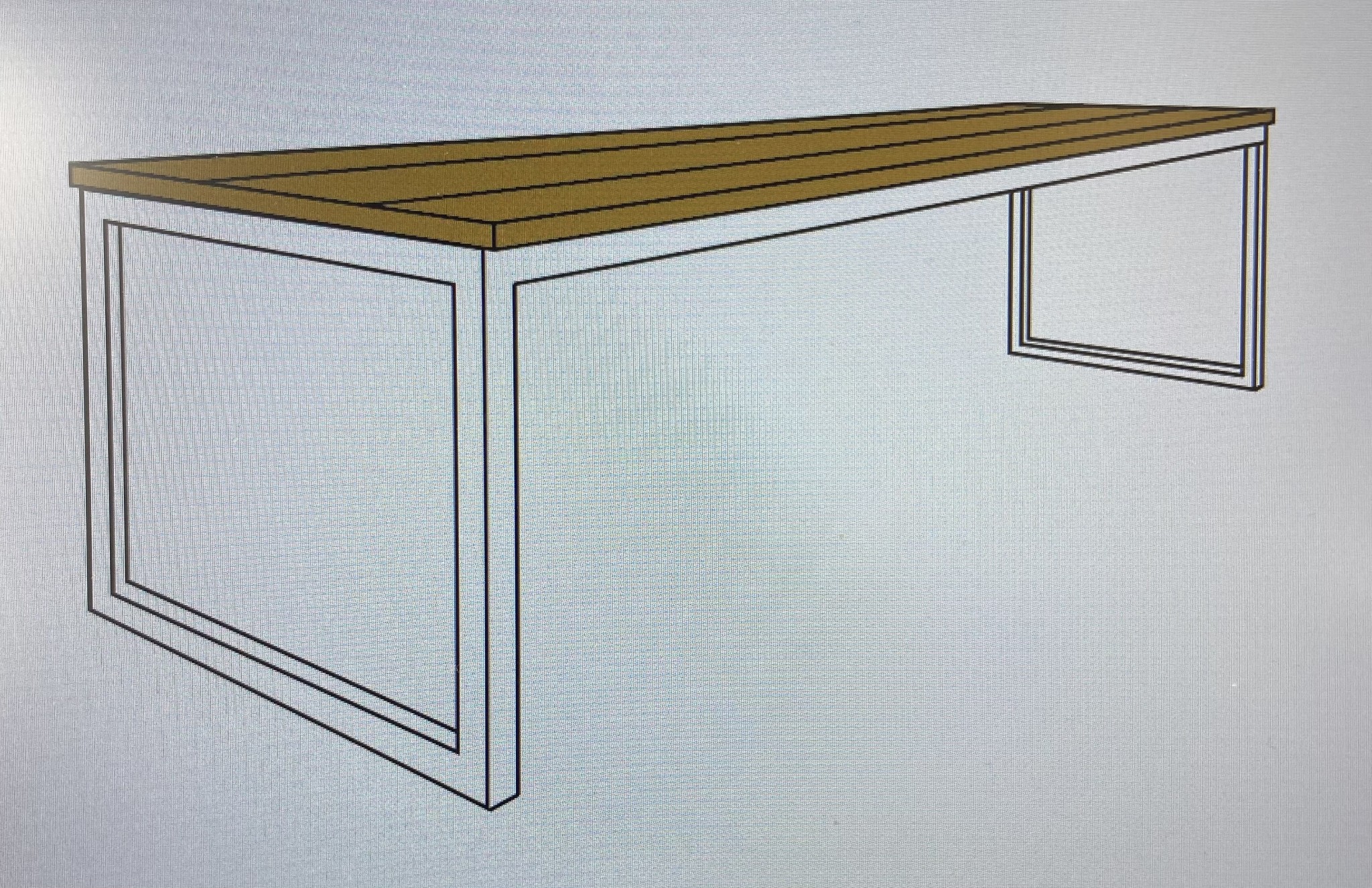
can you imagine a small welded-in spring towards the legs, it helps a lot.J Jonas Blom said:
but it is extremely easy to calculate both deflection and stress (in this case, deflection becomes the determining factor) if you disregard the profile-raising properties of the plate. The profile itself on a straight standard profile with two supports is basically a standard elementary case. It is also quite easy to enter into a CAD program with a simple calculation module.
thank you, that's right, it should be fairly simple if you know how to do it, calculations are not my strong suit but I'll give it a try. Unfortunately, I don't have a CAD program.F fsn said:can you imagine a small welded spring towards the legs, it helps a lot.
but it is extremely easy to calculate both deflection and tension (in this case it will be deflection that is decisive) if you disregard the sheet's profile-enhancing properties. The actual profile on a straight standard profile with two supports is essentially a standard elementary case. It is also quite easy to input it into a CAD program with a simpler calculation module.
if I go ahead and find it becomes too shaky, I'll simply have to weld on more profiles on the underside. Same with the spring if needed.
thanks for the input
if you want, you can send over the dimensions you wish to have tested. I need the length, dimension, and type and size of the load so I can run it through an extremely simple check of a profile if you want. The load is distributed and the size or spread of the distribution, or if you prefer a point load in the center. It's 15 minutes of work.J Jonas Blom said:thanks, that's right, it should be fairly simple if you know how to do it, calculations are not my strong suit but I'll give it a try. Unfortunately, I don't have any CAD program.
If I try it out and notice it becomes too flimsy, I'll simply weld more profiles on the underside. The same goes for the spring if needed.
Thanks for the input
thanks for the offer. I think I have a plan, so it's fine, but if I change my mind and need help, I'll reach out with a question. All the bestF fsn said:if you want, you can send over the dimension you wish to have tested. Length, dimension, and type and size of load are what I need so I can input it into an extremely simple check of a profile, just if you want it. The load is distributed and the size of the distribution or if you want a point load in the middle. It's 15 minutes of work.
Click here to reply