

The staircase creaks and cracks way too much. It's the first winter in the house, and I think the staircase sounds more now than in summer, probably because the wood shrinks with lower humidity indoors during winter.
In any case, it is an open staircase made of pine. I've read that you can loosen the molding under the tread, but it turned out that the tread and riser molding were one and the same piece! No signs of screws and not for the stringer either, so I assume the whole staircase is glued. There is about a 3 cm gap between the stringer and the wall, so the staircase is "cantilevered." How do I fix the staircase in the best way?
In any case, it is an open staircase made of pine. I've read that you can loosen the molding under the tread, but it turned out that the tread and riser molding were one and the same piece! No signs of screws and not for the stringer either, so I assume the whole staircase is glued. There is about a 3 cm gap between the stringer and the wall, so the staircase is "cantilevered." How do I fix the staircase in the best way?

Know-It-All
· Stockholms län
· 822 posts
Is it an old or new staircase? A staircase should be screwed, not glued. That might be why it creaks. The screws in the stringers are often hidden behind wooden plugs that can be difficult to detect.
The house was built in 1980. I assume the staircase was installed then.
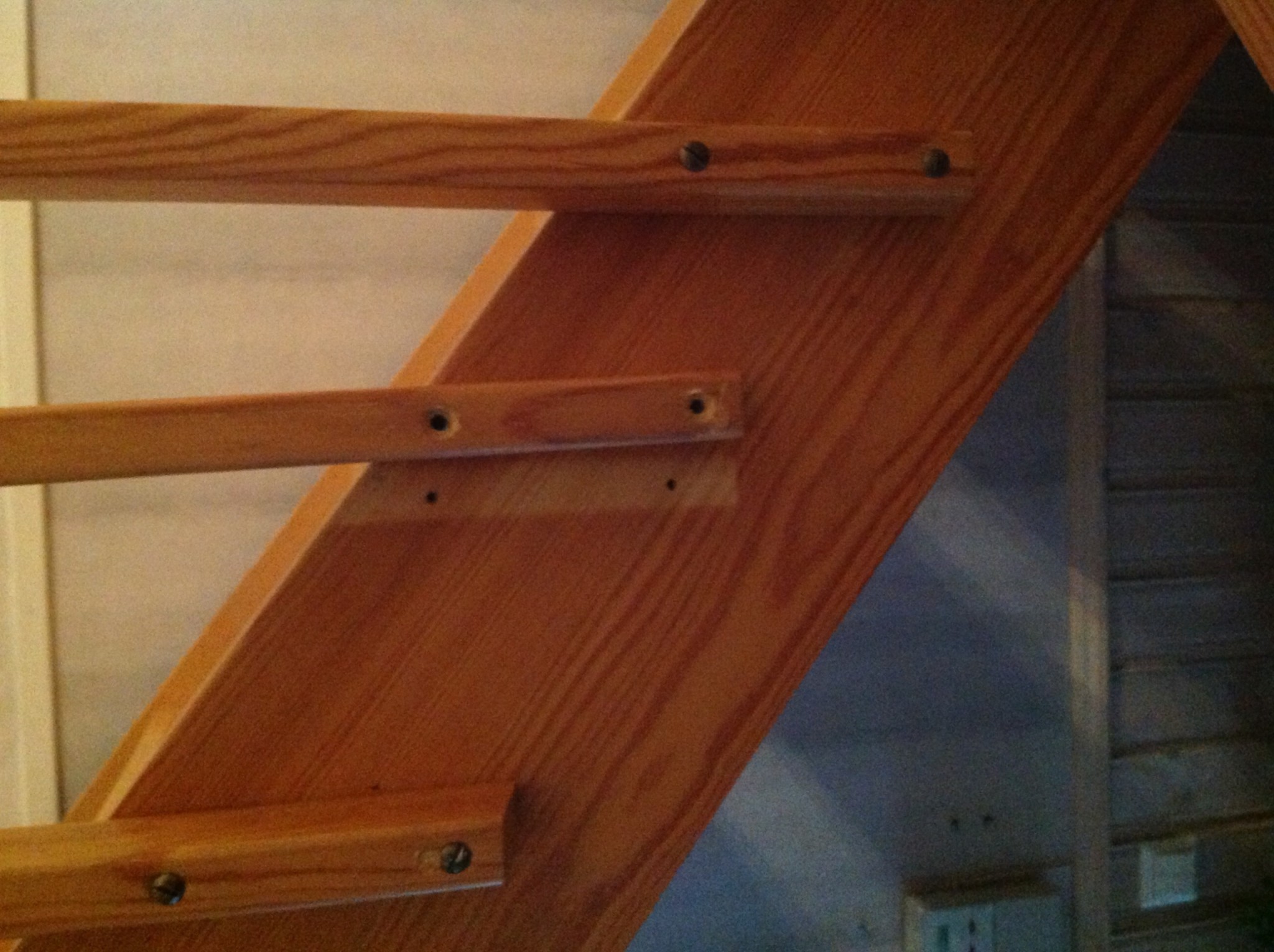
There are screws at the spindles that go into the step, but on the wall side, I neither see nor feel any screw, cover cap, or plug. I have no desire to take down the entire staircase to check. It got marginally better by loosening a bit on the screws to the spindles.
There are screws at the spindles that go into the step, but on the wall side, I neither see nor feel any screw, cover cap, or plug. I have no desire to take down the entire staircase to check. It got marginally better by loosening a bit on the screws to the spindles.
Know-It-All
· Stockholms län
· 822 posts
I have two stairs of a similar model at home and they also creak to varying degrees. Both are closed though (home-built with MDF).
One staircase is self-supporting, so it actually doesn't need to be attached to the wall. So, it's not certain that you'll find any screws at all fastening the stringers to the wall.
I believe it's the steps themselves that are creaking in your staircase and I don't know if anything can be done about it, but I'll leave that to the experts to decide.
Got a new staircase installed at home last year and it's completely silent. Everything is screwed on it, both treads and risers.
One staircase is self-supporting, so it actually doesn't need to be attached to the wall. So, it's not certain that you'll find any screws at all fastening the stringers to the wall.
I believe it's the steps themselves that are creaking in your staircase and I don't know if anything can be done about it, but I'll leave that to the experts to decide.
Got a new staircase installed at home last year and it's completely silent. Everything is screwed on it, both treads and risers.
What do you think about placing a block between the carriage and the wall, drilling, and inserting a plug? It is a gypsum wall. Theoretically, it should fit under the child rail.
Going to try silicone spray, should it be sprayed between the carriage and the step?
Going to try silicone spray, should it be sprayed between the carriage and the step?
S
sinuslinus
Träskalle
· Östergötlands län
· 6 112 posts
sinuslinus
Träskalle
- Östergötlands län
- 6,112 posts
What happens if you loosen all the spindles? Mostly to exclude...
Child safety gates are usually installed with spacers to avoid creaking, and open stairs typically don't creak as easily as stairs with risers. Risers are usually installed under tension to prevent creaking.
Child safety gates are usually installed with spacers to avoid creaking, and open stairs typically don't creak as easily as stairs with risers. Risers are usually installed under tension to prevent creaking.
Click here to reply