
Hello!
I am considering replacing a load-bearing wall with a glulam beam. So far, I've only removed all the drywall and noticed that the existing glulam beam supporting the balcony only goes about 2 meters in. The remaining part of the wall is about 4 meters where a new beam is needed. I just wanted to check if there are possibilities to splice these together. It's not something I plan to undertake without consulting an engineer.
The old beam measures 90x300, and the standard size nowadays nearby is 90x315.
My first thought was to put a pillar on both beams, but it feels unfortunate if it's not necessary. You want it open
The house is 1½ stories from -75.
I am considering replacing a load-bearing wall with a glulam beam. So far, I've only removed all the drywall and noticed that the existing glulam beam supporting the balcony only goes about 2 meters in. The remaining part of the wall is about 4 meters where a new beam is needed. I just wanted to check if there are possibilities to splice these together. It's not something I plan to undertake without consulting an engineer.
The old beam measures 90x300, and the standard size nowadays nearby is 90x315.
My first thought was to put a pillar on both beams, but it feels unfortunate if it's not necessary. You want it open
The house is 1½ stories from -75.
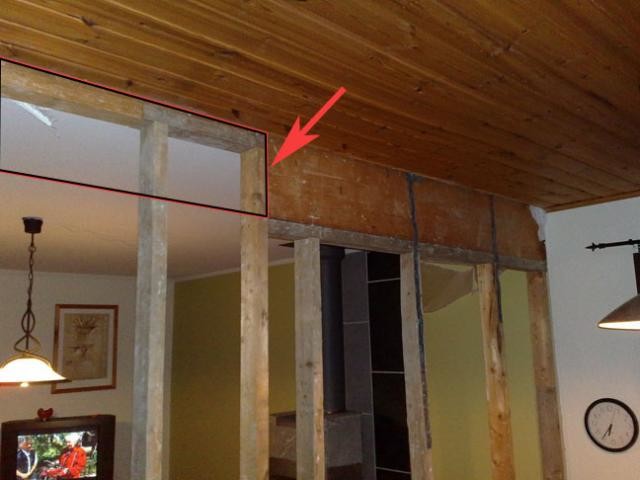
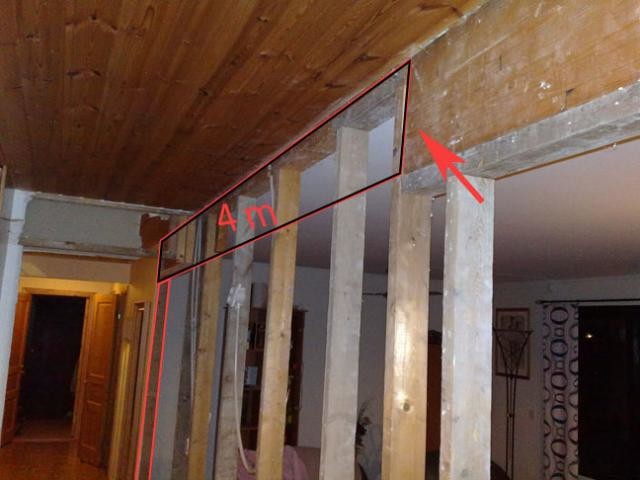
If you are also planning to remove the beams under the existing beam, you will need to have the entire load-bearing recalculated. If so, you are also removing the support for the existing beam. Expect that a stronger beam will be needed!
OK.
But the new beam must have sufficiently strong support.
It is not entirely certain that the old beam's support is sufficient for the new beam as well.
More than this cannot be said without a more thorough investigation on site.
At least expect that the new beam will probably be larger.
But the new beam must have sufficiently strong support.
It is not entirely certain that the old beam's support is sufficient for the new beam as well.
More than this cannot be said without a more thorough investigation on site.
At least expect that the new beam will probably be larger.
Yes, according to the calculation programs available, a 115x315 beam would be sufficient if it is supported on two pillars. However, I'm not sure what the old beam rests on in the wall. It is probably safest to place two individual pillars at the joint anyway.
You should probably avoid splicing the existing glulam beam and instead focus on laying a completely new glulam beam all the way. At least if you want it column-free at the splice. Otherwise, the load-bearing capacity for what's resting on both the existing and the extended beam will go down the drain.
However, there's a way to hang up the splice and avoid the column underneath. First, you need a beam that can handle the remaining load. And it might differ in dimension from the existing one and therefore require reinforcing the existing beam for a proper splice.
If you then make a tension frame of iron on both, you might manage without having to lay a completely new beam all the way, but your engineer will have to calculate that. I'm only describing the method here.
At the splice point, there should be a flat iron in the bottom chord. At each end, there should be corresponding flat iron in the top chord. On both sides of the glulam beams, there should be a round iron bar running from the top chord at one end beneath the flat iron at the splice midpoint and up to the flat iron in the top chord at the other end. By tensioning the round iron bars with a left-right threaded screw of the same type used to tension stays on a sailboat (but with a heavier dimension), it's possible to lift the point under the splice.
The engineer will then have to calculate both the beams and the iron for all the forces that will result. Special attention should be given to the risk of buckling and tilting in the glulam beams due to the compressive force resulting from the lift in the round iron bars. The shear forces in anchoring both flat irons in the top chord are also worth a closer examination.
___________________________
The Builder
However, there's a way to hang up the splice and avoid the column underneath. First, you need a beam that can handle the remaining load. And it might differ in dimension from the existing one and therefore require reinforcing the existing beam for a proper splice.
If you then make a tension frame of iron on both, you might manage without having to lay a completely new beam all the way, but your engineer will have to calculate that. I'm only describing the method here.
At the splice point, there should be a flat iron in the bottom chord. At each end, there should be corresponding flat iron in the top chord. On both sides of the glulam beams, there should be a round iron bar running from the top chord at one end beneath the flat iron at the splice midpoint and up to the flat iron in the top chord at the other end. By tensioning the round iron bars with a left-right threaded screw of the same type used to tension stays on a sailboat (but with a heavier dimension), it's possible to lift the point under the splice.
The engineer will then have to calculate both the beams and the iron for all the forces that will result. Special attention should be given to the risk of buckling and tilting in the glulam beams due to the compressive force resulting from the lift in the round iron bars. The shear forces in anchoring both flat irons in the top chord are also worth a closer examination.
___________________________
The Builder
Click here to reply