It is screwed onto a floor structure of 220x45 + 70x45 joists.
The 70 joists are therefore nailed/screwed on top of the 220 joists.
Approximately 8 meters span with support in the middle, i.e., about 4 m free.
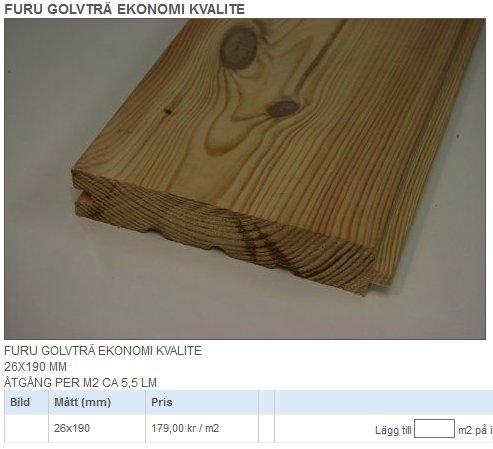
The whole floor feels very stable, and the floor is untreated but nice without visible defects,
even though it is called economy flooring.
I would have preferred it throughout the house instead of the beech parquet we chose.
Thank you very much for your response!
That's exactly the type of floor we have in mind!
I came home about an hour ago after laying the first joist base in the house with tongue and groove boards, and I do imagine a little that the joist base itself might have significance for the construction somehow, or at least it feels that way.. Just for fun, I cut a piece of asfaboard and placed it in some compartments in another room that has joists but not the joist base yet, and when walking around on the joists in the different rooms, it feels like the room with the tongue and groove joist base is now significantly "more stable," and I'm basing this on when I bounce around like a gazelle over the joists with my 118 kg. Maybe what was said is irrelevant for the finished floor, but right now there's a noticeable difference, at least in my opinion
In fact, standing here with what’s in front of me, it’s slightly tempting again to lay a solid wood floor directly on the joists anyway... but yeah.. I don’t know...? One doesn't want to spend money on floor chipboard, screws, glue, and paper for an entire floor if it may not make a huge noticeable difference, (and of course all the extra work), at the same time you certainly don't want to regret later because you might have thought wrongly and based facts on subjective grounds.. but it "feels" stable Oh well.. it simply needs some pondering.
Of course, some material helps the framework floor, but I also don't think it's anywhere near, for example, screwed and glued chipboard flooring. Your plank roof should behave a bit like a louver from a bending perspective (unless you've been so tricky that you've glued the planks).
When you perform the gazelle dance on an open joist, much of the flexibility you experience is probably the bending of the joists sideways when you jump around. That definitely helps your plank roof a lot, and also the bridging. But you'll also get that lateral support when you lay the top floor.
It is not possible to rely on intuition. One must calculate it. Some of the consequences of excessive deflection appear only after a longer period. The theories that the calculations are based on are from the 18th century. They must be considered well-tested...
Click here to reply
Vi vill skicka notiser för ämnen du bevakar och händelser som berör dig.