
30,098 views ·
57 replies
30k views
57 replies
Soundproofing - double drywall hasn't helped
Okay, thank you very much for your clarification. If it doesn't build out more than about 67 mm, then it's definitely worth it to get quieter. And this method you mean is better than putting soundproofing directly on the aerated concrete.J justusandersson said:Putting insulation material directly on the aerated concrete wall doesn't do much. Keep in mind that the entire wall acts as a loudspeaker membrane. A new wall with 45 mm studs builds out 10+45+12=67 mm. It's not that bad. The house has concrete floors so the damping vertically is much better. Hiring a soundproofing company naturally gives a good result but at a significantly higher cost.

Yes.
Okay, so you are also more in favor of building a new wall. It sounds advanced and like a big project. But maybe it isn't. I don't think it's the ventilation. It doesn't sound like that but rather that all the sound comes through the wall.F fiskbuggaren said:A new wall is perhaps slightly, but not unreasonably, more expensive than just adding more drywall to the existing one. The new wall has no load-bearing function. If you really hear as much as it seems like, make sure there isn't a completely open path for the sound, like leakage through electrical boxes, ventilation, or cable TV.
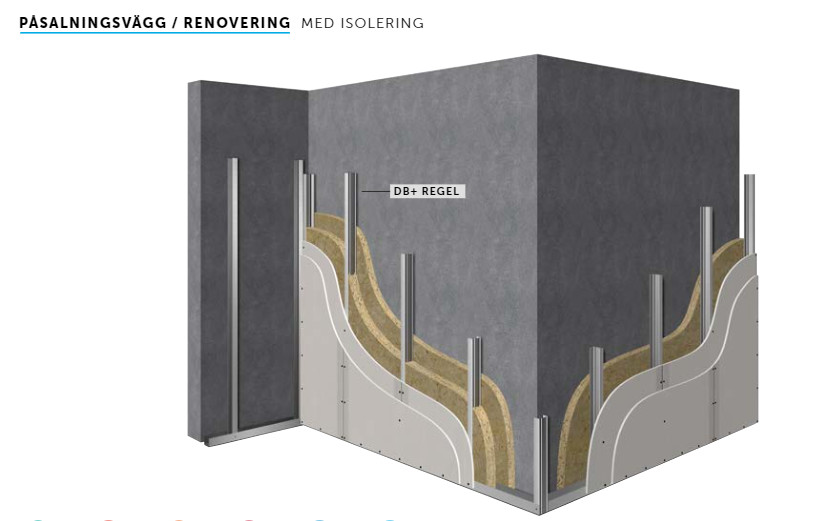
Norgips describes an Påsalningsvägg like this:
The wall is constructed with metal studs a bit from the existing wall.
* Floor, wall, and ceiling studs should be PE-coated so vibrations do not transmit
* The framework consists of DB-regel
* Heavy insulation
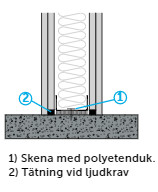
* Double plasterboards, with staggered joints. The inner board should NOT rest on the floor or touch the wall. The gap should be sealed with a soft joint. The outer board can connect to the ceiling, wall, and floor.
Detail/cross-section of the stud, and how the plasterboards are set:
In addition, you can probably use a plasterboard that soundproofs better - Norgips has a "Silentboard" that is supposed to be better for the purpose:
https://www.norgips.se/produkter/silent-board/
Last edited:
Don't forget to check for things like pipe penetrations, ventilation, or other openings where sound can travel. I previously lived in an apartment where it was "open" to the neighbor above via the radiators. I could hear everything that was said if they sat by that window. So we insulated the volume again and it improved.
In addition to the air gap and insulation (with a focus on sound), I would have installed double layers of drywall with staggered joints and sealed around everything so sound wouldn’t slip through.
In addition to the air gap and insulation (with a focus on sound), I would have installed double layers of drywall with staggered joints and sealed around everything so sound wouldn’t slip through.
Thank you very much for this description. The big question is what I do with the existing plasterboards that are there now? Can they be taken down, or should they stay?Fasting65 said:
[image]
Norgips describes a Påsalningsvägg like this:
The wall is built with metal studs a bit away from the existing wall.
* Floor, wall, and ceiling studs should be PE-coated so vibrations do not propagate
* The framework consists of DB-stud
* Heavy insulation
* Double plasterboards, shifted joints. The inner board should NOT rest on the floor or touch the wall. The gap should be sealed with soft sealant. The outer board can connect to the ceiling, wall, and floor.
Detail/cross-section of the stud, and how the plasterboards are set:
[image]
In addition, one could use a plasterboard that insulates sound better - Norgips has a "Silentboard" that is supposed to be better for the purpose:
[link]
Okay, thanks for the tips. Not easy to figure out which paths the sound takes? It sounds like it's coming through the wall, I think. It's the neighbor next door. So via the radiator pipes, I don't think so since they run vertically. The ventilation, I would have heard through it but I don't. There's an electrical outlet in the interior wall. There's also a Comhem cable 90 degrees from the interior wall on another wall.Viktor.J said:
Don't forget to check for things like pipe penetrations, ventilation, or other openings where sound can travel. I used to live in an apartment where it was "open" to the neighbor above via the radiators. I could hear everything they said if they sat by that window. So we sealed up the volume and it got better.
In addition to the air gap and insulation (with a focus on sound), I would have installed double layers of drywall with staggered joints and sealed around everything so sound doesn't leak through.

Tool enthusiast
· Stockholm
· 1 399 posts
The principle of soundproofing is mass - air gap - mass. The higher the mass and/or air gap, the better the sound isolation. If the existing wall is homogeneous, retain the gypsum since it adds mass. However, if it is a studded wall, the paneling on your side must be removed to avoid two cavity resonances. You then stud the new wall inside the existing wall. It's important that it doesn't short circuit with the existing wall. The larger the air gap, the better the isolation at low frequencies. If it mainly concerns speech, about 100 mm is reasonable. The stud cavities are filled with stone wool, not high density but regular wall insulation such as Flexibatt is excellent for absorbing the cavity resonance in the stud cavity. The function of the insulation is sound absorbent, nothing else. You then panel the wall with 2-3 layers of regular gypsum with staggered joints. It's the gypsum that constitutes the actual sound barrier. Make sure it is sealed around and at penetrations.


Tool enthusiast
· Stockholm
· 1 399 posts
Unfortunately, most of what he says in the film is inaccuracies. The construction he builds is a "triple leaf" construction that creates two cavity resonances, which is undesirable. At certain frequencies, that wall will have poorer sound insulation. Insulation improves Rw (sound insulation) by about 3 dB and should be placed right up against the gypsum and not in contact with the other wall studs. The paneling should be done with joints against the frame, not as in the film.
I also soundproofed and came across Green glue, which I thought would never work, but it seems to. Ultimately, I chose a completely different product.
"ViscoLam 65" from a company called Chova. It's a special rubber that weighs more than lead while being flexible. This is placed between two layers of drywall. It comes in a self-adhesive mat. I also looked at special "clips" that are sound-absorbing, e.g., reducto clip, but avoided these as it was difficult to find the right studs in Sweden. It's worth noting that to achieve complete soundproofing, you also need to address the floor and ceiling, as the sound will propagate through the entire structure.
"ViscoLam 65" from a company called Chova. It's a special rubber that weighs more than lead while being flexible. This is placed between two layers of drywall. It comes in a self-adhesive mat. I also looked at special "clips" that are sound-absorbing, e.g., reducto clip, but avoided these as it was difficult to find the right studs in Sweden. It's worth noting that to achieve complete soundproofing, you also need to address the floor and ceiling, as the sound will propagate through the entire structure.
Is the construction that Fasting65 links to a few posts above better?Unfortunately, most of what he says in the film are inaccuracies. The construction he is building is a "triple leaf" construction that results in two cavity resonances which is undesirable. At certain frequencies, that wall will have poorer sound insulation.
Insulation improves Rw (sound insulation) by about 3 dB and should be fitted tightly against the gypsum without contacting the other wall frame. The panels should be installed with joints against the studs, not as shown in the film.