
3,353 views ·
14 replies
3k views
14 replies
Soundproof with double plasterboard against concrete wall.
Hello,
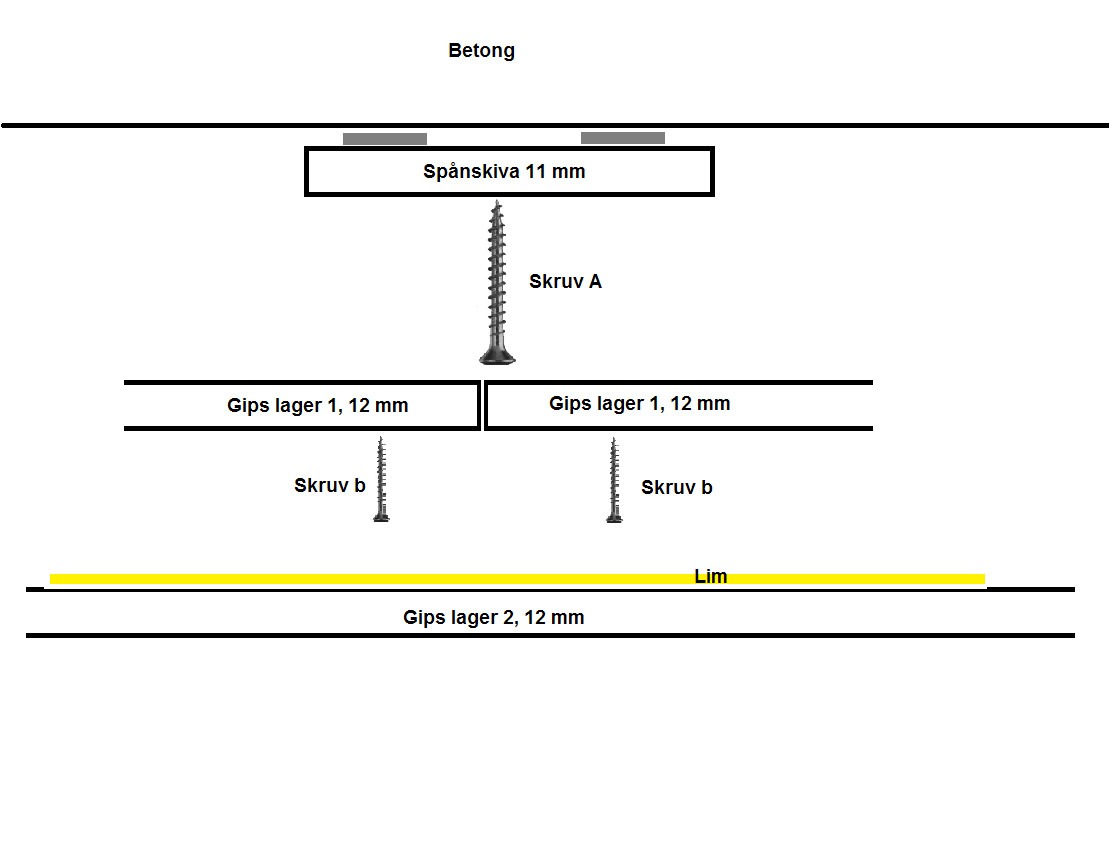
Is this a good solution? A cross-section from above.
Planning to soundproof a concrete wall.
1. Attach foam rubber to a chipboard plank (10 cm wide, 1.1 cm thick)
2. Screw the chipboard plank onto the concrete wall with Screw A.
3. Screw the first layer of gypsum with Screw B only into the chipboard. But is the screw too short? Can I use a plug?
4. Glue the second layer of gypsum onto the first layer? (Screw if needed during gluing)
There will be an air gap of about 11 mm between the concrete and the gypsum.
What dimensions should the screws be?
Is this a good solution? A cross-section from above.
Planning to soundproof a concrete wall.
1. Attach foam rubber to a chipboard plank (10 cm wide, 1.1 cm thick)
2. Screw the chipboard plank onto the concrete wall with Screw A.
3. Screw the first layer of gypsum with Screw B only into the chipboard. But is the screw too short? Can I use a plug?
4. Glue the second layer of gypsum onto the first layer? (Screw if needed during gluing)
There will be an air gap of about 11 mm between the concrete and the gypsum.
What dimensions should the screws be?
Do not use chipboard in the first layer. Screws attach better in wood, but the best option is probably plywood.
Personally, I would not reuse old pallets indoors, you never know what kind of toxins and crap they have accumulated over the years. A little creosote with the coffee... no thanks. Compare, for instance, with the fact that you shouldn't use pressure-treated wood indoors.E Ett_unikt_namn said:
Generally speaking, I wonder how you’re going to make it hold. If you screw the first layer directly into the concrete wall, you’re creating a thermal bridge with the screws, and then the foam plastic serves no purpose. At the same time, you must fasten it with screws so it stays in place. And if you screw with some kind of "play," you'll be able to wiggle the entire wall when you're in the mood.
A better suggestion:
1. Air gap of a few cm, completely empty
2. Steel studs (not wood) and regular insulation, for example, fiberglass or stone wool. Preferably two layers with overlapping seams and studs if you have the space.
3. Optionally OSB or plywood if you want to hang heavy items.
4. Two layers of drywall with overlapping seams.
If that doesn't help, you'll have to give the neighbor cough medicine.
A better suggestion:
1. Air gap of a few cm, completely empty
2. Steel studs (not wood) and regular insulation, for example, fiberglass or stone wool. Preferably two layers with overlapping seams and studs if you have the space.
3. Optionally OSB or plywood if you want to hang heavy items.
4. Two layers of drywall with overlapping seams.
If that doesn't help, you'll have to give the neighbor cough medicine.
I wouldn't use pallets either. Regular boards are so cheap and better. But pressure-treated wood is not a problem to have indoors.ricebridge said:

Know-It-All
· Västra Götaland
· 12 472 posts
I would have framed an independent wall with mineral wool instead. But before that, review other parts of the house to ensure where the biggest sound leak is.
@ricebridge is right!
To get effective soundproofing you MUST build a freestanding wall that has no connection to the existing wall. If you also have wooden floors (parquet), cut them and any material that is against the wall you want to soundproof.
To get effective soundproofing you MUST build a freestanding wall that has no connection to the existing wall. If you also have wooden floors (parquet), cut them and any material that is against the wall you want to soundproof.
Sound-insulating metal studs have foam rubber, so I'm thinking of replicating this.Then in general, I wonder how you are going to get it to stay. If you're going to screw the first layer directly into the concrete wall, you are indeed creating a bridge via the screws, and then the foam plastic serves no function. At the same time, you have to fasten it to make it stay. And if you screw with some kind of “play,” you'll be able to wiggle the whole wall when you're in that mood.
A better suggestion:
1. Air gap a few cm, completely empty
2. Steel studs (not wood) and regular insulation, like fiberglass or stone wool. Preferably two layers with overlapping seams and studs if you have space.
3. Possibly OSB or plywood if you want to hang heavy things.
4. Two layers of drywall with overlapping seams.
If that doesn't help, you'll have to give your neighbor cough medicine.
I would prefer not to build out too much from the wall. I'm probably thinking of going with 24 mm plywood.
Can I drill through plywood and concrete with the same drill?
I don't want to extend the wall too much. If I were to place studs in the ceiling and floor, the wall would have to be extended quite a bit.anders07 said:
I mostly think - is it the wall that is the problem? Concrete as a material has very good sound properties.
If it really is the wall that is the problem, it's probably not concrete. If it is concrete, it's probably not the wall that is the problem.
If it really is the wall that is the problem, it's probably not concrete. If it is concrete, it's probably not the wall that is the problem.
I don't know what else could be the problem. I think the concrete isn't thick enough. That the concrete absorbs the sound and carries it further. If I extend the wall by 5 cm, the flanking transmission will also be reduced.C C.Lundin said:
Click here to reply