I am going to build an interior wall that separates two apartments in a single-family house. I want to make as little impact on the existing floor and walls as possible, so I plan to attach the bottom horizontal stud with double-sided tape to the tile floor. I think this will suffice because the wall will only be 2 meters wide and other studs are fastened to the wall and ceiling.
To soundproof as much as possible, I plan to lay some kind of rubber between the studs and the floor, then add OSB + plasterboard. What I'm wondering is what I should fill the cavity in the wall with. Is there something suitable that dampens more than regular insulation? And what material/rubber should I place between the studs and the existing floor/wall to reduce vibrations and sound transmission?
Build with "Ljudreglar" maybe?
There are special steel studs designed to reduce sound through walls. I seem to remember seeing some with rubber on the surface that is to be mounted against another wall.
(Haven't used it myself so I can't say if it's good or bad)
Build with "Ljudreglar" maybe?
There are special steel studs designed to reduce sound through walls. I believe I've seen ones with rubber on the surface that will be mounted against another wall.
(I haven't used it myself, so I can't say if it’s good or bad)
/M
Haven't dared to make the "switch" to steel studs yet, I've built a few interior walls before in various contexts but always used wood studs . Do you need special tools to work with steel studs, and is it otherwise the same screws and construction technique as with wood studs?
With "TM-innervägg" you don't have to nail at all... [link]
Thank you, it's an option but there will still be limited damage to existing walls even if I build a wall on site. A few screw holes that I can easily fill in if and when the wall is to be taken down again (I will also build in a door opening behind the plasterboard in case I want to install a door in the future).
The standard recipe is to use double layers of regular insulation and then double layers of gypsum board staggered, so the outermost layer covers the joints of the next gypsum layer. This will insulate fairly well against mid and high-frequency sounds like speech, singing, dish clatter, and glass-breaking competitions.
You cut steel studs with regular tin snips. Nothing strange about it, but they insulate sound better than wood.
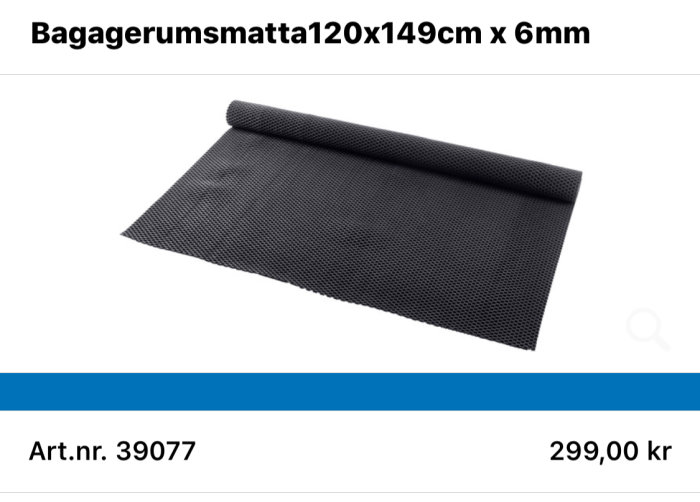
The rubber at the bottom, as you were thinking, can be any rubber as long as it is as thick as possible. If you're going to cover it up anyway, it might not matter if it's not so pretty. A tip could be a trunk mat from Biltema, which you cut into strips and layer on top of each other:
The problem, however, will be structure-borne sound, i.e., sounds that propagate through the building's frame, such as when the neighbor and his 27 friends meet to play bass drum together and dance the jenka. Such sounds you will not be able to get away from with a wall, and therefore you may feel it does not soundproof as well as you had hoped. But it becomes quite difficult to stop without major renovations.

 http://www.tibromobelindustri.com/kategori/13/innervaggar.html
Gammelnörden said: