
Hello
I'm building a house with bauroc 375 lightweight concrete blocks.
The construction drawings specify ytong 365.
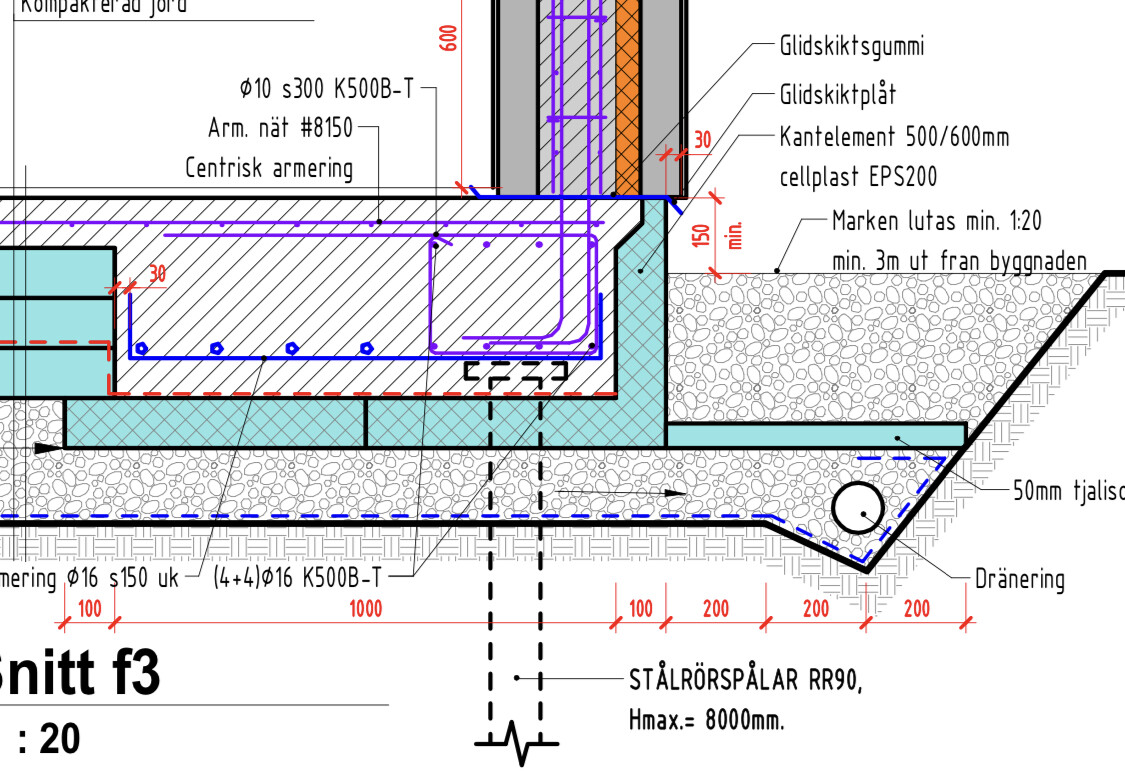
The designer has indicated that there should be glide sheet rubber and glide sheet metal under the exterior walls. Bauroc's instructions state that there should only be foundation felt underneath.
If you look at what's available to buy online, there's Finja's glide sheet metal, but it doesn't fit because it's only 10 cm wide and is for Finja's exact block.
I also find Murma's foundation plate/combi plate.
I expect it to cost 10-15k SEK for both rubber and metal for 50 linear meters (if not more).
I suspect it's because of the metal, which is made of A2 stainless steel.
Can regular sheet metal be used?
Is there any other glide sheet metal or metal product that can be used under the wall that is cheaper...
I see it as an unnecessary expense since the bauroc system doesn't require it.
Thank you!
I'm building a house with bauroc 375 lightweight concrete blocks.
The construction drawings specify ytong 365.
The designer has indicated that there should be glide sheet rubber and glide sheet metal under the exterior walls. Bauroc's instructions state that there should only be foundation felt underneath.
If you look at what's available to buy online, there's Finja's glide sheet metal, but it doesn't fit because it's only 10 cm wide and is for Finja's exact block.
I also find Murma's foundation plate/combi plate.
I expect it to cost 10-15k SEK for both rubber and metal for 50 linear meters (if not more).
I suspect it's because of the metal, which is made of A2 stainless steel.
Can regular sheet metal be used?
Is there any other glide sheet metal or metal product that can be used under the wall that is cheaper...
I see it as an unnecessary expense since the bauroc system doesn't require it.
Thank you!
Weber seems to think foundation tar paper is sufficient
https://www.se.weber/gor-det-sjalv/mura/mura-med-lecablock
But I would have asked the designer before making any deviations.
https://www.se.weber/gor-det-sjalv/mura/mura-med-lecablock
But I would have asked the designer before making any deviations.
you are right, I will contact the designer.B BSOD said:
I'm trying not to make deviations and therefore wonder if I can get the same function with regular sheet metal, if someone might have done it before..
Do I understand correctly that the reinforcement goes up from the slab and into the wall at each block but it is drawn with a slip layer so the wall can slide against the slab?
How is it intended to work?
Have no advice other than "talk to the designer" sounds reasonable.
Sorry for my possibly confused thoughts.
How is it intended to work?
Have no advice other than "talk to the designer" sounds reasonable.
Sorry for my possibly confused thoughts.

My company's engineer designed this order and we have since resolved it with the customer. I forwarded the following response:
As you surely understand, the purpose is to have some form of insulation between the foundation and the wall to prevent water from rising. There are many options from super tight (sheet metal and rubber as Ytong prescribes) to moderate (e.g., a thin layer of plastic). Anything in between is probably possible, but the thinner it is, the greater the risk of damage with the heavy blocks on it.
In any case, Bauroc prescribes bitumen and it seems to me to be a cheap and durable option (cheaper than sheet metal at least). If you want to be sure, you can email or call them to ask if they recommend a Swedish product.
As you surely understand, the purpose is to have some form of insulation between the foundation and the wall to prevent water from rising. There are many options from super tight (sheet metal and rubber as Ytong prescribes) to moderate (e.g., a thin layer of plastic). Anything in between is probably possible, but the thinner it is, the greater the risk of damage with the heavy blocks on it.
In any case, Bauroc prescribes bitumen and it seems to me to be a cheap and durable option (cheaper than sheet metal at least). If you want to be sure, you can email or call them to ask if they recommend a Swedish product.
Hi, the method we initially designed is a solution from Finja. It's correct that the wall above doesn't move because of the reinforcement. The layers in between are meant to ensure that water doesn't rise through capillary action. There are also other bitumen solutions for this.redarn said:
Do I understand correctly that the reinforcement goes up from the slab and into the wall at each block, but it's drawn with a sliding layer so the wall can slide against the slab?
How is that supposed to work?
I have no advice other than that "talking to the designer" seems reasonable.
Sorry for any possibly confused thoughts.
Click here to reply