
Hello
I am in the middle of a small renovation of the living room and I wonder if the silver vapor barrier should be replaced with something else when installing new drywall.
If it should be replaced, should something similar be used? Or is plastic the standard?
Or can it be skipped and install new drywall directly onto the raw planks?
House built in 1970.
I am in the middle of a small renovation of the living room and I wonder if the silver vapor barrier should be replaced with something else when installing new drywall.
If it should be replaced, should something similar be used? Or is plastic the standard?
Or can it be skipped and install new drywall directly onto the raw planks?
House built in 1970.
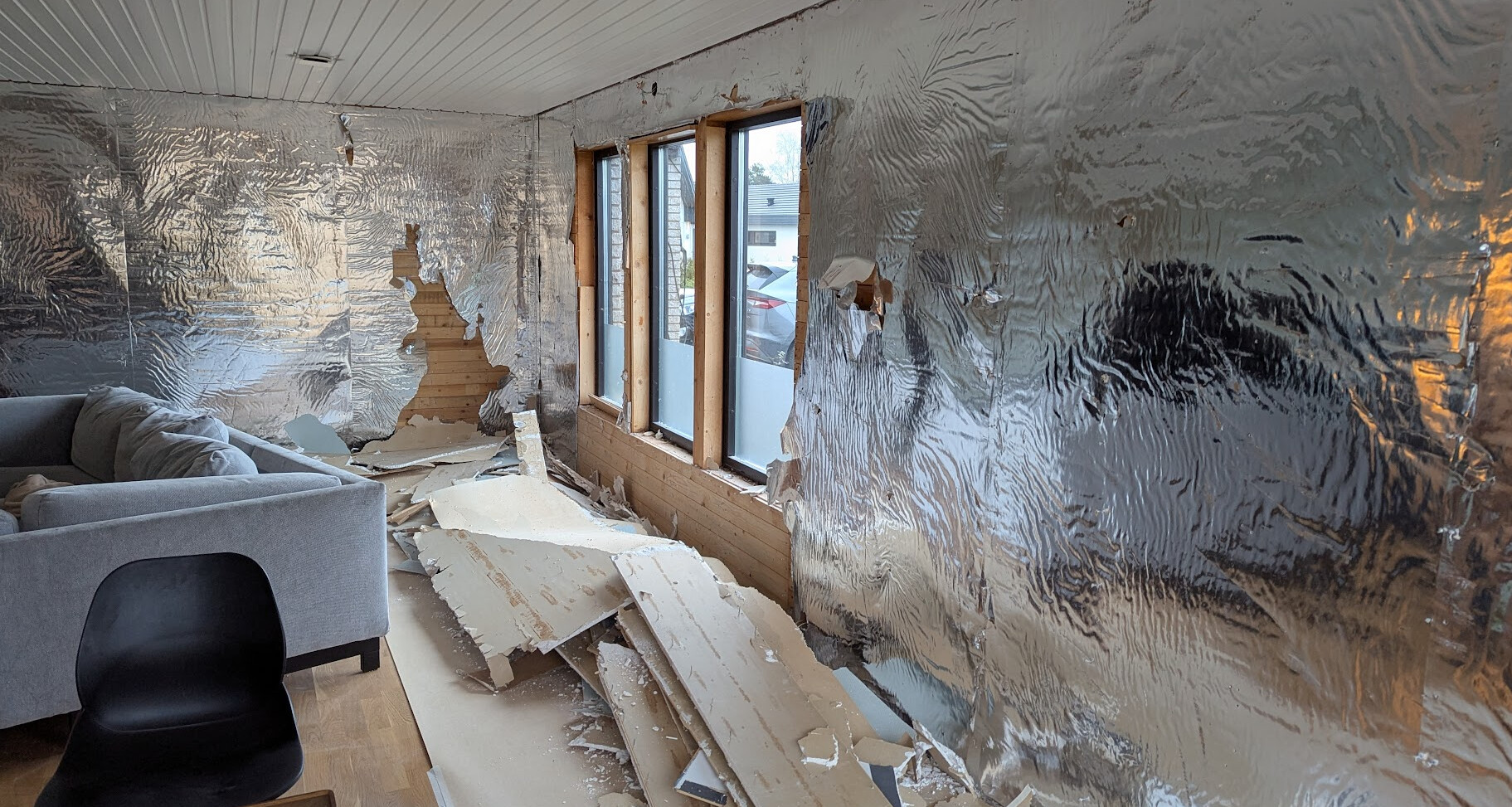

Never seen that before..
Could it be some idea related to heat reflection or something?
There were indeed some strange ideas in the 70s...
It probably works as a vapor barrier, so replace it with building plastic, yes.
Could it be some idea related to heat reflection or something?
There were indeed some strange ideas in the 70s...
It probably works as a vapor barrier, so replace it with building plastic, yes.
Those of you who have purchased a soft cooler bag - which often also has an aluminum layer as a heat shield in its thin insulation, and had the misfortune of buying the version without the heat shield one year (and there wasn't any with a shield among all those with different brand names sold that year - which indicated there's one single manufacturer behind them) - know that there's a big difference in thermal insulation capability between these. Those without a heat shield were practically useless as a cooler even with ice packs inside, while those with an aluminum shield could maintain decent coolness with the same number of ice packs for almost a whole workday...
so the aluminum shield does make a little difference when it comes to thermal radiation between the layers.
so the aluminum shield does make a little difference when it comes to thermal radiation between the layers.
HiX xxargs said:Those of you who have gotten a soft cooler bag - which often also has an aluminum layer as a thermal barrier in its thin insulation, and happened to have the misfortune to buy the version one year that did not have the thermal barrier (and there were none with a barrier among all those with different brands sold that year - which indicated it was the same manufacturer behind them) - know there is a big difference between these in thermal insulation ability - those without the thermal barrier were basically useless as a cooler bag even with ice packs in them, whereas those with an aluminum barrier could maintain decent cold with the same number of ice packs for nearly a full workday...
So the aluminum barrier helps when it comes to thermal radiation between layers.
So you think it worked more as a thermal barrier than a vapor barrier?
The house originally had heating via "ceiling heating," so there might be something to that.
I should also add that we have an FTX system that I installed about 4 years ago.
But now it is time to put up new drywall on the walls, so the question is whether to replace it with a vapor barrier or vapor brake, or alternatively just put up drywall directly against the wood sheathing...
Does anyone have any insights? Building plastic maybe feels a bit too moisture-sealing, or? Is a vapor brake a better alternative perhaps?
// Thomas Ljunggren

I am completely convinced that the aluminum layer makes a difference for thermal radiation. How much of a difference it makes I leave unsaid since I haven't come across any scientific studies on it and therefore have no opinion. It also functions as a vapor barrier.
So, I would keep everything that was intact. Where it's damaged, I would use construction plastic or tape if there were smaller damages/tears/holes.
As I perceive that the walls are completely okay, i.e., the solution has worked excellently for >50 years, the basic principle is not to change anything that has proven to work. Every change made can cause problems. It doesn't matter what intentions we have with the change; history shows time and time again that we are not capable of predicting everything no matter how much we try.
So, I would keep everything that was intact. Where it's damaged, I would use construction plastic or tape if there were smaller damages/tears/holes.
As I perceive that the walls are completely okay, i.e., the solution has worked excellently for >50 years, the basic principle is not to change anything that has proven to work. Every change made can cause problems. It doesn't matter what intentions we have with the change; history shows time and time again that we are not capable of predicting everything no matter how much we try.
Click here to reply