Hello,
The Problem:
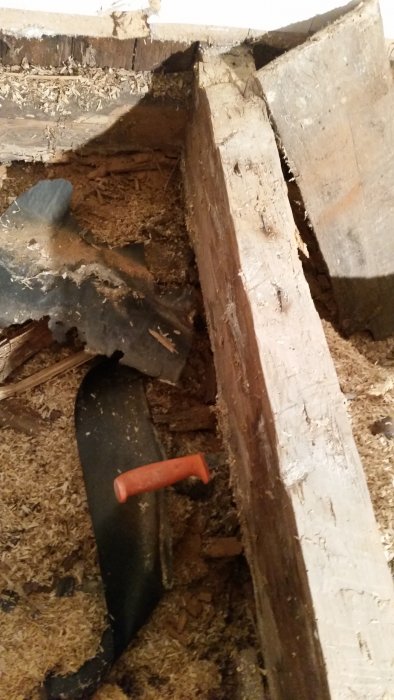
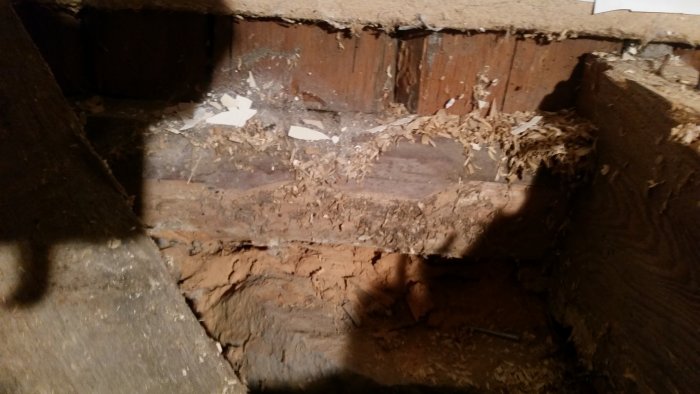
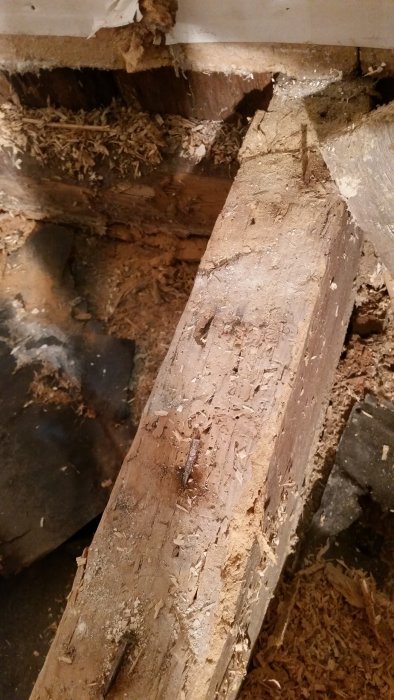
Now I would like to have lots of opinions. I have torn up the floor to insulate again. Suspected there was something with the bottom plate. In the pictures, we see the joists that are rotten at the bottom (inserted the knife) and the bottom plate that the joists rest on, which is also rotten.
Cause:
We lowered the ground level outside three years ago.
I think it simply stood under the ground, and that’s the reason for this.
When I read about rotten bottom plates and the like, questions about cinnamon-like powder, dry rot, etc., often come up. When I poke with the knife, it falls apart quite easily. I wouldn’t have reacted if it wasn’t for what I’ve read on the internet.
Action:
Got a tip from a person to reinforce the beams, place studs on tar paper, against the foundation stone, between the floor joists and attach these studs to the floor joists and the standing planks (timber) so that this becomes self-supporting. I myself don’t know right now what I will do.
Questions:
Do I need to clean out all the rotten wood, or can I just add reinforcements to the floor joists anyway? If not, what is dangerous about bone-dry, yet unusable, wood?
What do you think about the idea above?
(I’m going to install underfloor heating on the entire ground floor and renovate quite a bit, so I hadn’t accounted for the extra time this takes, which means I’m looking for a simple, yet durable solution)
Hello, thanks for the reply. Yes, there probably was some sort of worm there when it was wet. Today I have cut away some old parts and haven't seen any signs of life in the wood. I think it was wet quite a long time ago.
Probably not true dry rot. It likely wouldn't have given up so easily. Probably just "ordinary" rot breaking down the wood.
If the foundation and the logs are now bone dry, that's good. Then there should not be renewed moisture problems.
The quick, simple, cheapest solution is probably the one you sketched out. It works as long as the moisture level in the foundation stays low.
Otherwise, the recommendation is still to remove all moisture-damaged wood.
If you want to be completely sure of what it is, you should be able to send in samples for analysis, but it probably takes some time.
Has the ground level always been as it was before you lowered it, or has it slowly risen over time and you have restored the original level?
Click here to reply
Vi vill skicka notiser för ämnen du bevakar och händelser som berör dig.