

Does anyone know how to calculate the side forces and lift forces that the sill might be subjected to?
For example, if I have been informed that the reference wind speed for the location is 24.
It might not be that simple... The shape of the roof, the height of the building, etc., might also affect it...
For example, if I have been informed that the reference wind speed for the location is 24.
It might not be that simple... The shape of the roof, the height of the building, etc., might also affect it...
The reason I'm wondering is that when I need to fasten a sill in lightweight concrete, it's difficult to find fasteners that provide better strength than 0.2 - 0.3 kN tensile load and 0.15-0.25 kN shear load.
That is, much less than expansion bolts for concrete. So then I wonder if I need to fasten much more closely instead.
That is, much less than expansion bolts for concrete. So then I wonder if I need to fasten much more closely instead.

The answer can be found in the book "Snow and Wind Load" from Boverket, and as you guess, the loads depend on the house's height, roof slope, wind exposure, and the distance between wind-stabilizing walls.
http://www.boverket.se/shopping/ShowItem.aspx?id=1141&epslanguage=SV
I have it at work, but unfortunately not at home...
Fastening of the sill in LECA can be difficult if there are large lifting forces - if it's a layer of LECA on a concrete slab, you can fasten through the LECA and down into the concrete.
/The Engineer
http://www.boverket.se/shopping/ShowItem.aspx?id=1141&epslanguage=SV
I have it at work, but unfortunately not at home...
Fastening of the sill in LECA can be difficult if there are large lifting forces - if it's a layer of LECA on a concrete slab, you can fasten through the LECA and down into the concrete.
/The Engineer
Yes, it seems like nothing can ever be really simple ... 
Under the lightweight aggregate shift, I have, yes exactly more lightweight aggregate, so accessing concrete with the help of long fixings is unfortunately not an option. However, I might be able to attach something on the inside of this LECA ring, which could then be fastened to the concrete slab, maybe it would be best to cast in some bracket in that case.
The building is a garage with a height of 2.9 meters and 3.9 meters at the ridge, approximately. 4x10 meters.
I looked a bit at a construction drawing here. It is an extension that is about as wide and high as my garage (although it is attached to another house at one gable). But there, the designer prescribed Hilti nail plug on C-C60 with a tensile strength of 0.7 kN in concrete. (Checked on Hilti's own page) If I then use ESSVE's turbo plug TM8 which has 0.63 kN, it seems like I'm all set. Then I can pull them into C-C 30 as well.
But I have no idea what wind conditions are at the location for that construction drawing I looked at, so trusting this doesn't feel OK.
So really, I was hoping that some designer would tell me that the reason for setting c-c 60 in sill anchoring is to keep it tight between sill and slab, not for the sake of strength. That in principle, it would be enough with only like two concrete anchors for the whole house in terms of strength. In other words, that my main concern is actually a non-issue. If you understand what I mean ...
Under the lightweight aggregate shift, I have, yes exactly more lightweight aggregate, so accessing concrete with the help of long fixings is unfortunately not an option. However, I might be able to attach something on the inside of this LECA ring, which could then be fastened to the concrete slab, maybe it would be best to cast in some bracket in that case.
The building is a garage with a height of 2.9 meters and 3.9 meters at the ridge, approximately. 4x10 meters.
I looked a bit at a construction drawing here. It is an extension that is about as wide and high as my garage (although it is attached to another house at one gable). But there, the designer prescribed Hilti nail plug on C-C60 with a tensile strength of 0.7 kN in concrete. (Checked on Hilti's own page) If I then use ESSVE's turbo plug TM8 which has 0.63 kN, it seems like I'm all set. Then I can pull them into C-C 30 as well.
But I have no idea what wind conditions are at the location for that construction drawing I looked at, so trusting this doesn't feel OK.
So really, I was hoping that some designer would tell me that the reason for setting c-c 60 in sill anchoring is to keep it tight between sill and slab, not for the sake of strength. That in principle, it would be enough with only like two concrete anchors for the whole house in terms of strength. In other words, that my main concern is actually a non-issue. If you understand what I mean ...
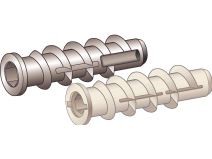
Unfortunately, significant lift forces can affect a building as light as your garage. It's not just roofs that can be blown off; entire buildings can actually move.
Sure, I've been considering chemical anchors.
If I can avoid them, I'd gladly do so. It's probably quite tricky to apply a row of chemical anchors to attach the sill.
But if the engineer or perhaps the I.builder, whom I also suspect knows this pretty well, could give me a hint on how to calculate side and tensile loads for wall fastening, I would be very grateful. If it's not too complicated, that is.
Having endured both a 4-year technical program and subsequently an engineering degree, not too many formulas for load cases should deter me.
However, I understand that the complication might lie in transferring this knowledge to a forum thread, as it might be based on numerous tables, for instance.
But if I can get a clue about the approximate load to be accounted for, I can arrange for stronger connections and/or place them closer together.
If I can avoid them, I'd gladly do so. It's probably quite tricky to apply a row of chemical anchors to attach the sill.
But if the engineer or perhaps the I.builder, whom I also suspect knows this pretty well, could give me a hint on how to calculate side and tensile loads for wall fastening, I would be very grateful. If it's not too complicated, that is.
Having endured both a 4-year technical program and subsequently an engineering degree, not too many formulas for load cases should deter me.
However, I understand that the complication might lie in transferring this knowledge to a forum thread, as it might be based on numerous tables, for instance.
But if I can get a clue about the approximate load to be accounted for, I can arrange for stronger connections and/or place them closer together.
I have only completed a two-year mechanic training and I'm terrible at math..............but my common sense tells me that if you fasten the sill with facade screws, long ones, maybe cc 40, it would take a lot to blow the house away. You apparently have the base fully built up with leca and the cast slab inside, so the construction can’t be stronger than what the base is.
.........but my common sense tells me that if you fasten the sill with facade screws, long ones, maybe cc 40, it would take a lot to blow the house away. You apparently have the base fully built up with leca and the cast slab inside, so the construction can’t be stronger than what the base is.
That Leca row can be kicked away with sandals on your feet, unless they are also fastened with 300mm screws. I myself use fully threaded rods, 12mm with a bend at the end that is pressed down into the slab's concrete. As anaitis mentions, there are enormous forces that some buildings have to withstand, and you usually don't know until after the storm.Jan-L said:I have only completed a two-year mechanic training and I'm terrible at math.....

Building (among other things) a workshop 6x10m, 3m high LECA masonry and a high roof with a 45-degree roof pitch in the most exposed wind conditions on Gotland.Mikael_L said:Sure, I've thought about chemical anchors. If it's not too complicated. But having endured 4 years of technical studies and later an engineering degree, not many formulas for load cases should deter me.
But I understand that the tricky part might be transferring this knowledge to a forum thread, perhaps based on a lot of tables.
But if I can get a hint about the approximate load that needs to be supported, I can arrange for stronger joints and/or place them closer together.
Equipped with a high school and engineering education (electrical/telecommunications/technical physics), I've tried to calculate different load cases using what I've Googled on the internet. Not exactly easy when many terms and symbols are not defined, maybe I should have gone into Construction instead...
Anyway, I came up with the following hopefully reassuring results and measures:
1. The masonry weighs about 20 tons and will not slide off the slab despite standing entirely "loose" on the felt. No anchors in the slab, thus.
2. The lower beams of the trusses are fastened with tension straps (25x1mm) at an angle downwards five layers, secured with nail plugs in each layer. The weight of the five layers plus it's built up at the peaks on the gables is more than enough to hold the roof in place. The outer trusses are also bolted to the masonry in the gables.
3. The problem is quite long walls with substantial windows and partially without supporting interior walls. Particularly on one gable, the pressure is several tons, and the buckling forces are considerable. I have therefore placed maximum reinforcement (wire mesh) in each layer and laid double rings with double ribbed bar reinforcement. The critical gable, where there is also no supporting intermediate floor, has additionally received a horizontal 240 mm I-beam as extra support. I might also mill in vertical reinforcement.
The result after the winter storms when the house stood partially without windows, but with a roof, is that everything has held, I can't see any cracks or other impacts. However, the forces will increase significantly when all the windows are in place.
Okay, maybe not the answer to your questions, but still. If anyone thinks my results are completely off-base, it would be fun to know!
Click here to reply