One of the door's hinges broke off. I've bought new hinges but I'm having decision anxiety about whether I should take the opportunity to fix the door that's damaged at the bottom - though it might hold up a while longer.
The question is whether paneling in those dimensions is even available anymore. 2 cm thick.
Feels like it would be faster to build two new doors on-site.
At the same time, they might be sound enough in the timber that normal people would just put on new hinges and straighten the doors with threaded rods.
I think the wood seems to have a lot of life left in it. It just looks dried out, not rotten. Give them a dose of raw linseed oil to perk them up and repel rainwater a bit better. Keep in mind that you'll get lesser quality wood if you buy new for building.
Have they been tarred?
Apply a new layer of light wood tar to preserve and keep visible some of the fantastically clear grain.
Then repeat the process as needed (every 5-25 years depending on the direction) and the doors will last indefinitely.
Roslagsmahogny is also an alternative, i.e. one-third each of tar, raw linseed oil, and balsam turpentine. (preferably purchased pre-mixed)
Personally, I find it easier to work with than pure tar, but it essentially serves the same function.
How do I prepare the gates before treatment with Roslagsmahogny that piqued my curiosity. Scrape/high-pressure wash/chemical/nothing at all?
Does the wood need a specific moisture level and does the outdoor weather need to have a high average temperature?
*thinking it's starting to be autumn outside*
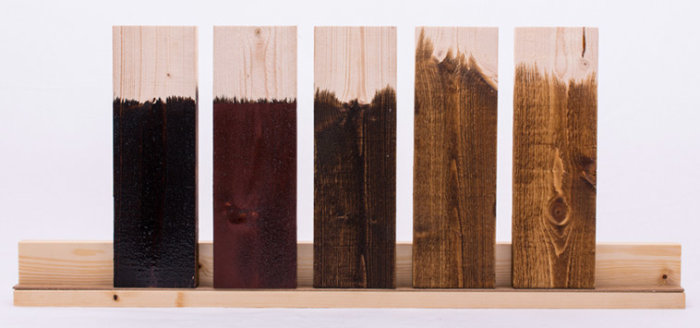
Is it possible to mix in a bit more black pigment/tar? to get closer to black wood tar
From left to right
1. Wood tar
2. Red tar
3. Roslagsmahogny with 60% wood tar
4. Roslagsmahogny with 30% wood tar
5. Roslagsfernissa with 20% wood tar
Brush off or even nothing at all is enough in your case. If there is a bothersome growth etc. somewhere, scrape it off, but it doesn't need to be done perfectly and I don't see any direct need in your pictures.
Fairly normal dry is enough, it's not critical in the same way as painting. It's more about if the wood has absorbed moisture, it won't be able to absorb the oil. If you choose a day with reasonably good weather and there is no remaining rain moisture, it works all autumn.
You already have a bit of dark pigmentation on the door that will contribute. (extra reason to minimize the prep work) Then it gets a bit darker each time you apply it.
Tar needs warmth to avoid becoming sticky on the surface, so higher mixing maybe isn't smart now this autumn. (not familiar with the 60% variant, what does the seller say?)
Your doors will probably absorb so much that you'll need to do it a couple of times, both now in autumn and next year. If you don't like the first result, you can wait and choose a darker variant in the spring.
Looking forward to hearing what you think and seeing the results then.
Since roslagsmahogny is wood tar diluted with turpentine and/or denatured alcohol and linseed oil, it is very easy to apply/runny, so the temperature that is suitable for 100% tar is not at all critical.
Just as Räknenisse above says, I think it's best to start with the standard mixture. Your doors already have a black base tone, and if it's not satisfactory, it’s only beneficial to apply another layer, with or without black pigment. (There is black tar, i.e., with carbon black pigment, (Auson), but there is also a difference in color depending on the quality of the tar. The cheapest tar tends to be really black from pitch/soot. The finer/more expensive the tar, the lighter the color.
Preparation: none. (Your doors looked fine.)
Moisture: Not a problem unless the doors are wet from driving rain. In that case, you need to wait a day or two for them to dry. Tar allows the wood to breathe, so it's not that critical. But as mentioned, if the wood is saturated with water, it won’t absorb the tar well.
Click here to reply
Vi vill skicka notiser för ämnen du bevakar och händelser som berör dig.