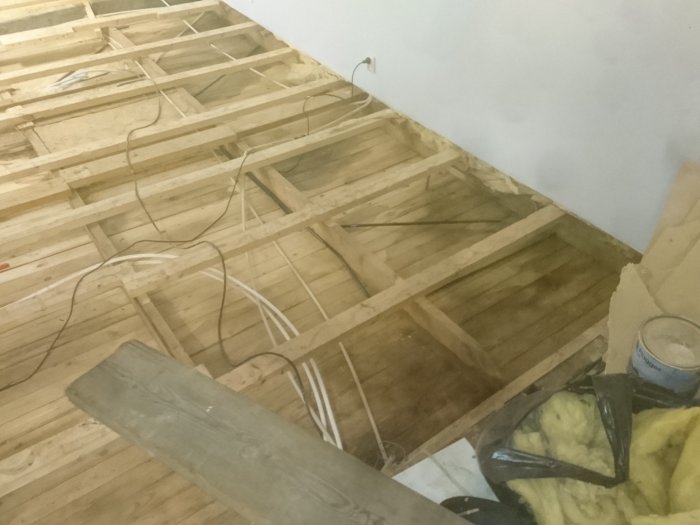
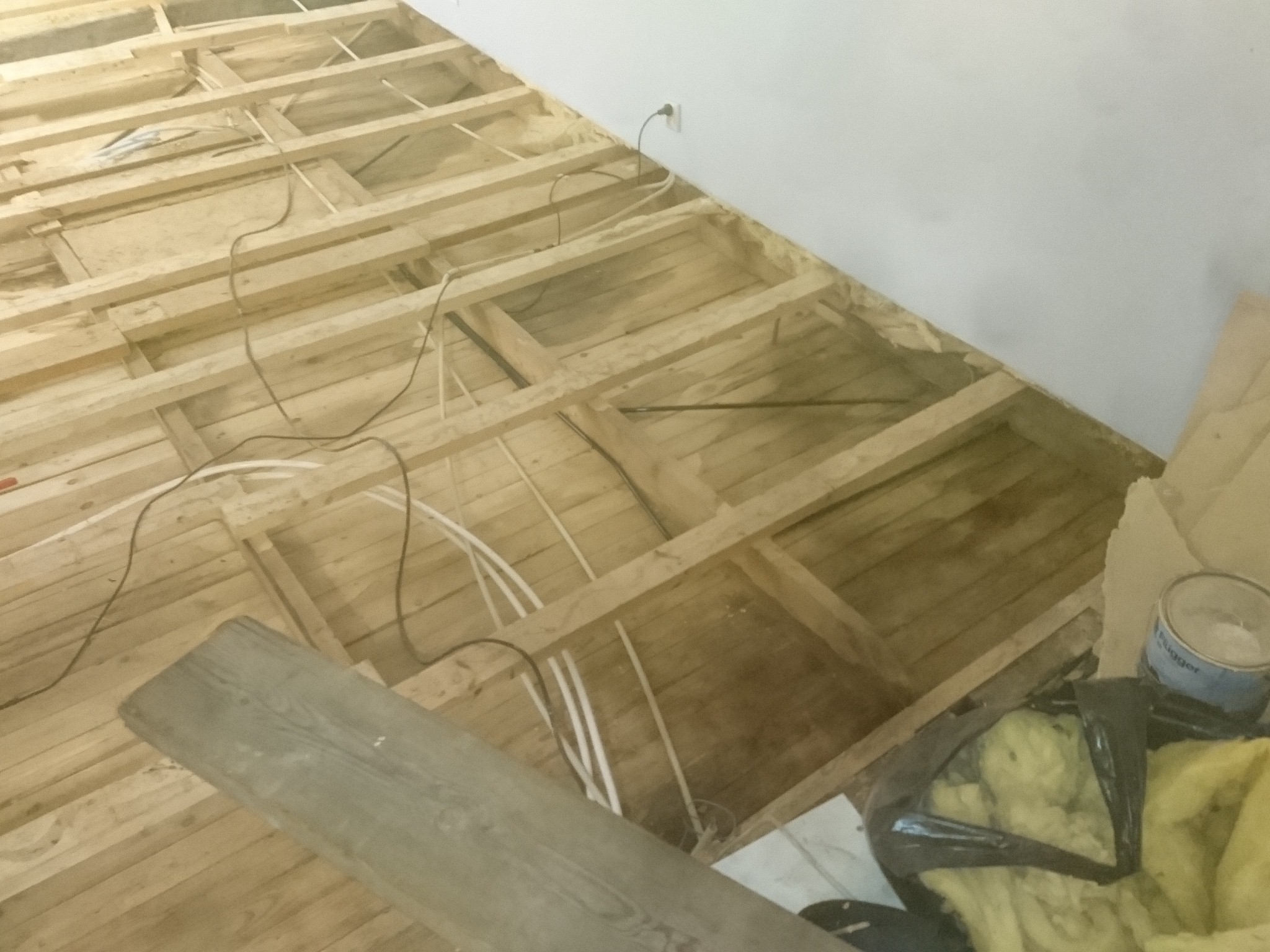
The floor structure in our house consists of joists approximately 70x160, spaced at 900-1200 center-to-center, with a span of 4930mm. On this, there are (among other things) 45x95 laid crosswise! The result is that the floor sags significantly.
I am thinking of installing a cross beam or a kkr-hole profile with a width of 3600mm. Then I plan to notch the old joists, attach them to it, and just let them support the ceiling while complementing with 45x195 to support the flooring. The span on them will be about 2445mm, so that feels safe. But how do I size the cross beam?
A flat bar of 120x5mm should work, so what do you think about screw-gluing one between two joists (to gain lateral stability and it makes it easy to attach joist hangers)?
If the room measures 4.93x3.6 m, or just under 18 sqm, you multiply this area by the design load, which should be about 2.5 kN/sqm. The result is 45 kN. Half of this, 22.5 kN, is taken up by a new central beam that is 3.6 m long. The distributed load on this beam is then 22.5/3.6, i.e., 6.25 kN/m. This is quite a lot and requires glulam or steel to keep the deflection at the desired level. A glulam beam measuring 190x180 can handle it, provided you can attach it properly.
Thanks for the answer, you confirmed that I was thinking correctly with the load (though I calculated with 2.85kN/sqm). =)
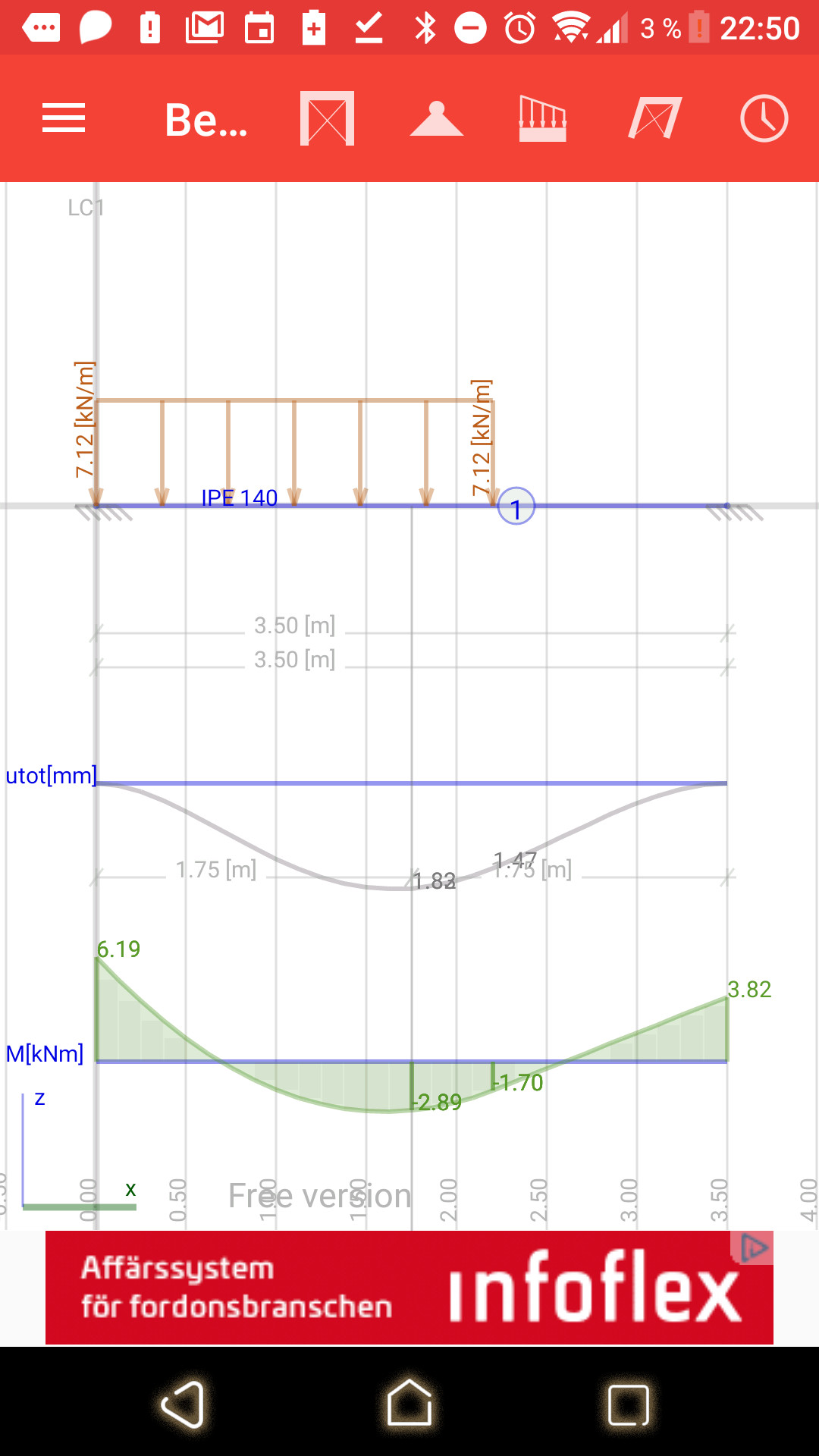
However, about 1/3 of the span is a knee wall where the load is much less, but I found an app that seems to work very well and I'm leaning towards an IPE140.
The observation made by bossespecials is important and can be deduced from the moment diagram in the app. If one is not sure how the app works, caution is advised. I assume you know the self-weight of the floor slab better than I do, so I have recalculated based on 2.85 kN/sqm. In that case, I would like to change the dimension of the glulam beam I suggest to 215x180. If you want an IPE steel beam, you probably need to go up to IPE 160. However, I would advise against steel in this case. In practice, you gain nothing in terms of height. It could even be higher due to fire protection insulation. It is also considerably more complicated to attach all the wooden parts to the steel.
I recalculated the deadweight, and justusandersson's 0.5kN/m2 fits better than my 0.85kN/m2. If I change the load and fixings to hinged, I get a deflection of 3.95mm with HEA140 and 4.69mm with IPE160.
Are the glulam beams 215mm and 190mm in height? One side will be placed on a masonry wall and the other on an old solid wood wall. I assume you can't screw-glue several narrower glulam beams together, right? Thinking it's easier to get hold of.
A third option would be to lay 70x220 C24 along the entire length of 4930mm. According to Svenskt Trä, it should work up to 4.97m with cc400 and 5.4m with cc300.
A fourth option that I would prefer to avoid is to place a visible beam in the living room directly below, as the beam and joists would then support the load together.
Ideally, I would want it to build a maximum of 190mm so I don't have to raise the floor next to it, which will be in the same space when it's finished.
If 0.5 kN/sqm fits better, we are back to glulam 190x180 where 190 is the width and 180 height. For IPE 160 and HEA 140, I get significantly larger deflections than you do, but within the acceptable range. However, this makes me a bit suspicious of your app. 70x220 C24 c/c 400 over the entire length does not meet the deflection requirement. Not even with glued chipboard. Such a non-principled solution requires glulam.
In my view, a 190x180 glulam central beam combined with 45x170 C24 joists in the other direction is both the cheapest, simplest, and most height-efficient solution.
Been to two "real" hardware stores and they don't even seem to be able to order a beam of 190x180.
Is it not possible to screw-glue 5 pieces of 42x180?
I could install a 90x270, cut out the inner ceiling, and have the underside of the beam visible. Shouldn't that be enough?
Can you calculate using b*h^3 to compare? 190*180*180*180 < 90*270*270*270
Yes, almost. The correct formula is b*h^3/12. 56x270 is closer.
190x180 is a standard dimension but hardly a stock item. I'm quite sure they can order a beam with the right dimensions and length. Stock beams are usually 6 meters long, which leads to unnecessary waste.
It's important to hold back a bit, curb the enthusiasm, and think, what is most important?