Now I need some tips on how to best proceed, in what order, and if you have any other tips and tricks.
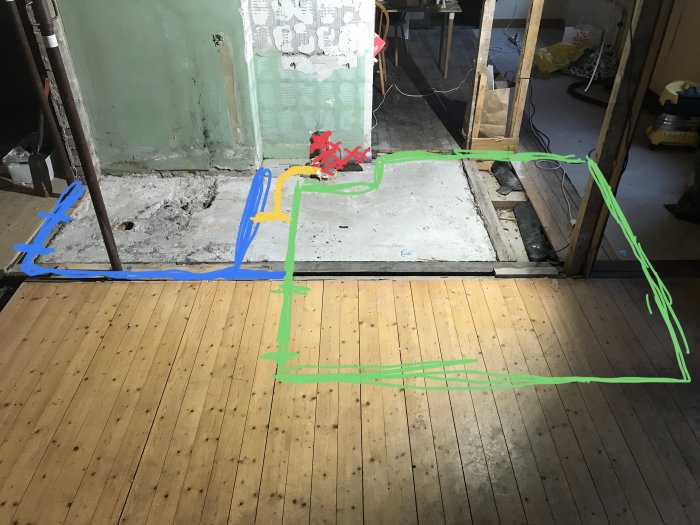
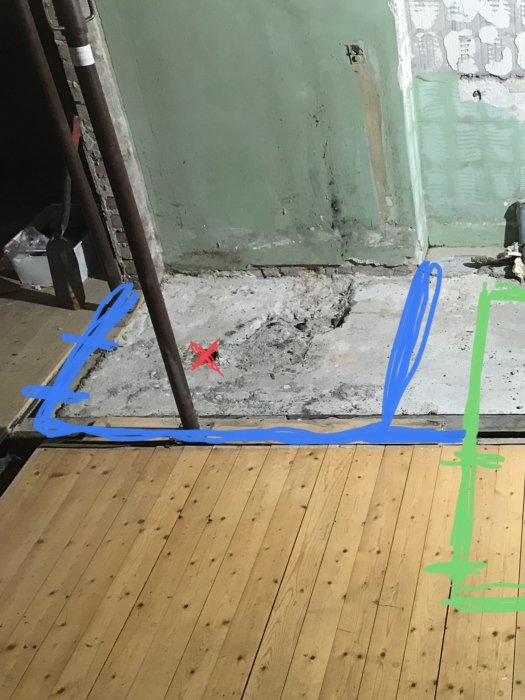
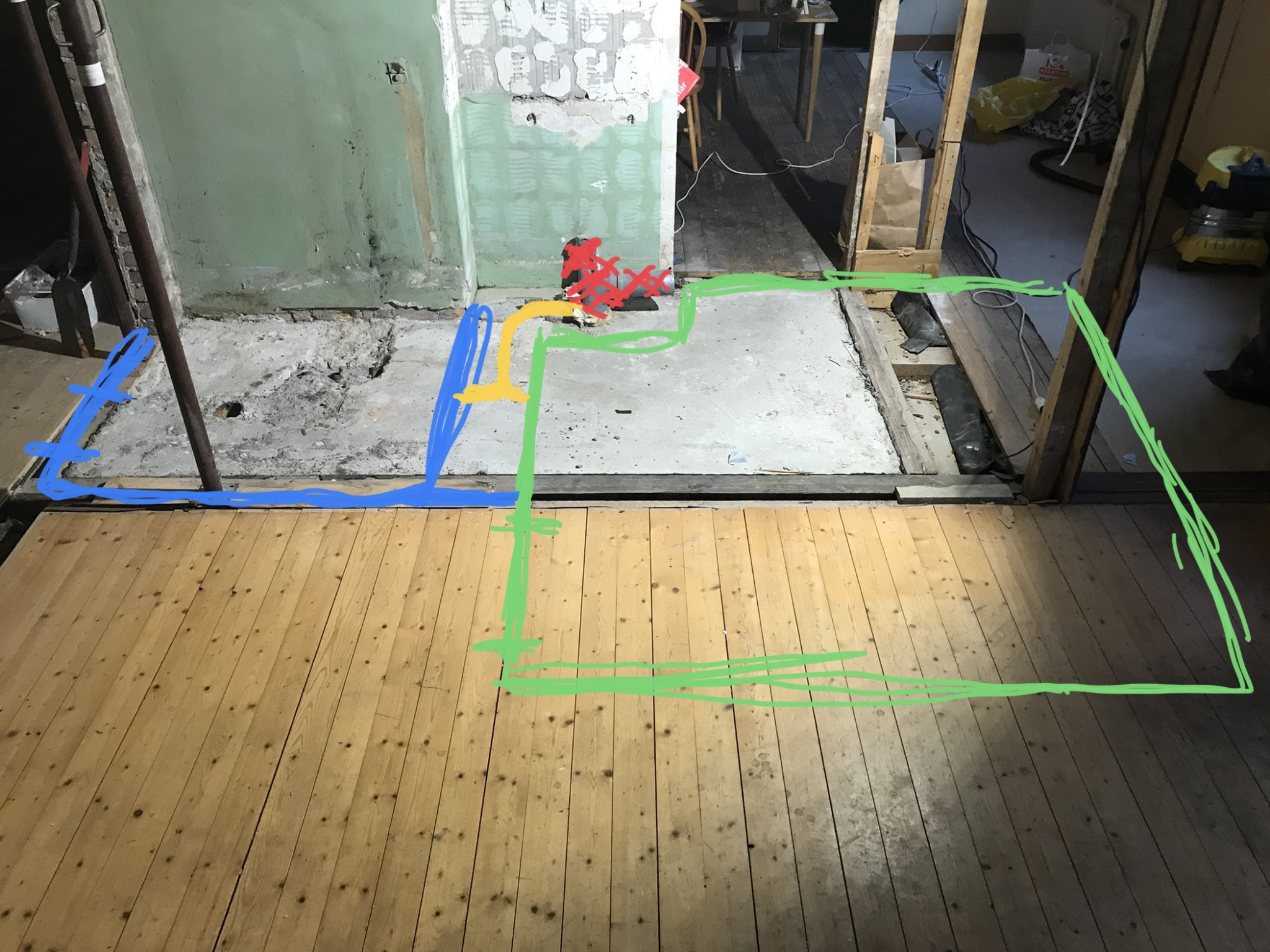
First, some pictures before the questions. In the pictures you see:
The blue area that will become a small toilet (floor WC with drainage through the wall, not in the floor)
The green area that will become a bathroom (without a toilet)
And a gap where all pipes will run
The red are old pipes that need to be removed, but new ones will be installed through the same hole to the basement
Note: no underfloor heating in any of the spaces, just self-leveling compound, waterproofing, tiles
So, now to my questions.
Toilet:
1. I think I should build the walls first, before I do the floor. Right?
2. As seen, the slab in the bathroom is very uneven. Do I need to level it first, or can I self-level over it?
3. Can I apply self-leveling compound directly on the slab? Or do I need to use something like a moisture barrier from the self-leveling compound?
4. Do I need to protect the floor joists somehow from the compound? With plastic strips? Or can I self-level directly against/over them? I'm thinking that moisture might penetrate into the wood then...
5. Should I even lay plastic over the entire slab and over the floor joists, and then self-level over that, as I would do if it was EPS cement in the floor joists?
6. Do I need reinforcement mesh during self-leveling, even if I don't have underfloor heating?
I think that's enough to start with... hope you want to give some tips and answers! <3
1. Should have built the wall first.
2. No, put on filler.
3. Vacuum and then primer.
4. Wouldn't float on that at all, break up and then framework with chipboard.
but what does the construction look like? What is the slab placed on? And you're supposed to lay floorboards on the part that extends out beyond the slab, right? Is it an option to break away the slab and create a proper structure with floorboards? What type of flooring are you planning to use? If it's tiles, you need to establish a solid base.
You probably need to read up a bit: https://www.sakervatten.se/bygga-ratt/konsumenter
Click on the pdf: Bygg Badrummet Rätt 2014.
From that, you should conclude that you need to start with rebuilding the joists...
Yes, I have read up quite a bit, but of course there's always more to read .
There is a basement underneath. The slab surrounds the chimney stack. For the part outside the slab (bathroom without a toilet), I am thinking of furring and laying EPS in the gaps, and then casting on top of that (according to this principle:
).
There have been various bathrooms on that slab previously, at different times, with many layers (tiles, sand, 2cm casting, etc., as seen against the wall in the gap between the intended walls). So the slab holds, I'm not worried about that.






 .
.