I have recently had the opportunity to mill lumber and am now fully engaged in milling ash. However, I'm a bit uncertain about which dimensions I should cut for upcoming projects. It's on a hobby basis, but I can imagine selling a small portion. I have thought about making flooring, plank tables, kitchen frames, and cabinet doors.
A lot of planks have already been cut, quite a few 2", 1.75", 1.5", and 1", but is there any dimension I haven't considered, or that might be more marketable elsewhere? I've only thought about future projects and don't want to focus too much on one certain dimension, but I also don't want to have too much of a dimension that won't be used. If you take an upper cabinet in a kitchen at 60x80x38cm as an example, it consumes slightly over 1m2 of glued board. But when cutting the boards for this, what percentage of waste might be expected?
Regarding 18mm glued boards, which seem to be the most workable for kitchen frames, is this usually 1" before drying or planing, or can it be made thinner? The same goes for plank tables and other items; obviously, there's some uncertainty about how much thickness is lost after drying and planing. Everything will be dried down to furniture-dry, i.e., around 8-10%.
How would you approach milling for future projects concerning thicknesses and other dimensions?
Also, to avoid cracks during the drying process, I will apply white glue to the end grain, but should I also use some form of S-bracket or "split stopper" at the ends of the boards to reduce the risk of cracking? Or should they be ignored and use cracked boards for making glued panels? Perhaps a low percentage of planks crack if they dry relatively slowly without direct sunlight?
Do you mean that the sawdust is not a source of mold like on pine, spruce, and birch?
I would rather cover the end of the lumber stack with a plywood board to reduce the risk of cracks.
Yep, it was aspen that was sawn, so you use sawdust from the saw, meaning aspen sawdust, it's not at all the same as, for example, pine, which is extremely sensitive.
If covering with plywood, should it be something special, most are made of spruce, pine, or birch?
Yep, they were cutting aspen, so what you're using is sawdust from the saw, meaning aspen sawdust, which is not at all the same as, for example, pine that is extremely sensitive.
If you cover with plywood, should there be a specific one, most of them are made of spruce, pine, or birch.
No, the thread is about ash.
I have hung regular packaging material on the sun-exposed end grain when I've cut carpentry wood, I believe it was poplar plywood.
I have hung regular packaging material on the sun-exposed end of the stub when I've sawn carpentry wood, think it was poplar plywood.
Ok, but ash is also not a sensitive wood type; it's a hard and tough wood.
It is used for wheels, spokes, sled runners, skis, gun stocks, etc.
What matters for mold attacks is the time of year the trees are felled.
Trees cut down in the summer have a lot of sap in the sapwood, which contains a lot of sugar. And sugar is a real power nutrient for mold.
And people used to know this, which is why they only logged timber in the forests during the winters.
Thick planks that are then cut to the right dimensions once they've dried further and you know what you want/need.
But in the case of thick dimensions, it can always get a bit tricky as it is difficult/impossible to split, for example, a 2" board into two 1" ones, as the saw blade's thickness disappears, etc.
But I have mainly used resawing, that is, slicing the logs to be able to edge and cut out the right dimensions later. Easiest in the small sawmill but also possible with a plunge or circular saw with a guide rail.
I cut up some ash a few years ago. It cracked quite a lot, painting the end grain can reduce the risk somewhat.
Did you dry yours entirely without glue? I'm considering gluing but might also insert a "split stopper" in the end to prevent the crack from propagating, especially in 1.5-2" boards. But maybe overkill?
All the answers you could ever need are here:
[link]
I'm a member there! But generally speaking, everyone suggests everything, anchorseal, white glue, salt solution, s-iron, splitstopper, only dry slowly, nothing else needed, steam chamber, etc.
It's quite difficult to know what's best, even though there are many options. Although I haven't asked about the most common dimensions, that might be a good idea to do.
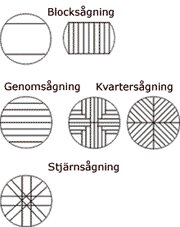
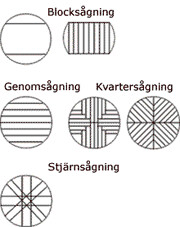
There are many ways to saw, different methods give different characteristics to the board.
You can read more here: [link]
[image]
Have done a fair amount of sawing, big difference between through-sawing and quarter-sawing. Both in results and in how long the actual sawing takes.
So far, I have mainly used through-sawing, where I plan to cut to the right dimensions at a later stage but also to some extent block-sawing. What would you say is the biggest advantage of quarter-sawing? How do you dry your planks to avoid cracks?
Do you mean that the shavings are not a source of mold like on pine, spruce, and birch?
I would rather cover the end of the lumber stack with a plywood sheet to reduce the risk of cracks.
Great tip to cover the end with plywood! I might consider something similar since it's the end grain that is the most sensitive. But maybe just white glue is enough?
Vi vill skicka notiser för ämnen du bevakar och händelser som berör dig.



TorpAnders said:
 But generally speaking, everyone suggests everything, anchorseal, white glue, salt solution, s-iron, splitstopper, only dry slowly, nothing else needed, steam chamber, etc.
AXS said: