
3,007 views ·
14 replies
3k views
14 replies
Sagging glulam beam at house purchase
Hello everyone,
We have signed the purchase contract for a house
Everything looked good in the inspection (very well-maintained house that has been continuously fixed), built in the late 90s, except for a sagging glulam beam. This "holds up" the roof in a connected extension where there is an indoor pool. The beam runs from the short side of the house, over the pool and then attaches to the rafters. The total span is about 7-8m. According to the drawings, it is "glulam strength class L40, Bonding class U". The roof is low-pitched and has BTG tiles.
The roof was also noted to be a bit uneven.
What might be worth mentioning is that the house, in general, was in extremely good condition and very well-maintained, which is why this stood out a bit in the inspection. I don’t want to post drawings and photos out of respect for the current homeowners.
I understand it's not possible to answer exact details, so I formulate the following questions:
- Is it reasonable that a 20-year-old extension has undersized beams?
- Could it be that the humidity in the room has been higher than calculated and therefore the beam is sagging?
- As I understand it, it takes an extreme amount before the beam totally collapses. But should this be addressed in the near future (for example a 5-year period)?
- Is it worth bringing in a structural engineer to look at it?
- Should we try to lower the price due to this finding?
Extremely grateful if you have any input.
All the best,
/Nervous first-time homebuyer
We have signed the purchase contract for a house
Everything looked good in the inspection (very well-maintained house that has been continuously fixed), built in the late 90s, except for a sagging glulam beam. This "holds up" the roof in a connected extension where there is an indoor pool. The beam runs from the short side of the house, over the pool and then attaches to the rafters. The total span is about 7-8m. According to the drawings, it is "glulam strength class L40, Bonding class U". The roof is low-pitched and has BTG tiles.
The roof was also noted to be a bit uneven.
What might be worth mentioning is that the house, in general, was in extremely good condition and very well-maintained, which is why this stood out a bit in the inspection. I don’t want to post drawings and photos out of respect for the current homeowners.
I understand it's not possible to answer exact details, so I formulate the following questions:
- Is it reasonable that a 20-year-old extension has undersized beams?
- Could it be that the humidity in the room has been higher than calculated and therefore the beam is sagging?
- As I understand it, it takes an extreme amount before the beam totally collapses. But should this be addressed in the near future (for example a 5-year period)?
- Is it worth bringing in a structural engineer to look at it?
- Should we try to lower the price due to this finding?
Extremely grateful if you have any input.
All the best,
/Nervous first-time homebuyer
Hi! Great with a quick responsetensiden said:
Of course, we didn't know the condition beforehand. It was discovered during the inspection (signed with the usual clause).
Member
· Västernorrland
· 12 076 posts
A normal beam of 7-8 m will probably sag a little over time if it doesn't have any support other than at the ends. You would need quite hefty dimensions to keep it straight that way.

As stated, 7 - 8m is a long span. But hasn't bes, the man measured or estimated the dimension of the beam?
I guess you need a beam that is 70cm high or more.
There are calculation tools on the website of beam manufacturers (Moelven), or on "svenskt trä". What you need to know for the calculation is the dimension of the room (which gives how large the load will be).
I guess you need a beam that is 70cm high or more.
There are calculation tools on the website of beam manufacturers (Moelven), or on "svenskt trä". What you need to know for the calculation is the dimension of the room (which gives how large the load will be).
no snow load on the roof that can make it sag a little now during the winter?
The idea that it attaches to rafters also sounds doubtful. There will be a very high load at the attachment point.
If you imagine a room of 4x8 m, you have 32 sqm of roof. Calculate a snow load and the roof's own weight as, for example, 250 kg/sqm. Total weight 8 tons. Of that, the beam supports half (the outer walls bear the rest), and each attachment point for the beam then half of that, so 2 tons at the beam's support point.
But now I'm just speculating about the size of the room, and I also don't know what the correct snow load to calculate with is (depends on where in the country).
If you imagine a room of 4x8 m, you have 32 sqm of roof. Calculate a snow load and the roof's own weight as, for example, 250 kg/sqm. Total weight 8 tons. Of that, the beam supports half (the outer walls bear the rest), and each attachment point for the beam then half of that, so 2 tons at the beam's support point.
But now I'm just speculating about the size of the room, and I also don't know what the correct snow load to calculate with is (depends on where in the country).
Member
· Västernorrland
· 12 076 posts
Maybe no one has even calculated how the beam behaves either..........Some people think that the smallest possible beam is deflection-free and stays straight by itself. It's a beam after all........
Then there are those who do the opposite too. Someone here at home has made a small gabled roof over a porch and the more you look at it, you realize that the beam doesn't serve any function at all........It just kind of hangs under the rafters by itself, but it probably looks impressive.
Then there are those who do the opposite too. Someone here at home has made a small gabled roof over a porch and the more you look at it, you realize that the beam doesn't serve any function at all........It just kind of hangs under the rafters by itself, but it probably looks impressive.
Thank you for all the feedback! The inspector didn't conduct any calculations or measurements, he just stated what he observed and "had to" recommend further investigation (but himself seemed a bit skeptical about whether it was really needed). There are very few days per year where any significant snow would affect the weight of the roof. According to the drawing, the beam is L115x315.
Isn't it the case that the municipality makes some kind of assessment if the dimension is sufficient before granting a building permit? Or is that not something one can rely on at all?
Thank you all!
Isn't it the case that the municipality makes some kind of assessment if the dimension is sufficient before granting a building permit? Or is that not something one can rely on at all?
Thank you all!
Member
· Västernorrland
· 12 076 posts
I wouldn't worry about it too much. Just because it's a bit saggy doesn't necessarily mean there's something "wrong".........If I thought the same way about my house from 1900, I'd probably have to evacuate immediately. Here everything is sagging, crooked, and askew.....
Ask the current owner to show the calculations that formed the basis for the construction. Is there a building permit for the extension?
Without seeing drawings, it's hard to make a statement, but a 315 mm high beam sounds too weak for an 8-meter span. It has held for 20 years, to be sure, but it's the snow load that is dimensioning. That snow load might only occur once in 50 years, but when it happens, it's unfortunate.
Without seeing drawings, it's hard to make a statement, but a 315 mm high beam sounds too weak for an 8-meter span. It has held for 20 years, to be sure, but it's the snow load that is dimensioning. That snow load might only occur once in 50 years, but when it happens, it's unfortunate.

The interesting thing is the dimension of the beam. Then you can calculate whether it holds or not.
It's probably not a problem. Beams can bend a lot before approaching the breaking point. The rule of thumb is usually that the deflection should be at most 1/500 of the length. Not because it affects the function but because if the deflection is larger, it becomes visible and then people get scared.
It's probably not a problem. Beams can bend a lot before approaching the breaking point. The rule of thumb is usually that the deflection should be at most 1/500 of the length. Not because it affects the function but because if the deflection is larger, it becomes visible and then people get scared.
According to a quick check on the wood guide for a ridge beam in a room that is 4x8 meters, it seems that at least 495x115 is needed for the beam to hold. Now, you might have a different snow zone than what I chose, but 315 is probably way too weak no matter where you live in Sweden.
https://www.byggbeskrivningar.se/dimensionering/nockbalkar-och-takasar/
https://www.byggbeskrivningar.se/dimensionering/nockbalkar-och-takasar/
Hello!
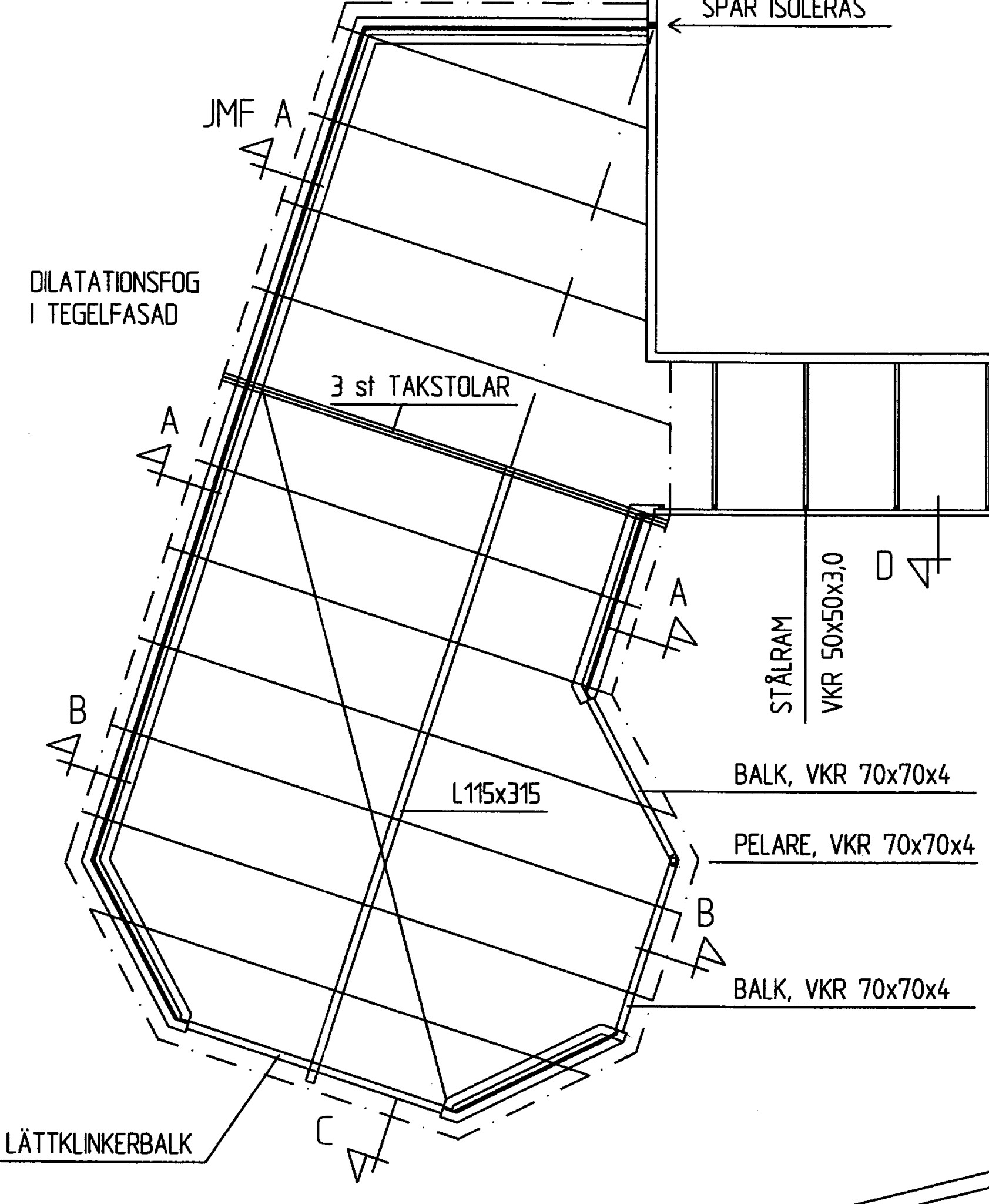
I understand that it's extremely difficult without a drawing. Therefore, I am attaching a small excerpt.
The beam is approximately 8m long in total.
Thus, about 1140mm between rafters.
Roof pitch at a low 14%.
Virtually no eaves.
The tricky part is that it varies in width so that where it is narrower between the walls (about 4500mm), the beam gets more support while it has to support more where it is longest between the walls (7536mm).
If you elaborate with the numbers on the page that @Janus82 kindly linked to, the beam indeed seems to be too weak.
There is a building permit, so everything seems legit. It seems there was a designer who made drawings (asked about calculations), but in any case, there is obviously a problem. It may take a lot for the roof to collapse, but still. If nothing else, aesthetically. Is it grounds to negotiate down the price and how quickly should it be addressed?
I understand that it's extremely difficult without a drawing. Therefore, I am attaching a small excerpt.
The beam is approximately 8m long in total.
Thus, about 1140mm between rafters.
Roof pitch at a low 14%.
Virtually no eaves.
The tricky part is that it varies in width so that where it is narrower between the walls (about 4500mm), the beam gets more support while it has to support more where it is longest between the walls (7536mm).
If you elaborate with the numbers on the page that @Janus82 kindly linked to, the beam indeed seems to be too weak.
There is a building permit, so everything seems legit. It seems there was a designer who made drawings (asked about calculations), but in any case, there is obviously a problem. It may take a lot for the roof to collapse, but still. If nothing else, aesthetically. Is it grounds to negotiate down the price and how quickly should it be addressed?
Click here to reply