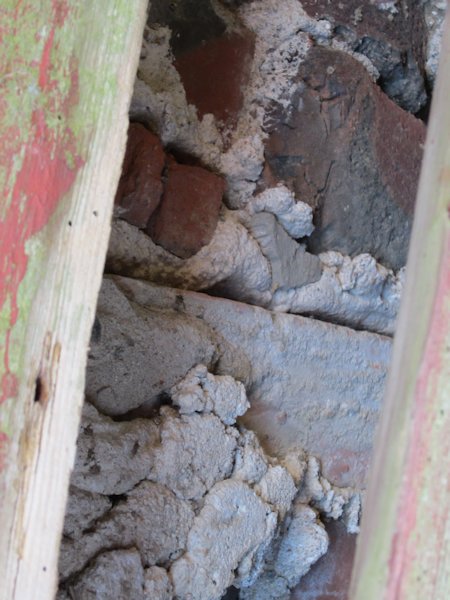
Clay bricks are often in brick molds, I have them myself in some interior walls. Back in the day, it was cheaper than brick as they could be made on the property with local clay. As long as they don't get wet, they have quite good properties, including an incredible ability to buffer moisture and keep indoor humidity even. There's some reading material about them, see here for example (pdf).
But it's not impossible that it's brick either, maybe laid with clay mortar in that case, I suppose? You can tell quite quickly if you scratch the stone a little or poke it a bit.
In the construction above, the timber framing is load-bearing. The clay brick is filler, and the panel protects the two from rain and weather.
I don't know what the best strategies are for renovating it, but I wouldn't rule out keeping the clay brick. I might refer to this thesis from LTH: A 200-year-old Skåne length meets 21st-century energy requirements. It's especially wet rooms that can become tricky, especially against outer walls.
Make sure to get someone who knows old Skåne lengths to inspect it if you're going to buy. I might be able to help with a contact from when we inspected our house if it becomes relevant, let me know in that case.
Do you live in a Skåne length yourself? *curious*
I got a bit puzzled when you said that about the clay bricks, that they are also in brick form... hard to know what's hiding behind. In an outhouse, I found several hm "grayish" stones... which I might now suspect are indeed clay bricks?? But on the other hand, I photographed somewhere (although it may have been done afterwards) such classic red brick blocks with a high joint/fix on them...
Next time I have a look, I'll poke the stone too
You mentioned that they had a good ability to keep even humidity... and that the timber framing was load-bearing... how does such a construction generally work concerning insulation... windproofing, etc.? I know how a modern outer wall is built... and understand how it insulates and prevents moisture migration... but such a wall? how do they work? :x
I had actually found that thesis and have saved it hehe, quite interesting, and they even had pictures I'll take a closer look at it later too...
Why would wet rooms be tricky? For the same reasons they can be tricky in a basement? That you have to use materials that prevent moisture from moving as intended..? (rubber goo I think is the official name haha).
Thanks, I'll keep that in mind if we get that far..! Regarding the contact for inspection of the lengths...
I think you should check out the building conservation forum here. There are probably some people who know old half-timbered houses. Especially if you are interested in getting advice on how to take care of the existing buildings. Many otherwise have the mindset of "tear it down and build new." This applies to builders, real estate agents, forum users, and acquaintances alike.
Everything can basically be put in order. It's just a matter of interest, time, and resources. I think it's great that you're considering if the buildings can be saved. Keep in mind that there are countless new standard houses, but fewer and fewer old houses that aren't over-renovated. A catalog house is probably practical but can never tell a story like an old house. But you must be clear that it's a big project to take care of an old house with neglected maintenance. It probably involves many years of tinkering, but it can also give a lot back, both along the way and when things are finished.
I was wondering a bit about where to place this thread, it was a bit of a gamble. But I will definitely take a look inside the building conservation forum too. I can post a couple of other threads there if nothing else There's plenty of questions
Yeah, the whole "tear it down"... I understand in general (and to some extent about the object I looked at too). BUT, there's a certain charm in at least being able to keep some of the old... I mean even if you have to tear down half, maybe half can be saved, and that feels like a bit of a win!
I feel the same about the renovation... even if some things have to be done "modernly," maybe not EVERYTHING has to be modern... I'm not so fussy... and it's not that I have to do everything by the book (some things may need changes)... but I still like things that have a history behind them...
If we were to buy the property in the end, it's not to move there immediately. We already live in a house and plan to stay there for at least a few more years... but we've been looking for a summer cottage/plot... and the object fit in there. It was the view around that I fell for... (i.e., the plot overall)... so I could also be happy knocking everything down and putting a small cabin there
But at the same time, I see no reason to just tear things down for the sake of tearing them down... for example, I think the roofs on the two large houses look okay (except in connection to the collapsed part of the "middle section")... if you disregard a bit too much moss growth on a certain area of the asbestos roof... but generally, it's a good start if the roof holds up... then the next problem is the foundation... both for the outbuildings and the main house... do they hold up? if not, what do you do... what does it cost... how much work is it...
Some questions popping up
But yes, it's a long-term project... and we'd renovate a little now (so you don't have to worry about it blowing over) and a little over time/along the way... but any major investments will probably be the day we decide to move there permanently and sell the house we're living in.
Until then, it can function as a summer residence... with some work
No, but in a stone townhouse from the 1800s. There are quite a few pictures, including of the claystone, on the blog in the signature!
You mentioned that they had a good ability to maintain even humidity... and that the timber frame was the load-bearing part... how does such a construction generally work in terms of insulation... airtightness, etc.? I know how a modern exterior wall is built... and I understand how it insulates and prevents moisture migration... but such a wall? how do they work? :x
Now, I'm definitely not an expert, so I can't answer too much, and take what I can say with a grain of salt. It would be fun if someone more knowledgeable could contribute! But it's quite clear that such a wall does not meet modern standards in terms of comfort or energy consumption. Making it airtight shouldn't really be a problem, clay can be very tight, and it becomes even tighter when it gets wet. But it can be difficult to address draughts around windows, floors, etc.
The claystone, as mentioned, has very special properties concerning moisture. It should not become too damp, as its load-bearing capacity decreases. Since it's the wood that's load-bearing, it shouldn't be a problem unless it gets directly wet in this case, though. The positive aspect of this is that it buffers a lot of moisture and keeps nearby wood safe in the same way as cellulose-based insulation. The indoor climate also benefits from this. But it means that it must be able to ventilate out any moisture that comes into it, so any form of waterproof layer can be problematic. A pure guess would be that cellulose-based insulation and wind paper are a good bet since they operate on similar principles.
Otherwise, it's traditionally clay or lime plaster used for wind and water-proofing. Or paneling, of course, as in your case.
Why would wet rooms be tricky? For the same reasons they can be tricky in a basement? That you have to use materials that prevent moisture from moving as intended...? (I believe gummigegga is the official name haha).
It's the waterproofing that's problematic because claystone needs to be able to "breathe" in both directions. For the most part, it is recommended not to install wet rooms in such houses, but instead to build an extension or outbuilding with modern standards.
The next best option is to avoid exterior walls.
Finally, one should be cautious with modern standards if choosing to make a wet room against a claystone wall. A compromise that might work is to only use a waterproof layer in the shower and on the floor, and ensure there's a really good moisture-controlled fan. But keep in mind that care is needed, and one cannot rely on insurance if water damage occurs.
We chose tadelakt in our bathroom partly to circumvent this issue. Then it turned out that there wasn't claystone in our exterior walls after all, and everything became a bit simpler. But I think it could be a very good solution for wet rooms with claystone walls if combined with waterproof layers where it's exposed to direct and regular water exposure.
One thing I thought about... When it's eternit, any renovation/demolition of the collapsed roof becomes a bit more complicated
Yes, it is a bit more complicated on that front, but the part that has already collapsed... is actually tile. You could say that half of the middle house has a tile roof and half eternit (and 1/4 of the eternit part consists of roofing felt of some kind).
The other roofs (the two wings that have entirely eternit roofs) I think look quite okay, the residential building wing has a bit too much moss growth in some places... and some corner of one or two eternit sheets are damaged... but overall okay.
You might have to take the opportunity to get some help taking them down and then drive them (wrapped) to the dump yourself (it's usually better to leave them at the dump as a private person...). Tile, wood, and concrete (which the rest seems to be) can just be sent down into some container...
Hello Snigla,
I don't know if my experiences can be helpful. I'm not knowledgeable on the subject in any way, but I have sporadic experiences from renovating our Skånelänga. The building was originally, which in this case is the late 1700s or early 1800s, a barn or log house. We believe it was converted to a residence sometime in the early 1900s. Over all these years, materials and techniques have been changed, added to, replaced, built upon, etc. I think that's how it is with quite a few simpler Skåne farms that they are not uniform but a mix of all sorts of things. The foundation of our house is natural stone, i.e., large boulders that have been dragged here and lie deep in the ground and have been there for a few hundred years, quite stable indeed. On top of the foundation, the exterior walls were probably originally built with clay bricks mixed with natural stone. So, no timber framing. Some walls or parts of walls have then been demolished or collapsed and rebuilt with regular bricks. About 25 years ago, the entire facade was replastered, and then the exterior walls were reinforced in various ways with reinforcement and concrete. In connection with drainage around the house, a new support foundation with concrete was cast "outside" the old boulders. When we moved in almost 15 years ago, there were plastic mats on all the wooden floors indoors, and the roof was asbestos cement. What we have done since is to dig out the floor inside, insulate the ground, and cast a thinner slab with water-based underfloor heating. We have also replaced the asbestos roof with clay tiles. You should definitely have a professional do this part, as we all know what it means to handle asbestos. When we replaced the roof tiles and wanted to furnish the attic, it turned out that the roof trusses, or rather the eaves, had been "built into" the wall plate and therefore had rotted in some parts. So the entire roof structure is completely new, as well as the kitchen, bathroom, electricity, heating, etc. The house is now top-notch, but it has taken its time and cost quite a bit. My opinion is that if you're going to do something similar, the property you buy must be a bargain price-wise and have the right potential, because when you start digging into old houses, you will, in one way or another, encounter surprises, both fun and less fun, and not all of them are simple or cheap to address. By the way, also check the windows. If they are period-appropriate but need renovation, it's a laborious matter both time-wise, cost-wise, and generally troublesome. New flat windows in PVC frames might not be what you want in an old Skånelänga.
It took a while before I found the website (I didn't see any signature, but found it in your profile). The stones there looked familiar... (the ones in the corner where you were installing floor heating and smoothing) looked like a fun blog... I'll take a closer look tonight! Always fun with renovation blogs... I think!
Regarding wet rooms... there's a small possibility of possibly accommodating a bathroom in the new section (assuming you demolish one of the wings... where the roof has already collapsed and the floor cracked... and everything else is generally rotten)... in the new section, you can build everything according to more modern principles (without disturbing the old... which might actually be saved)... and install plumbing and such directly when doing everything (i.e., you don't need to bring in drainage and such into the old foundation but start a completely new project in the new part)...
Now, as I said, I don't know how bad the situation is with the floor and wall in the residence, but it's clear it has its flaws... the question is how much... (but you can always brainstorm some ideas/thoughts...)
Wondering if this is a "quick fix"?.. or what they actually did.. is behind a "plank" on one gable (the picture I published before was the other gable.. so that's why I was unsure about what material was used and how it should be)
Skånelängor can vary quite a bit in construction, primarily depending on where in Skåne they are located. Additionally, as previously mentioned, there aren't many untouched houses left; most have likely been modified, renovated, extended, patched, and repaired with varying materials and methods. Generally, I believe that if you're going to preserve the old, you should use traditional methods and materials. They work based on the same principles, and the old style is preserved much better. BBR can be thrown in the trash. It is for new houses and not compatible with old houses. You should be handy and do most of the work yourself. Labor time (craftsmen's) is expensive, and because everything is crooked and should/ought to be done in the old way, it becomes costly with craftsmen. If you even manage to find craftsmen of the old school who are competent and willing to work with old techniques (and materials). On the other hand, old houses are often simply and straightforwardly constructed using robust, simple, and inexpensive materials, which means that if, for example, water damage occurs, you can relatively easily and cheaply fix it yourself. If you also use it as a summer residence, you can manage excellently with the old and simple.
There will likely be a lot of work. If it is in too poor condition, I think it is better to preserve what is okay and try to reuse it as picturesque/charming details in a new build. But investigate everything thoroughly. Things often look worse than they are. Superior quality materials were used in the past, and in generously large dimensions. For example, I have an old barn that looks dilapidated and shabby, but what timber! It outmatches today’s balsa wood by a long shot. That barn, as worn, crooked, and worm-eaten as it is, is guaranteed much more stable and durable than the newly built garage.
They are regular bricks lying there, even if they are old and irregular. You can see clay bricks here for example.
ahh..they were quite similar after all mine (the picture above) are definitely orange.. and then the difference was obvious.. yours were more discreet (the regular ones)..
Skånelängor can vary quite a bit in construction, especially depending on where in Skåne they are located. Moreover, as previously mentioned, there are not many untouched houses left, most have probably been rebuilt, renovated, extended, patched, and repaired with varying materials and methods. Generally, I believe that if you're going to preserve the old, you should use old methods and materials. Partly because they work on the same principles, and partly because the old style is preserved much better. BBR can be thrown in the trash bin. It is for new houses and not compatible with old houses. One should be handy and do most of it themselves. Labor time (craftsmen's) is expensive, and since everything is crooked and should/ought to be done in the old way, it becomes expensive with craftsmen. If you can even find craftsmen of the old school who are competent and willing to work with old techniques (and materials). On the other hand, old houses are usually simply and straightforwardly constructed with robust, simple, and cheap materials, which means that if, for example, a water damage occurs, one can remedy it fairly simply and cheaply. If you also have it as a summer residence, you manage excellently with the old and simple.
A lot of work it will be. If it's in too poor a condition, I believe it's better to save what's okay and try to reuse it as picturesque/charming details in a new build. But inspect everything carefully. Much usually looks worse than it is. The materials used in the past were of vastly superior quality and in generously sized dimensions. I have, for instance, an old barn that looks rickety and run-down, but oh the timber! It's miles better than today's balsa wood. That barn, as worn, crooked, and worm-eaten as it is, is guaranteed to be much more stable and durable than the newly built garage.
That's why you have to check a bit how it actually works, how certain things were done "back in the day" like the floor construction is very interesting (I also have an open thread on building conservation now: Link here where I just asked about the floor construction)..because if you are forced to tear up the floor (rotten beams, moisture, or whatever it may be due to) you have to somehow get it back.. with a functioning concept hehe..
I have seen some who have cast a slab.. and sure, I'm curious how that is also done, but I'm also curious how it was done "in the old way" (though with modern materials I suppose..).
We had thought to "Tinker a bit ourselves" with things we can.. but it's not like I (or my husband) have had a Skåne farm before.. a more recent house we could remodel both front and back quite easily.. but not really the same with old ones..
The plan is to have it as a summer residence while we renovate and then move there permanently..