
How is it best to place studs to attach plasterboards in the red-marked area on the picture? Two boards should meet in the middle of the window, just as you usually place boards at doors and windows.
But how should the stud be attached to the ceiling? There's nothing else but the underside of the roof truss and the battens are mounted on it. Anyone with ideas?
But how should the stud be attached to the ceiling? There's nothing else but the underside of the roof truss and the battens are mounted on it. Anyone with ideas?
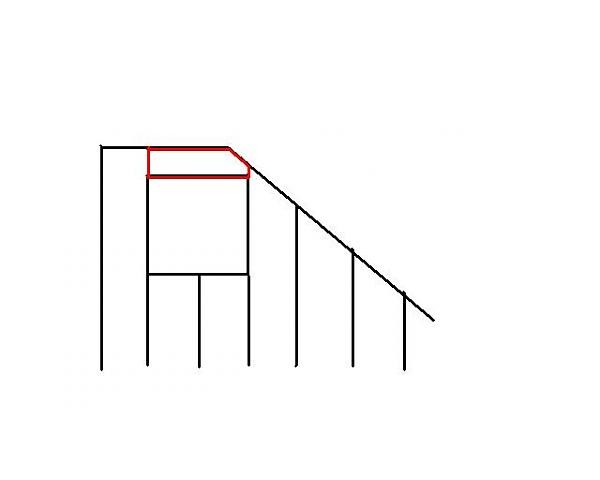

I would estimate that the distance between the top of the window and the ceiling is about 25cm
I have drawn a new picture where the plasterboards are marked in blue and pink indicating how they are intended to be placed, but how to attach them at the top (red line) is the difficult part. Or do you mean that it doesn't need to be attached and that it should be possible to plaster without it moving too much?
Also, how do you attach the crossbeam above the window if there isn't a beam where the red line is aligned?
I have drawn a new picture where the plasterboards are marked in blue and pink indicating how they are intended to be placed, but how to attach them at the top (red line) is the difficult part. Or do you mean that it doesn't need to be attached and that it should be possible to plaster without it moving too much?
Also, how do you attach the crossbeam above the window if there isn't a beam where the red line is aligned?
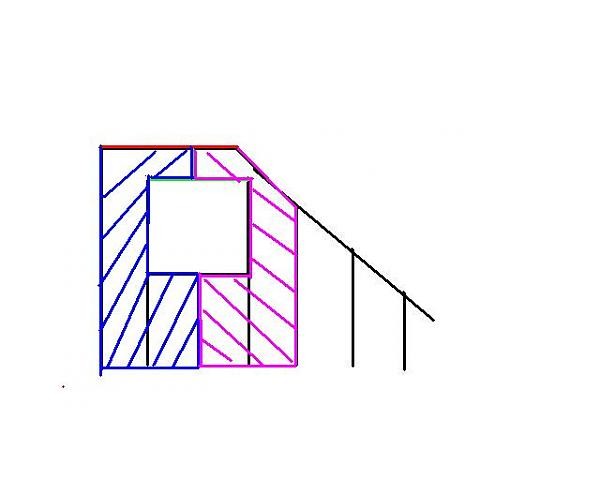

yes but it seems that the whole thing is complicated by the fact that they don't seem to have any upright studs on either side of the window.... Instead, in the sketch, it looks like it's just a frame..... If that's the case, I would redo everything.... Upright studs exactly to the right and left of a door or window opening is standard, and it's primarily to give stability to the section... Every time you close a door or window, vibrations occur.... These vibrations can trigger a host of problems in the future......
It's my drawing that is incorrect, the stud on the sides of the window goes all the way up, but there is a missing stud in the middle above the window, though there is one below, so I don't understand why they didn't do that above as well from the start.Milkshaken said:yes but it seems that the whole thing is complicated by the fact that they don't seem to have any vertical studs on either side of the window.... But in the sketch, it looks like it's just a frame..... In that case, I would redo everything if that's the case.... Vertical studs right to the right and left of a door or window opening are standard, and it's primarily to provide stability to the section... Every time you close a door or window, vibrations occur.... These vibrations can trigger a number of problems in the future......
Then you can place a kortling over it as I explained before. Why hasn't it been done??? Well, carelessness or ignorance... you should always have a rule behind a board joint, the exception might be if it's like, 5 cm in betweenträ and trä...
But if a gles is missing at the top of the window, you must put one there to create the recesses, etc., later on anyway, so it's just as well to skew-nail a gles both at the top of the window and at the bottom of the rafter, then you kotla between the boards as MoN wrote.
There's no gles missing above the window, but it's missing just under the ceiling. The trims won't be a problem. The problem is that I don't see a convenient way to nail at the bottom of the ceiling.Norell said:
Click here to reply
Similar threads
-
Adding a lot of weight to a house in the form of new framed walls with OSB and plasterboard
Building Materials and Construction Technology -
Wood studs vary in width, does it matter for the drywall?
Building Materials and Construction Technology -
Rules for fiber gypsum and distance
Building Materials and Construction Technology