
Now I have encountered a strange variant of nailed-together studs in my house so many times that I have to ask a question:
On several of my load-bearing walls, there are two pieces of 45x70 studs that are nailed together with a small piece of board between the studs that is 28x70.
Some sort of sandwich construction of the studs thus.
The follow-up question is, why is it done this way?
Does it provide greater strength then?
Why not just nail the studs directly to each other?
See attached image!
// Kim
On several of my load-bearing walls, there are two pieces of 45x70 studs that are nailed together with a small piece of board between the studs that is 28x70.
Some sort of sandwich construction of the studs thus.
The follow-up question is, why is it done this way?
Does it provide greater strength then?
Why not just nail the studs directly to each other?
See attached image!
// Kim
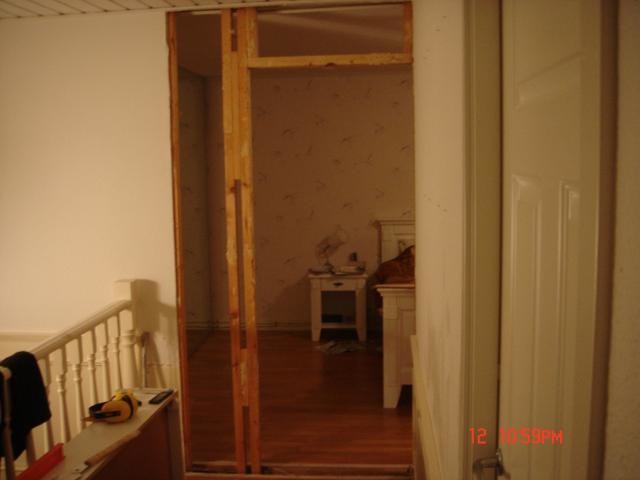
looks like there was a door there. Maybe it didn't fit with the framing, but with a 28x70 +45x70 it turned out well. There's not really any difference in load-bearing. Load-bearing interior walls in catalog houses are usually 45x95 with an embedded 45x95 in ök under the hammerbeam.
Thanks for the response!
Yes, that's absolutely correct, there used to be a door there A new door will be placed there soon, but approximately 400 mm more to the left in the image.
Regarding if the double stud would be load-bearing;
Directly above the "double stud" there's a roof truss, so I thought I would place a prop a bit further into the room at the same spot as the double stud, then nail another beam in the ceiling under the existing one. (As reinforcement since the new studs don't end up directly under the roof truss)
Afterwards, nail new studs that fit the new location for the door.
What do you think of my construction?
// Kim
Yes, that's absolutely correct, there used to be a door there
A new door will be placed there soon, but approximately 400 mm more to the left in the image.Regarding if the double stud would be load-bearing;
Directly above the "double stud" there's a roof truss, so I thought I would place a prop a bit further into the room at the same spot as the double stud, then nail another beam in the ceiling under the existing one. (As reinforcement since the new studs don't end up directly under the roof truss)
Afterwards, nail new studs that fit the new location for the door.
What do you think of my construction?
// Kim
No, in old houses it is common for some tension to develop even in non-load-bearing constructions when there has been pressure from above for several years.daviden said:
Click here to reply