Trying to construct a special roof under a patio. The patio is located above a "conservatory." The patio floor will likely consist of several "slabs" / decking wood / composite (preferably dense decking)? that lie loose for easy cleaning of the roof under the floor.
To retain ceiling height in the space under the patio, I initially planned to lay tongue-and-groove boards with a slope (about 15cm over 4 meters). This "roof" I then planned to cover with roofing felt, i.e., both floor joists and tongue-and-groove boards (and then lay the decking directly on the roofing felt over the floor joists). The floor joists should be impregnated (currently, these are 195 x 45 mm).
(Trying to figure out what spacing between the floor joists is needed to handle the load - snow slide - perhaps 30-40cm?)
But then I started looking into roofing felt and realized it won't be diffusion-open...
Felt like that construction would rot pretty quickly - or???
Then the felt will probably only be possible to lay in one direction (in several layers) - The floor joists won't stick up at all at the far end, and almost the whole floor joist will be covered at the bottom in roofing felt. I probably must also put a sheet over the ridges so the decking doesn't get stuck in the felt...
Started thinking about full sheet metal, but all the folds might be a problem?. Maybe you could skip the tongue-and-groove boards. But then condensation water might start dripping from the roof?
I'm wavering on whether to have an underside under the floor joists.. (if so, only for aesthetic reasons)
Choose EPDM rubber instead of roofing felt or sheet metal. EPDM membrane is better and cheaper than both sheet metal and roofing felt. Install a subfloor with a slope between the deck floor joists and lay the EPDM membrane over joists and subfloor. Then screw the decking over. You will need to figure out a way to collect rainwater with gutters depending on how it looks at your place. EPDM membrane can be purchased as a seamless piece via mail order at garden pond shops.
However, some questions arise.
A) What thickness would be best? (seems to range from 1mm to 20mm?)
B) Is this type of rubber mat reinforced? (dimensionally stable in all thicknesses like construction plastic?)
C) Since the base will be slanted, it will be difficult to lay something "flat" over everything. There will be significantly more EPDM on the outer part of the "roof" than on the inside. This will cause the rubber to fold/almost double on the inside.
(Does it matter? or will the membrane crease with such sharp folds?)
D) Maybe the rubber will settle "airily" around the construction when condensation forms on the underside of the membrane so that rot does not occur? (or will this moisture remain in the construction?)
E) Will the EPDM rubber withstand the point load from the snow pressure? It gets quite heavy on the decking.
There will be a drip edge on the outside to direct rainwater to the gutter.
I wasn't planning on screwing down the decking (causing "holes" in the roof &/or the rubber).
A) Max 1 mm. 0.7 mm should work fine too. I bought a 1 mm sheet from boanäs.
B) Not reinforced but it feels thick and durable. It is heavy and completely impossible to tear by hand. No issues walking on it during the building process. A major advantage of EPDM is that it is UV resistant. It doesn't age from sunlight at all and can, unlike roofing felt, lie under the decking for its entire lifespan without the material aging.
C) Calculate how long the length will be with the folds around the beams. The sheet itself becomes wider at the end. I glued with Tec7 adhesive and construction sealant around the ends so the sheet smooths out and creates a good slope. I've only reached this step because scaffolding is in the way. But the intention is to stretch out the sheet, attach the decking, pull the sheet up over the outer wall, and trim along the edges (take a little extra so it's not crucial to place it exactly right).
D) The sheet is completely waterproof. There is no condensation underneath like with metal. EPDM is used as roofing membrane on flat roofs.
E) Yes.
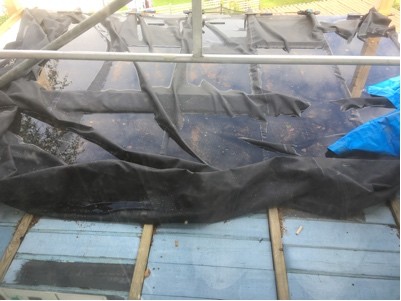
I plan to screw down the decking, I don't think much will leak through the deck screws. Attached is a picture of the sheet I've laid out provisionally. There are some things underneath, but it will be fine once it's stretched out. There's plenty of inspiration on YouTube and Pinterest for getting dry under the deck floor with EPDM.
Thanks for the pictures and for the tip to Boanas pond liner EPDM rubber
The rubber seems very compliant, according to the picture (it will probably work well for your project)
Is it a "real" roof you're working on? (Feels like it's leaning a bit)
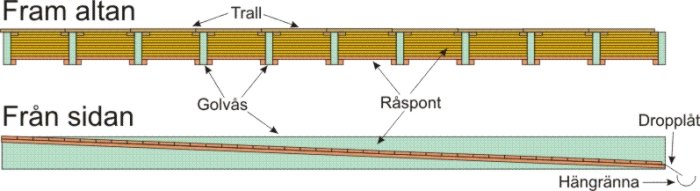
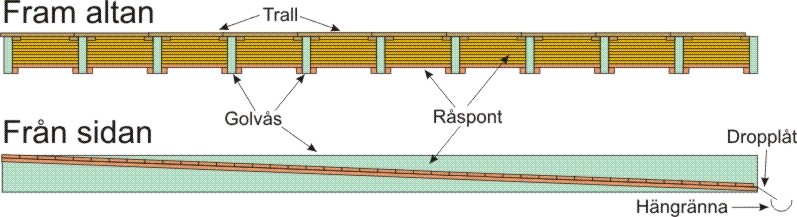
I made a sketch to try to describe my request a little better
The deck floor (decking) will cover about 4 x 4 meters (not drawn from the side in the sketch).
If the entire area is to be covered - up and down over all the floor joists, about 2.5-3m more rubber is needed at the bottom
(which must be "magically removed" - at the top)
The actual need is just to seal between the floor joists, i.e., to cover the sheathing so that rainwater does not run down underneath, would be enough for me.
- With EPDM rubber as the roof, perhaps ventilation is no longer necessary, - even though it seems to shape itself very tightly and as I understand it, the rubber is also diffusion-tight. (which I saw as a problem with roofing felt)
Why I'm considering decking on top of the joists is that leaves/seeds, etc., will fall between the gaps in the decking (I haven't found any other/better flooring that solves this) and if the need arises to clean, it becomes "easy" to lift a decking board and rinse the "roof." (how the pattern on the decking should look is not yet determined..)
I will also consider some kind of mesh at the end of the terrace, so that unwanted nests of various kinds will not end up there.
I just made a similar solution with the roof recessed between the joists. My patio is only a little over a meter high, but I store the lawnmower there and keep some pots and similar items in winter storage.
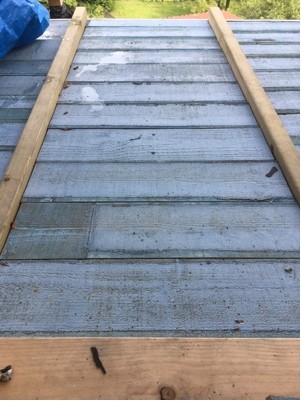
First, I thought about something with tongue and groove boards and roofing felt. But I chose a simpler solution. I bought the cheapest possible plastic roofing, cut it into strips that fit. These rest on battens that run crosswise between the joists. To seal between the plastic and the joist, I have installed window sills on the joists. This seems to be watertight.
Is it a "real" roof you're working on? (Feels like it's leaning a bit)
I have a two-story terrace and the image shows the blind bottom in the middle joist structure. The function of the blind bottom is to support the fabric so that local water puddles do not form because my slope is only 1 degree and to facilitate installation so one does not have to balance on the joists. The water is collected in a gutter outside the outermost beam line just like in your sketch. The roof of the lower terrace I will cover with wood paneling. Google epdm dry under deck and you'll find lots of American projects. I considered sheet metal, roofing felt, underlay fabric, plastic roofing, etc., between the joists but concluded that epdm would be the easiest to install, preserve the lifespan of the decking, be the most watertight, and it was also the cheapest per square meter. I'm not worried about the vapor barrier. But we'll see how it turns out, it's not finished yet...
I have a two-story deck, and the picture shows the undersurface in the floor structure. The function of the undersurface is to support the fabric so that local water puddles don't form as my slope is only 1 degree and to facilitate laying so you don't have to balance on the joists. The water is collected in a gutter outside the outermost support beam like in your sketch. The roof to the lower deck I will cover with wood paneling. Google epdm dry under deck and you'll find loads of American projects. I considered metal, roofing felt, underlayment fabric, plastic roofing, etc., between the joists but concluded that epdm would be the easiest to lay, maintain the deck's lifespan, be the most watertight, and was also the cheapest per square meter. I'm not worried about the diffusion tightness. But we'll see how it turns out; it's not finished yet...
(Fun with pictures)
Contacted Boanäs to see if the EPDM sheeting can withstand treated beams/linseed oil, etc. They responded "The issue of impregnation is difficult. The pond liner is intended for garden ponds where such chemicals are banned. However, I don't think regular wood impregnation should be a problem. When it comes to linseed oil, there is reason for caution: Synthetic rubber, like tar paper, is made from oil, so certain types of oil can affect the lifespan of the sheeting. I'm uncertain about the effect of linseed oil on EPDM sheeting, but I would avoid direct contact if possible. I believe this also applies to tar paper."
Good tip to Google epdm dry under deck, it showed several different solutions. This drainage under the floor seems more like an American preference; they seem to have more tailored products.
Looked at the Tec7 glue.
What a glue... works for everything (almost). But not on my treated floor beams... Does it work for the EPDM sheeting?
Will you @hejhopp let the entire floor slope 1 degree? (maybe you won't notice anything when walking on it?)
Hhempularen said:
... Initially thought of something with tongue and groove boards and felt. But chose a simpler solution. I bought the cheapest possible plastic roofing, cut strips to fit. These then rest on battens that run across the joists. To seal between plastic and joist, I have placed window flashings on the joists. This seems to hold tight.
Also not a bad solution, but standard window flashings are only 1 - 1.5m, right? (right now I would need about 60 * 1.5m...)
It's currently about 80cm between the beams, but it's designed with a support beam in the middle. (free span 2m)
Removed the support beam (free span 4m) and need to reinforce the floor beams so they hold when snow slides off the roof.
One idea, without being able to calculate structural integrity, was to place another floor beam in between, i.e., about 40cm spacing. (this results in 10 sections between the beams - see sketch above).
Would it be just as strong to place the floor beams close together? (still cc 75 - or whatever it becomes)? This would halve the number of sections between the beams... (but I'll start a new question on this)
When I read about Tec7 glue, they mentioned ship flooring... Maybe this is what I should aim for? Tilt it a degree so the water runs outward....
Very interesting proposition. The more I have looked at the solution, the better it seems. All the water will be collected in a "gutter" and in turn, this means that the underlay is likely to stay "cleaner." If one wants to use the "garden hose" solution for cleaning, that also works better with a defined gutter. The sheet metal also seems to be treated so that no galvanic currents arise between the metal and the impregnated joists (with a lot of different metals). The solution also seems so thoughtful that there will never be more than 2 layers of metal on top of the beams. (The height difference of the metal will probably also be negligible - about 0.5mm.). Something I've considered is whether "condensation drops" will form from the metal. But in my case, I don’t think that will happen, because the temperature difference above and below the metal will be marginal. I will probably choose this solution. (But first, I need to decide which type of floor I want - maybe I'll spend the money on a tighter floor?)
Click here to reply
Vi vill skicka notiser för ämnen du bevakar och händelser som berör dig.




Gammelnörden said: