78,607 views ·
78 replies
79k views
78 replies
Tear down load-bearing wall, install HEA Beam at 6 meters?

The ground snow load value is 2.5 kN/sqm in Kristinehamn. Considering the roof design, one can estimate 2 kN/sqm. I guess the roof structure weighs 1 kN/sqm. Based on the drawing's measurements, one can then assume that a 3.5 m long beam will have a maximum load of just under 14 kN/m. An IPE 160 will then have a maximum deflection of about 15 mm, which corresponds to 1/233 of the span, which is a bit much for a beam that in turn supports roof trusses. With an IPE 180, the deflection will be about 10 mm. The roof won't collapse with IPE 160, but it's not optimal either.

Interesting and probably a good calculation. I will see if they can get HEA160 or IPE180 just to be safe.J justusandersson said:The snow load value on the ground is 2.5 kN/sqm in Kristinehamn. Taking the roof design into account, you can estimate 2 kN/sqm. I guess the roof structure weighs 1 kN/sqm. Based on the drawing's dimensions, you can then assume that a 3.5 m long beam will have a maximum load of just under 14 kN/m. An IPE 160 will then have a maximum deflection of about 15 mm, which corresponds to 1/233 of the span, which is a bit much for a beam that in turn supports roof trusses. With an IPE 180, the deflection is about 10 mm. The roof won't collapse with IPE 160, but it's not optimal either.
Then your calculation must come close to the value for glulam 60x315?
Yes, it's in the same härad.
So now it's both belt and suspenders
Thank you so much for all the help
I am planning to extend the balcony from 2 m deep to 3.5 m in the spring. It is a welded I-beam construction that stands on 3 legs at the front and is bolted to the brick façade at the back.
The extension is planned with the same beam horizontally and 45-degree struts against the legs. Interested in calculating it if you get proper groundwork?
Have a nice weekend /Magnus
Thank you so much for all the help
I am planning to extend the balcony from 2 m deep to 3.5 m in the spring. It is a welded I-beam construction that stands on 3 legs at the front and is bolted to the brick façade at the back.
The extension is planned with the same beam horizontally and 45-degree struts against the legs. Interested in calculating it if you get proper groundwork?
Have a nice weekend /Magnus
Come on! Have a nice weekend too!

interesting, we currently have an hea-160 embedded in the floor structure which is at 3.4m, we want to replace this to 4.8mE Evamag said:We have just completed an opening of 5.8 which we are supporting with an HEA bslk. We also have low ceilings, so glulam was out of the question. The beam rests on 95x95 supports that are built into the walls. Supports to the rafters. We had to tear down the entire ceiling and build the supports into the walls. When everything is done, hardly anything will be visible.
Do you have more info on how the whole work went, and also pictures? You can pm if you prefer.

Hello everyone!
I need some help figuring out what type/size of wooden beam we need to install in our house. It could also be in metal, like HEA200. The house was built in 1975, 1 1/2 story house.
The opening will be 5m long.
I will upload some pictures with measurements. If someone knowledgeable in this can provide good advice, it would be greatly appreciated.
I need some help figuring out what type/size of wooden beam we need to install in our house. It could also be in metal, like HEA200. The house was built in 1975, 1 1/2 story house.
The opening will be 5m long.
I will upload some pictures with measurements. If someone knowledgeable in this can provide good advice, it would be greatly appreciated.
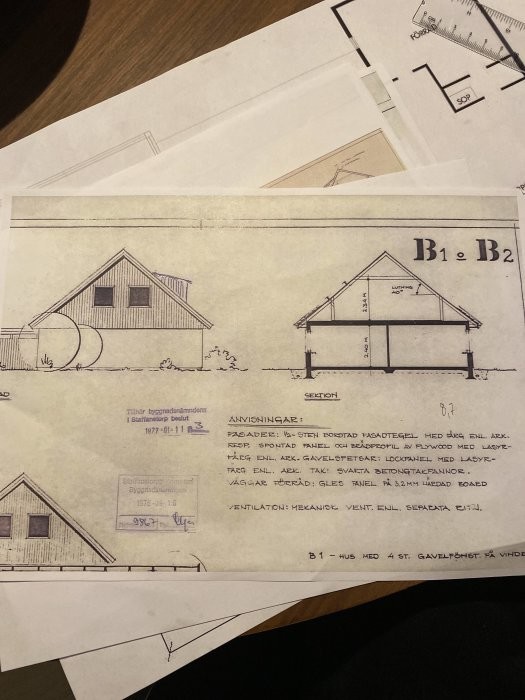
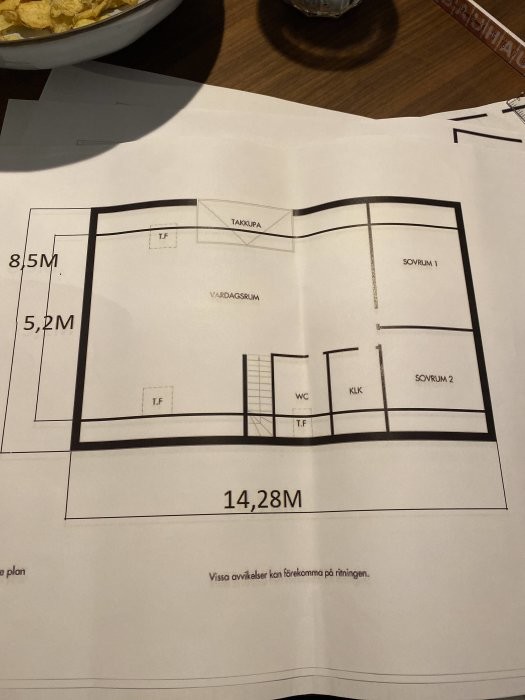
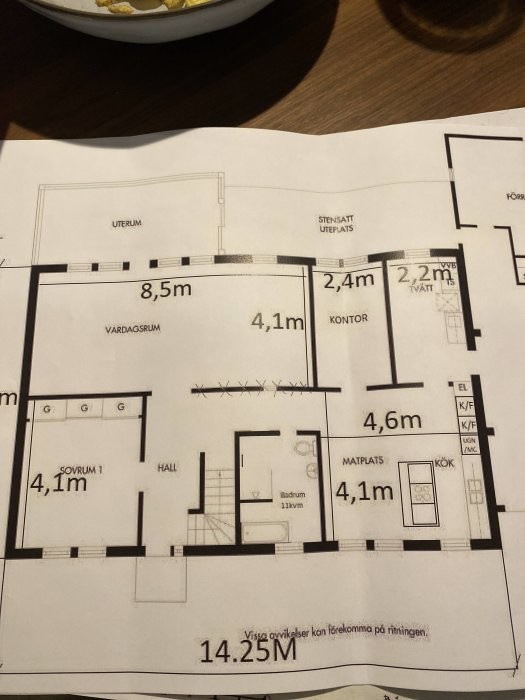
These will be quite substantial items. In snow zone 2 and with a roof slope of max 30°, it involves glulam 215x405 or HEA 220. I would question the point of this measure. The living room will be less furnishable and the door to the bathroom will lead directly into a furnished space. Additionally, the drawing is not correct. It is a realtor's drawing. The stairs to the upper floor are incorrectly drawn. You need to have a correct drawing as a basis for such a decision.
J justusandersson said:These are quite substantial elements. In snow zone 2 and with a roof slope of a maximum of 30°, it's about glulam 215x405 or HEA 220. I would question the point of this measure. The living room becomes less furnishable and the door to the bathroom will lead directly to a furnished space. Also, the drawing is not correct. It's a realtor's drawing. The staircase to the upper floor is misdrawn. You need a correct drawing as a basis for such a decision.
J justusandersson said:These are quite substantial elements. In snow zone 2 and with a roof slope of a maximum of 30°, it's about glulam 215x405 or HEA 220. I would question the point of this measure. The living room becomes less furnishable and the door to the bathroom will lead directly to a furnished space. Also, the drawing is not correct. It's a realtor's drawing. The staircase to the upper floor is misdrawn. You need a correct drawing as a basis for such a decision.
Hi, I know these are not accurate drawings.J justusandersson said:These are quite substantial elements. In snow zone 2 and with a roof slope of a maximum of 30°, it's about glulam 215x405 or HEA 220. I would question the point of this measure. The living room becomes less furnishable and the door to the bathroom will lead directly to a furnished space. Also, the drawing is not correct. It's a realtor's drawing. The staircase to the upper floor is misdrawn. You need a correct drawing as a basis for such a decision.
The house is located in snow zone 1 and the roof slope is 40 degrees.
The point of doing this is to get a feeling of an open-plan living area and thereby have the possibility to have a proper kitchen island without it feeling cramped.
So you are thinking of an HEA 220. How do you think it would be if we chose to put a post in the middle of the opening? Then it would be 2.5m on each side.
Appreciate your engagement.
A post in the middle gives completely different conditions. Then you can manage with modest 90x270 in glulam or HEA 140. Glulam is preferable because it makes connections to the posts easier. Regardless of whether you have two or three posts, you must check that the foundation under the slab can handle the point loads that will be relevant.
Thanks for the response.J justusandersson said:A post in the middle provides completely different conditions. Then, you could manage with modest 90x270 in glulam or HEA 140. Glulam is preferable as it simplifies the connections to the posts. Regardless of whether you have two or three posts, you need to check that the footing under the slab can handle the point loads that will be present.
So you believe in an HEA240 if we have two posts and 90x270 if we have three posts.
Do you have any experience with 70s houses regarding point loads?
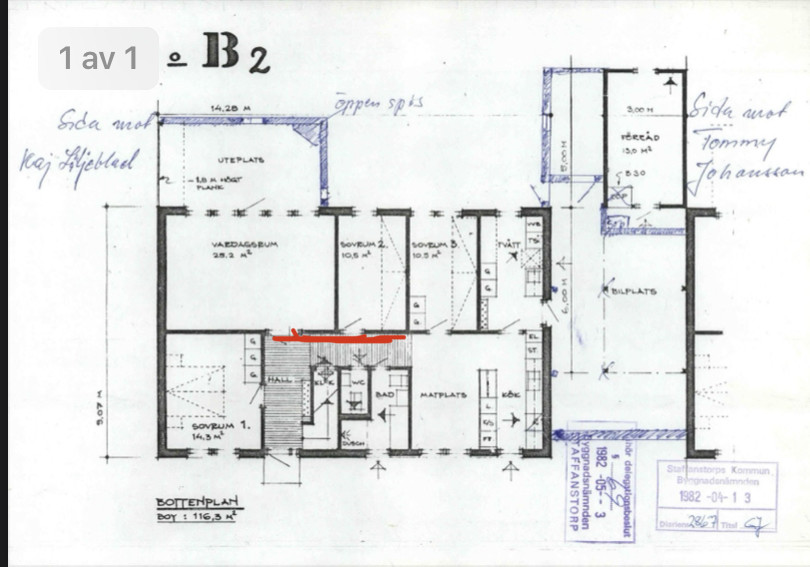
I have an old drawing of the house where it is clearly shown that it is reinforced in the middle too.
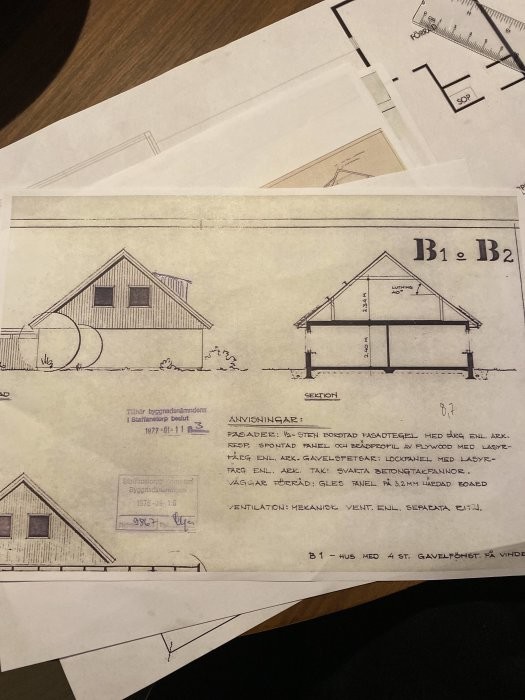
There are probably not two houses that are the same in that respect. It depends a lot on the current snow zone. You need to look at the K-drawing or the technical description. One plus is that it was more stringent what was submitted to the municipality at that time regarding construction calculations. The largest point load will be in the size of 50 kN.
Thanks for the response. I'll have to chase them a bit at the municipality.J justusandersson said:There are probably no two houses that are alike in this respect. It depends a lot on the current snow zone. You have to look at the K-drawing or the technical description. An advantage is that it was more careful what was submitted to the municipality at that time in terms of construction calculations. The largest point load will be around 50 kN.
Hello again, I have got hold of another picture that might say something more on this issue.J justusandersson said:There are probably no two houses that are alike in that respect. It depends greatly on the current snow zone. You have to check the K-drawing or the technical description. An advantage is that it was more meticulous what was submitted to the municipality at that time regarding structural calculations. The largest point load will be around 50 kN.