
5,759 views ·
26 replies
6k views
26 replies
Restoring reinforcement in wall after craftsmen
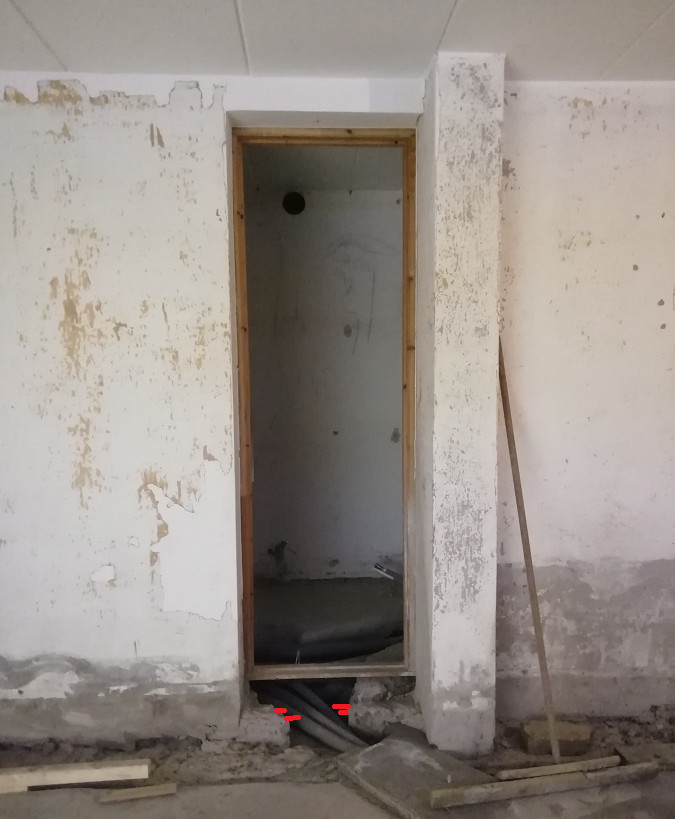
It's a central wall in a basement.E El-Löken66 said:Yes, it's crazy, the plumbing company won't pay in any case. First, they should be given the opportunity to rectify deficiencies, secondly, this won't be considered as such; it's good that you have protruding iron so you can fixate your reinforcement mesh.
But perhaps it would have been possible to thread the pipes underneath by chiseling around, but that would have meant more working hours.
The plumbing company was not interested in finishing. Or taking responsibility for the solution.
The pipes run freely under the reinforcement.
I can't understand how one considers this a well-executed job?
But what was said about restoration?KJD said:
It might not have been possible to thread the pipes without getting unnecessary joints
Member
· Västra Götaland
· 1 849 posts
The hole is in a doorway, the cut rebar most likely has no practical significance at all.
Just pour it again, throw in some rebar if you want.
I think the work looks perfectly fine, you're worrying unnecessarily.
Just pour it again, throw in some rebar if you want.
I think the work looks perfectly fine, you're worrying unnecessarily.
When you say "overlapping the bars," do you mean that they just really overlap/overlap lengthwise, or are you also referring to some form of fastening/type of tying?W witten said:Simplified, it's force reinforcement that needs to be spliced to maintain the full force, and you do this by overlapping the bars. The splices you've found are expensive special products used in sectioned beams, etc.
Crack reinforcement also needs to be spliced but we can leave that aside for your situation, it mostly concerns the casting phase.
Bear with my questions, I am ignorant (I know
 ), I just want to understand and be able to convince myself. Also, I want to be sure that I don't leave any mistakes (both for ourselves, and if one were to sell at some point).

We need to see a few more pictures to understand the whole, not close-ups.
It is the concrete that gives the wall compressive strength, not the irons.
The natural seems to be to just formwork and pour back some concrete and then plaster to get a nice surface finish, but as mentioned, you need to see a bit more to have an opinion.
It is the concrete that gives the wall compressive strength, not the irons.
The natural seems to be to just formwork and pour back some concrete and then plaster to get a nice surface finish, but as mentioned, you need to see a bit more to have an opinion.
Reinforcement is spliced by overlapping the irons, it is also possible to calculate how long the overlap needs to be using formulas in Eurocode if they are tensile irons in a beam, for example. Tying is only to ensure the reinforcement doesn't collapse before casting and has nothing to do with strength.When you say "lap the irons" are you referring to them just actually overlapping/overlapping in the longitudinal direction - or are you also referring to some form of fastening/type of tying then?
Please bear with my questions, I am ignorant (I know that
As long as this isn't a piled foundation, you don't need to worry, but I also don't like it when craftsmen go in and cut the reinforcement with a shrug. They often don't have a grasp of what function all types of reinforcement have. After all, it's often interventions in a load-bearing structure that is in question.
what remains of the bars is at the bottomW witten said:Reinforcement is spliced by overlapping the bars, and you can also calculate how long the overlap needs to be using formulas in Eurocode if it is a tension bar in a beam, for example. Tying is just to ensure the reinforcement doesn't collapse before casting and has nothing to do with the strength.
As long as this is not a piled foundation, you don't need to worry, but I also don't like when craftsmen cut reinforcement with a shrug. They often don't know the function of all types of reinforcement. After all, it's often interventions in a load-bearing structure that we're talking about.
Member
· Västra Götaland
· 1 849 posts
Ok, yes if it's in the corner to the right of that door, then just restore the wall with concrete or whatever fits - you can completely disregard the rebars. Besides the fact that it has absolutely no significance for the wall as a whole that the rebars are cut like that, you also have a buttress, an angled wall supporting that wall => everything is all good and you can go ahead without fussing with these rebars.

"Then the plumbing company will have to pay anyway". Are you so sure about that? One thing is certain, however. It is that: -you are worried! Usually, I am not impressed by the ability of Swedish craftsmen or their interest in earning their pay. BUT, in this case, the trade is innocent of all accusations from you regarding the reinforcement. So drop it and seal it again.You are probably worried because it's your own house, but you want to be able to stand by it later as well. Then the plumbing company will have to pay anyway. There wouldn't have been any problems at all to break away the concrete and squeeze the pipes underneath. So it's an execution error as I see it.
Staffan
It is simple, the contractor is responsible for their work and any consequences for ten years.
Reinforcement may be pointless or completely essential, you only know if you have access to the construction documentation.
If the client has now pointed out a fault/deviation, the contractor should be able to demonstrate, preferably with a statement from an expert engineer, that the execution is okay or just take responsibility and restore.
A cheerful okay from a forum where a number of contractors and their friends are trolling around I would not take as truth.
Reinforcement may be pointless or completely essential, you only know if you have access to the construction documentation.
If the client has now pointed out a fault/deviation, the contractor should be able to demonstrate, preferably with a statement from an expert engineer, that the execution is okay or just take responsibility and restore.
A cheerful okay from a forum where a number of contractors and their friends are trolling around I would not take as truth.
Click here to reply