
11,502 views ·
4 replies
12k views
4 replies
Replaster the entire basement wall?

I am in the process of removing the interior plaster in an uninsulated basement. The parts of the wall that are above ground are dry and fine without plaster detachment. How do you think I should treat them? Struggle to remove all the plaster or just sand off the paint?
My requirement for the finished surface is that I would prefer not to see seams, but the surface can be somewhat rough.
Tips and suggestions are greatly appreciated.
Regarding plaster choice for restoration, I have very good references for a product called Mapei antique. It reportedly adheres well even on very damp substrates without discoloration for many years.
Does anyone know if our Swedish producers have a similar product? (I do not know what it contains)
My requirement for the finished surface is that I would prefer not to see seams, but the surface can be somewhat rough.
Tips and suggestions are greatly appreciated.
Regarding plaster choice for restoration, I have very good references for a product called Mapei antique. It reportedly adheres well even on very damp substrates without discoloration for many years.
Does anyone know if our Swedish producers have a similar product? (I do not know what it contains)
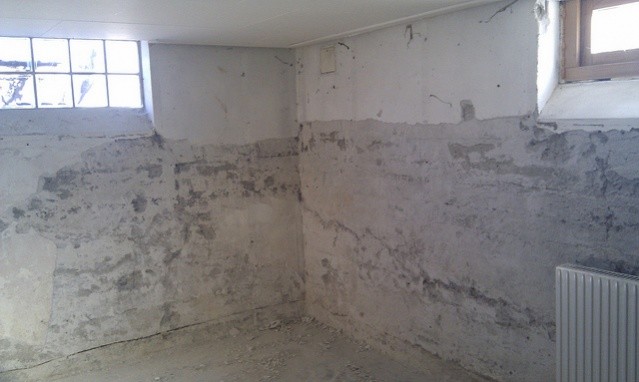
What color and plaster are on the walls today?
It is most appropriate to use the same type of plaster that is already there. I guess it's lime plaster, and there is no reason in the world for you to use anything else during renovation.
The plaster that is well adhered can stay, but not the paint if it has been too tight and caused plaster failure at the lower part.
Then you can re-plaster the whole thing: thicker (2 coats?) where the old plaster is gone, and thinner just to even out surfaces where you have scraped off the paint. Pre-wet the old plaster thoroughly as it will absorb well from the new one, and the plaster will come off if it is drained of water prematurely. Post-wet generously for a few days where it dries the fastest.
Be careful with products with strange names . Lime plaster is simple, and you know what you get. Antique???? will check what that is
Then you should choose the right paint for your newly plastered wall so that it lasts for many years to come. Lime paint or silicate are suitable in a basement with moderate moisture migration. If you choose silicate, wait a few months until the plaster has cured and bonded.
It will look nice when you're done
gaia
It is most appropriate to use the same type of plaster that is already there. I guess it's lime plaster, and there is no reason in the world for you to use anything else during renovation.
The plaster that is well adhered can stay, but not the paint if it has been too tight and caused plaster failure at the lower part.
Then you can re-plaster the whole thing: thicker (2 coats?) where the old plaster is gone, and thinner just to even out surfaces where you have scraped off the paint. Pre-wet the old plaster thoroughly as it will absorb well from the new one, and the plaster will come off if it is drained of water prematurely. Post-wet generously for a few days where it dries the fastest.
Be careful with products with strange names
. Lime plaster is simple, and you know what you get. Antique???? will check what that is Then you should choose the right paint for your newly plastered wall so that it lasts for many years to come. Lime paint or silicate are suitable in a basement with moderate moisture migration. If you choose silicate, wait a few months until the plaster has cured and bonded.
It will look nice when you're done
gaia
Hello.
Thank you for a comprehensive response with good tips and advice.
The reason I am considering a "superduperprodukt" is that I expect continued high moisture levels in the lower part of the wall.
Even when using silicate paint on a traditional plaster system, there will likely be discoloration and efflorescence in the floor/wall angle.
I do expect this and realize that some ongoing maintenance is required.
However, colleagues of mine have followed projects in truly problematic buildings where the Mapei product has been used. Even 12 years after the measure, there are no signs of efflorescence, etc.
Unfortunately, info is probably only available on the Italian page. Not on the Nordic ones, I recall.
http://www.mapei.it/Referenze/Multimedia/607_mapeantiquerinzaffo_gb.pdf
/David
Thank you for a comprehensive response with good tips and advice.
The reason I am considering a "superduperprodukt" is that I expect continued high moisture levels in the lower part of the wall.
Even when using silicate paint on a traditional plaster system, there will likely be discoloration and efflorescence in the floor/wall angle.
I do expect this and realize that some ongoing maintenance is required.
However, colleagues of mine have followed projects in truly problematic buildings where the Mapei product has been used. Even 12 years after the measure, there are no signs of efflorescence, etc.
Unfortunately, info is probably only available on the Italian page. Not on the Nordic ones, I recall.
http://www.mapei.it/Referenze/Multimedia/607_mapeantiquerinzaffo_gb.pdf
/David
Member
· Västra Götaland
· 525 posts
Hello,
I underwent the exact same operation that you are about to do and was torn between knocking everything down or saving some parts. I ended up removing everything down to the concrete hollow blocks. It looks like you have concrete hollow blocks too? Then I plastered with render and mortar C. It's significantly harder than the old lime plaster, which means you need to be meticulous about removing all the old material. If there's old, softer plaster behind it, it will eventually come off. I could have patched and repaired the old after sanding off the paint but assessed that it would have been at least as much work, if not more. Plus, I was annoyed that the old plaster was so soft, making it a hassle to mount anything on the wall. Moreover, the plaster was extremely thick, so the plugs barely reached the stone behind when trying to screw something in.
I use a fraction of 0-3 mm on the plaster and find that it provides a suitably rough surface. If you want a finer finish, you can apply a thinner layer with 0-1 mm on top to get it really smooth.
I have now plastered 3 out of 4 walls in the room and am starting to get the hang of it. The first wall didn't turn out so well, the second better, and the third I'm almost satisfied with. The last wall will hopefully be perfect. It will be painted with silicate paint afterwards, and the floor will get tiles.
I underwent the exact same operation that you are about to do and was torn between knocking everything down or saving some parts. I ended up removing everything down to the concrete hollow blocks. It looks like you have concrete hollow blocks too? Then I plastered with render and mortar C. It's significantly harder than the old lime plaster, which means you need to be meticulous about removing all the old material. If there's old, softer plaster behind it, it will eventually come off. I could have patched and repaired the old after sanding off the paint but assessed that it would have been at least as much work, if not more. Plus, I was annoyed that the old plaster was so soft, making it a hassle to mount anything on the wall. Moreover, the plaster was extremely thick, so the plugs barely reached the stone behind when trying to screw something in.
I use a fraction of 0-3 mm on the plaster and find that it provides a suitably rough surface. If you want a finer finish, you can apply a thinner layer with 0-1 mm on top to get it really smooth.
I have now plastered 3 out of 4 walls in the room and am starting to get the hang of it. The first wall didn't turn out so well, the second better, and the third I'm almost satisfied with. The last wall will hopefully be perfect. It will be painted with silicate paint afterwards, and the floor will get tiles.
found Mapei Antique and discovered information in English stating that it is cement-free... so that's good. There is a product from the Antique series used for a thin layer (5mm) and then another product to plaster over the first one. The barrier is supposed to bind chloride salts (in Venice?) and prevent them from penetrating. I guess it's hydraulic lime + additives like reinforcing fibers and other things that make it easier to work with.
Your walls in the picture don't look too frightening. If it was a tight paint that prevented moisture migration in your case, then just the fact that the paint is gone allows the wall to start drying after years of suffocation. It may not be as bad as you suspect. Just let it sit and breathe for a while, and see if it gets better or worse. Yes, the walls closest to the floor are most exposed to moisture migration, but if the plaster allows vapor to pass through, it doesn't show, at least not for me. I have a bit of paint peeling in one place, which I think I painted too early, or that Beckers silicate paint is some sort of poor mixture. Luckily, the rest of the basement was painted with another brand (foreign and smelly for outdoor use but holds up well).
Twelve years ago, lime plaster was a forgotten material here, and cement mixes were number one on the market. Then it was discovered that lime plaster has many advantages when used in the right places, and new lime products emerged. When I searched for lime plaster in well-stocked building markets 8 years ago, there was only burnt lime in a 10kg bag far back in the warehouse - minimal demand in the land of wooden houses. Maybe sold mostly to make lime paint for liming stable walls. I had to mix my own lime plaster from raw material, i.e., lime powder + sand + water. Today, there's more to choose from from Maxit and others.
If you're not planning to tile the walls, lime plaster is perfectly OK. If you're going to have tiles, you can choose a stronger hydraulic lime plaster. That's how I chose to the best of my ability, but the hydraulic is only 1 year old, so I can't give any recommendations today. However, my lime plaster has been nicely in place for 7-8 years even in places where I didn't think it would hold up. I had damages caused by plastic paint and cement filler at the base of the floors, where the plaster had turned into loose, wet sand.
When you buy ready-mixed, you'll face the choice of grain size in the plaster. If you want to do it like the old masters, go for coarser as the first layer where you've removed plaster, and the finer as a final finish on new and old plaster to get a fine surface and no seams either. Hope you report on the Mapei products if you get hold of them and aren't scared off by their prices . I'm just guessing they're adapted for high building tempo and offer shorter waiting times than with ordinary lime plaster without additives. If you have time and no seawater near the house corner, maybe the regular one suffices too .
gaia.
Your walls in the picture don't look too frightening. If it was a tight paint that prevented moisture migration in your case, then just the fact that the paint is gone allows the wall to start drying after years of suffocation. It may not be as bad as you suspect
. Just let it sit and breathe for a while, and see if it gets better or worse. Yes, the walls closest to the floor are most exposed to moisture migration, but if the plaster allows vapor to pass through, it doesn't show, at least not for me. I have a bit of paint peeling in one place, which I think I painted too early, or that Beckers silicate paint is some sort of poor mixture. Luckily, the rest of the basement was painted with another brand (foreign and smelly for outdoor use but holds up well). Twelve years ago, lime plaster was a forgotten material here, and cement mixes were number one on the market. Then it was discovered that lime plaster has many advantages when used in the right places, and new lime products emerged. When I searched for lime plaster in well-stocked building markets 8 years ago, there was only burnt lime in a 10kg bag far back in the warehouse - minimal demand in the land of wooden houses. Maybe sold mostly to make lime paint for liming stable walls. I had to mix my own lime plaster from raw material, i.e., lime powder + sand + water
. Today, there's more to choose from from Maxit and others.If you're not planning to tile the walls, lime plaster is perfectly OK. If you're going to have tiles, you can choose a stronger hydraulic lime plaster. That's how I chose to the best of my ability, but the hydraulic is only 1 year old, so I can't give any recommendations today. However, my lime plaster has been nicely in place for 7-8 years even in places where I didn't think it would hold up. I had damages caused by plastic paint and cement filler at the base of the floors, where the plaster had turned into loose, wet sand.
When you buy ready-mixed, you'll face the choice of grain size in the plaster. If you want to do it like the old masters, go for coarser as the first layer where you've removed plaster, and the finer as a final finish on new and old plaster to get a fine surface and no seams either
. Hope you report on the Mapei products if you get hold of them and aren't scared off by their prices . I'm just guessing they're adapted for high building tempo and offer shorter waiting times than with ordinary lime plaster without additives. If you have time and no seawater near the house corner, maybe the regular one suffices too .gaia.
Click here to reply