
27,501 views ·
5 replies
28k views
5 replies
Replaster interior basement wall?
Hello everyone. I am planning an office in a basement storage room. Currently, it seems like it was once painted with some kind of plastic paint on all the walls. The outer wall seems to have gotten a round of moisture before it was drained, which makes it sound hollow when you knock on the wall, and large pieces of plaster are coming off at the bottom. See attached image.
My questions are:
How do you go about plastering the walls?
Is it something a DIY enthusiast can handle on their own?
What products should be used?
What do you do with the other walls that are painted with the same plastic paint? Do you sand these?
My questions are:
How do you go about plastering the walls?
Is it something a DIY enthusiast can handle on their own?
What products should be used?
What do you do with the other walls that are painted with the same plastic paint? Do you sand these?
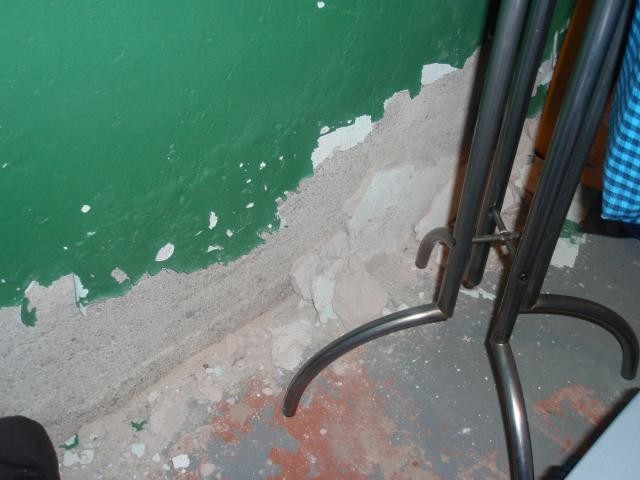
The likely explanation is that this is lime mortar. It becomes porous over time, especially where there is moisture movement. The picture doesn't reveal if it's damp or not, but I think it looks quite normal. At the bottom of the basement wall, this is common, especially where floors have been painted. The moisture is forced up where the wall meets the floor. Unfortunately, there might be more spots where it sounds "hollow." You can hear it quite clearly if you tap lightly on the wall. It sounds hollow compared to where the plaster sticks well. Unfortunately, there are no direct shortcuts, and you have a dusty job ahead of you. What you need to do is chip away the loose spots and replaster. And lime mortar dusts like hell. I have EXACTLY the same problem, I can tell you. So we are in the same boat if that's any consolation. I tried sanding off the paint - it didn't work. Then I tried a heat gun, but that didn't work either. I haven't tried using gas, though. I just had to scrape down the mess. And man, was I dirty. If you finally decide to remove all the plaster, I can't recommend putting lime plaster back on as I did without thinking ahead. Now, my wife wants tiles on the wall. Instead, use cement-based. Then you can tile directly without worrying whether it will hold or not. It SEEMS the level of knowledge both among tile setters and here on the forum is quite low when it comes to lime mortar. I've been in contact with several tile-setting professionals and keep getting different answers. Some say tear it down and start over; others say keep it. What you should use is hydraulic lime mortar. Maxit Serpo 148 or similar. Plastering this is a messy business at first, but eventually, you get the hang of it and can throw it up and smooth it out. Buy a large flat trowel (or whatever it's called) and hold it at a 45-degree angle off the wall with both hands. Start from the bottom. Then let someone (like a wife) put a hefty scoop of mortar on it. Pull upward and smooth it out. It takes a few scoops to get it right. Then the wife can go do something else.
Hello Knecke,
As mentioned, this is definitely a dusty job, but it must be done to prevent the wall from getting worse. What I would recommend is sanding the walls with a renovation grinder or diamond sander with a dust extractor to remove the paint. You will also remove the loose parts of the wall, the so-called bom.
Then you just need to fill in the large holes and apply a new surface layer to the walls or just brush on a new thin layer with a suitable plaster. This is unless the substrate is completely inadequate, in which case you need to remove all the plaster with, for example, a chisel hammer and replaster from scratch, but as mentioned, this is a lot of work.
It is perfectly fine to use a steel trowel to apply the plaster, as erber talked about in the previous post, but needing hydraulic lime mortar for this work is overly advanced; regular Kalkcement C works perfectly. And if you want to go really thin, there are many special variants on the market.
Be thorough, it pays off with plastering... and there's always a bit of extra charisma with a bit of life in the plaster!
Take care!!
As mentioned, this is definitely a dusty job, but it must be done to prevent the wall from getting worse. What I would recommend is sanding the walls with a renovation grinder or diamond sander with a dust extractor to remove the paint. You will also remove the loose parts of the wall, the so-called bom.
Then you just need to fill in the large holes and apply a new surface layer to the walls or just brush on a new thin layer with a suitable plaster. This is unless the substrate is completely inadequate, in which case you need to remove all the plaster with, for example, a chisel hammer and replaster from scratch, but as mentioned, this is a lot of work.
It is perfectly fine to use a steel trowel to apply the plaster, as erber talked about in the previous post, but needing hydraulic lime mortar for this work is overly advanced; regular Kalkcement C works perfectly. And if you want to go really thin, there are many special variants on the market.
Be thorough, it pays off with plastering... and there's always a bit of extra charisma with a bit of life in the plaster!
Take care!!
I'm borrowing your thread a bit
I'm also in the process of converting part of the basement into an office. On all the concrete walls, there is wallpaper today that needs to be removed with a steam machine. But then under the wallpaper, the wall is a bit uneven, but very slightly.
What should I use to fix the walls? I also have some small bubbles on another basement wall that need to be fixed too. I think there's some kind of plastic paint on that wall. Doesn't look quite as bad as yours, Knecke.
I'm also in the process of converting part of the basement into an office. On all the concrete walls, there is wallpaper today that needs to be removed with a steam machine. But then under the wallpaper, the wall is a bit uneven, but very slightly.
What should I use to fix the walls? I also have some small bubbles on another basement wall that need to be fixed too. I think there's some kind of plastic paint on that wall. Doesn't look quite as bad as yours, Knecke.
I had similar damage in my basement. I hadn't tried plastering before, but took it on anyway. First, knock down all the old plaster so the brickwork is visible. Then I got Plastering Mortar C and got started. Messy but fun!Knecke said:Hello everyone. I am planning an office in a basement storage room. As it stands, it seems to have been painted with some plastic paint a long time ago on all the walls. The outer wall seems to have gotten a bout of moisture before it was drained, which makes it sound hollow when knocked on, and at the bottom, large chunks of plaster are coming off. See attached image.
My questions are:
How do you go about plastering the walls?
Is it something a DIYer can handle on their own?
What products should be used?
What do you do with the other walls that are painted with the same plastic paint? Do you sand them?
Click here to reply