
1,075 views ·
3 replies
1k views
3 replies
Renovation of intermediate floor - tips
Hello Byggahus,
I recently acquired a house, a two-story built in '98. During the winter, it was chilly upstairs. I've now decided to tear up the floor (which is worn out anyway) and subfloor to install grooved chipboard and water-based underfloor heating.
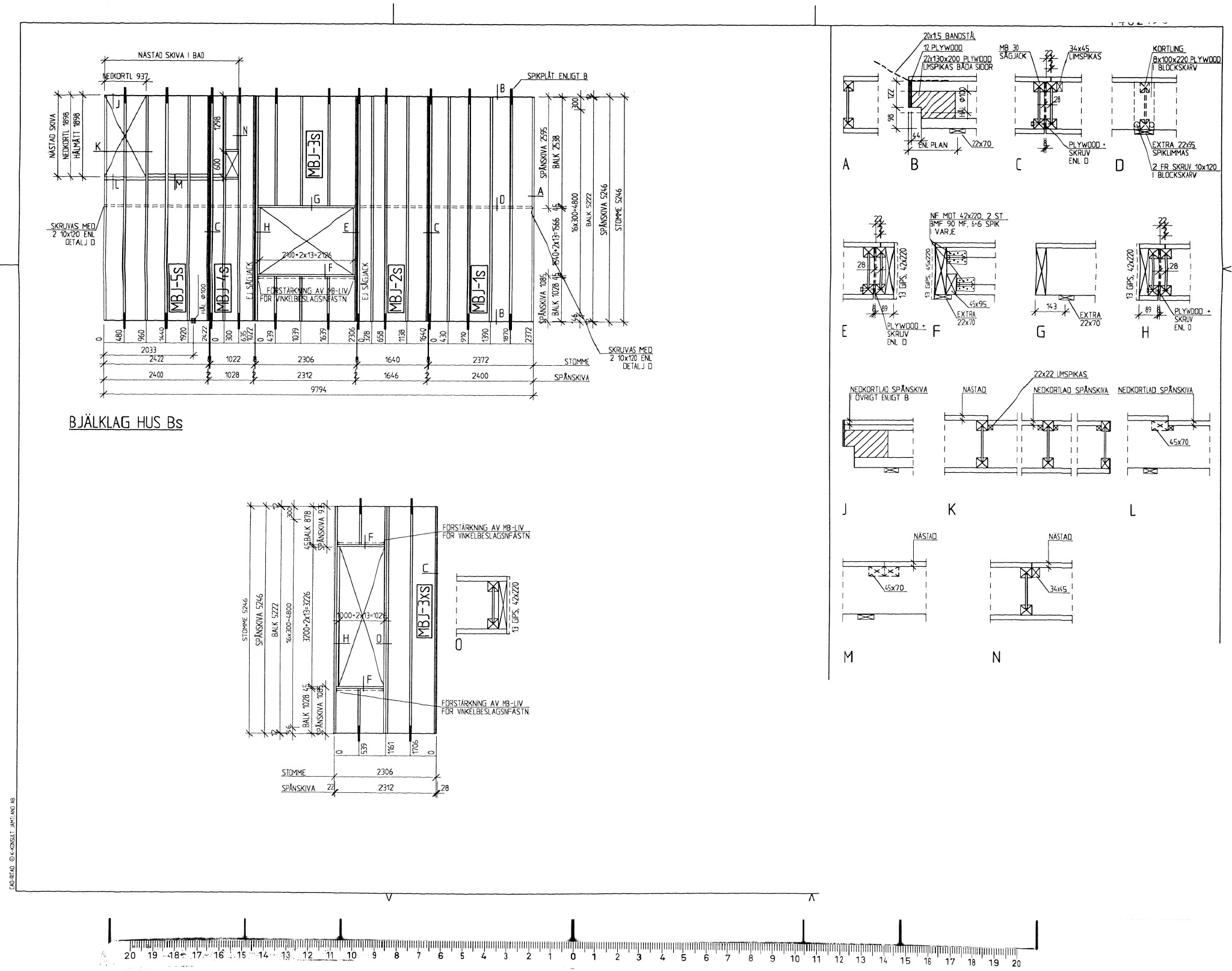
The intermediate joist floor currently consists very simply of lightweight beams with subfloor and then flooring on top. In some places, it sounds hollow (like a box) when you walk on it. I see on the building plan that the spacing is somewhat wider between the beams (600 mm) compared to elsewhere, see picture around the staircase.
What I am wondering from the forum is, what should I seize the opportunity to improve while I have the intermediate joist floor open? What "low-hanging" improvements should I consider? Insulation in terms of sound and thermal barrier between floors? Would it be beneficial to add bridging between beams where it is extra wide?
Grateful for responses!
I recently acquired a house, a two-story built in '98. During the winter, it was chilly upstairs. I've now decided to tear up the floor (which is worn out anyway) and subfloor to install grooved chipboard and water-based underfloor heating.
The intermediate joist floor currently consists very simply of lightweight beams with subfloor and then flooring on top. In some places, it sounds hollow (like a box) when you walk on it. I see on the building plan that the spacing is somewhat wider between the beams (600 mm) compared to elsewhere, see picture around the staircase.
What I am wondering from the forum is, what should I seize the opportunity to improve while I have the intermediate joist floor open? What "low-hanging" improvements should I consider? Insulation in terms of sound and thermal barrier between floors? Would it be beneficial to add bridging between beams where it is extra wide?
Grateful for responses!
Last edited:
As far as I can see, there is only one place where it is more than 600 mm, and it is, as you say, by the stairwell where it is 670 mm. Otherwise, it ranges from 600 to 300 mm c/c measurements on your beams, so I don't see a significant need for noggings unless you feel it is sagging. On one side of that gap, it appears to be doubled with double light beams and a stud throughout (see section E).
Does the floor sag in the section where you have a slightly larger gap? If so, perhaps an additional stud is appropriate there, but not otherwise. The house doesn't seem very wide, and there is a supporting wall holding up the floor structure if I'm interpreting the drawing correctly.
When it comes to insulation between the upper and lower floors, there's probably no significant reason unless the lower floor is unheated. However, for impact sound, there might be a point in adding loose-fill of some heavy insulating material, such as cellulose fiber. There are also impact sound boards to place between chipboard and parquet, but I don't know how they affect underfloor heating.
Does the floor sag in the section where you have a slightly larger gap? If so, perhaps an additional stud is appropriate there, but not otherwise. The house doesn't seem very wide, and there is a supporting wall holding up the floor structure if I'm interpreting the drawing correctly.
When it comes to insulation between the upper and lower floors, there's probably no significant reason unless the lower floor is unheated. However, for impact sound, there might be a point in adding loose-fill of some heavy insulating material, such as cellulose fiber. There are also impact sound boards to place between chipboard and parquet, but I don't know how they affect underfloor heating.
Thanks for the involvement.T Testarn said:As far as I can see, there's only one place where it's more than 600 mm, and that's as you say at the stairwell, where it's 670 mm. Otherwise, it's 600 down to 300 mm c/c measurements on your beams, so I don't see a great need for noggings unless you feel it flexes. On one side of that space, it seems to be doubled with double light beams and a stud the entire way (see section E).
Does the floor flex in the section where you have a slightly larger space? If so, maybe an additional stud is in order there but not elsewhere. The house doesn't seem so wide, and there is a supporting wall that holds up the floor if I'm not misinterpreting the drawing.
When it comes to insulation between the upper floor and the lower floor, there's no significant reason unless the lower floor is unheated, but for impact sound, it might be worthwhile to install loose fill of a heavy insulation material, like cellulose fiber. There are also impact sound boards to place between chipboard and parquet, but I don't know how they affect underfloor heating.
No, I don't experience any floor flexing. However, there's a noticeable "box sound" when walking over it. Perhaps this can be addressed with an additional stud as you mentioned, or noggings(?).
So one insulates purely for soundproofing? I'll take a further look at impact sound boards.
Thanks!
For soundproofing and impact sound insulation, you want the floor structure to have high weight. Fully insulate with heavy insulation (e.g., mineral wool). Then, add as much floor chipboard and floor gyproc as you can fit. The more layers, the better. An impact sound mat unfortunately helps almost nothing on light wooden floor structures. These are only effective from 500 Hz and upwards. The problems in light wooden floor structures are at very low frequencies.
Click here to reply