Hello!
We are in the process of renovating our bedroom. We're planning to demolish a storage area to make the bedroom larger, and the storage space will be gone. The previous owners partially removed the wall and placed wardrobes. The bedroom is on the upper floor of a 1.5-story house built in the mid-1940s.
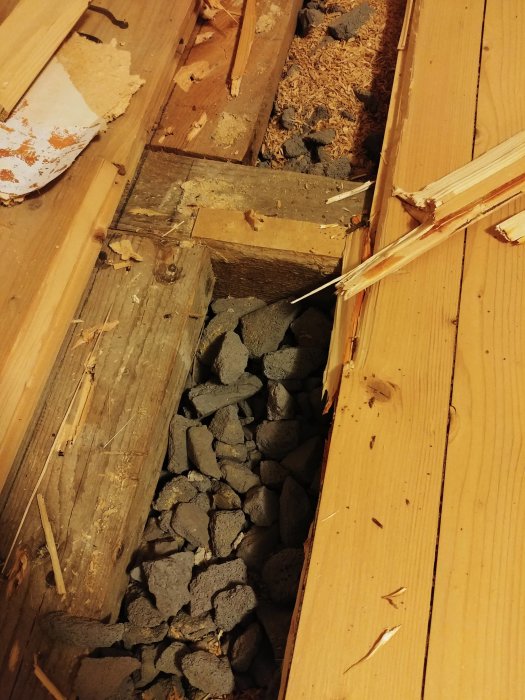
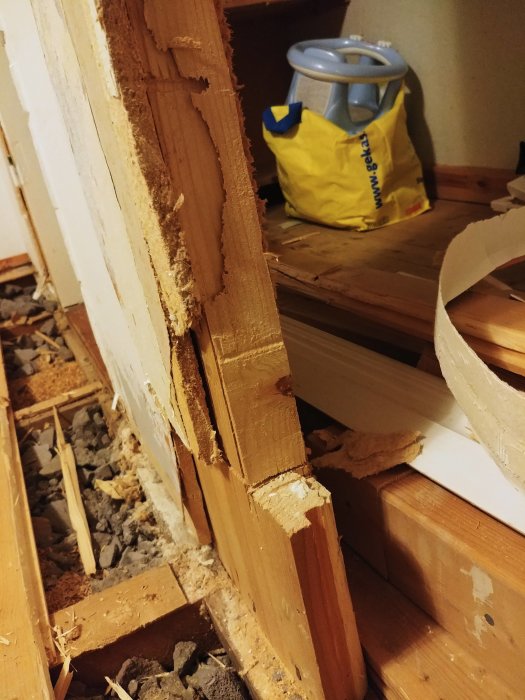
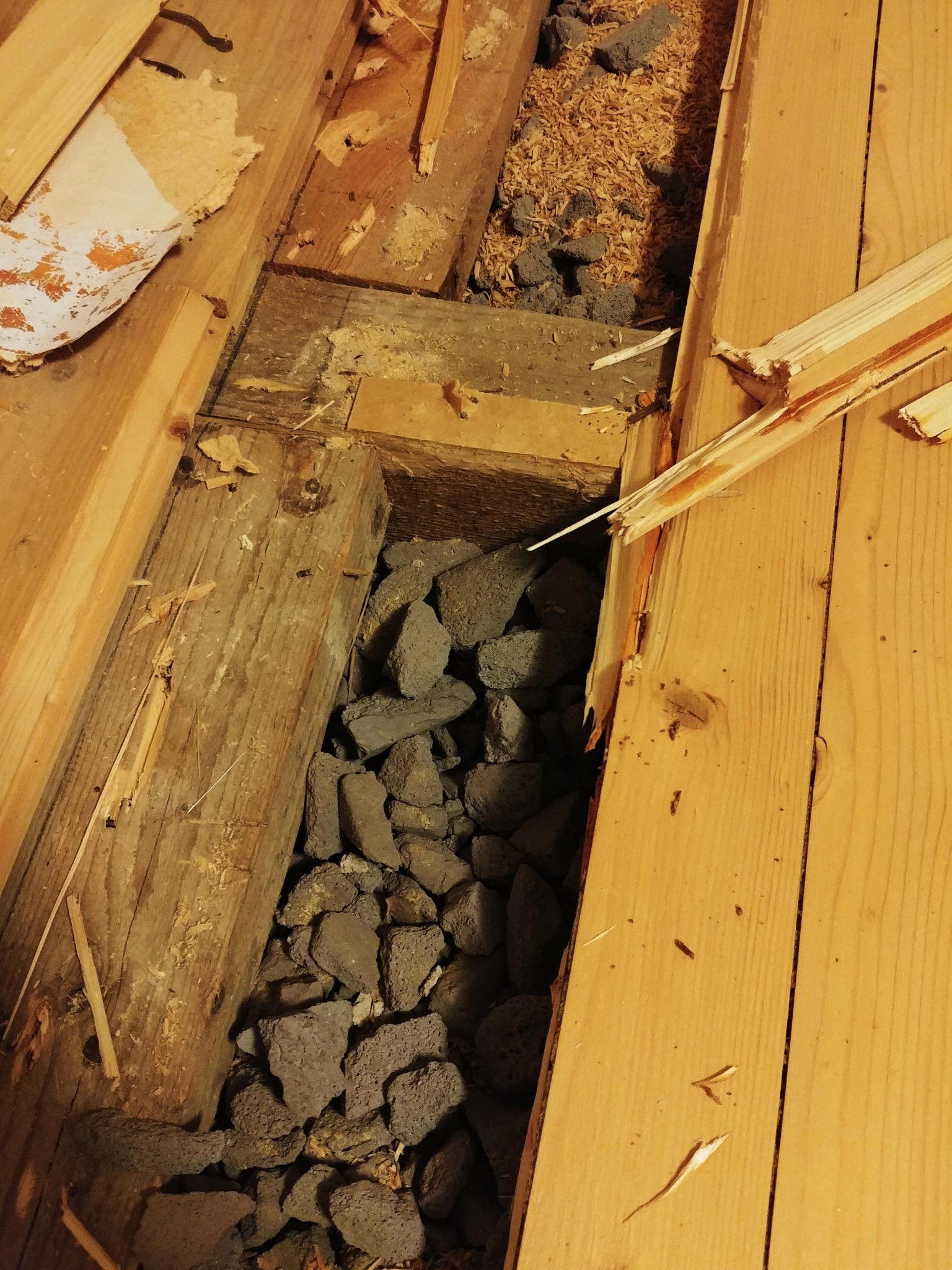
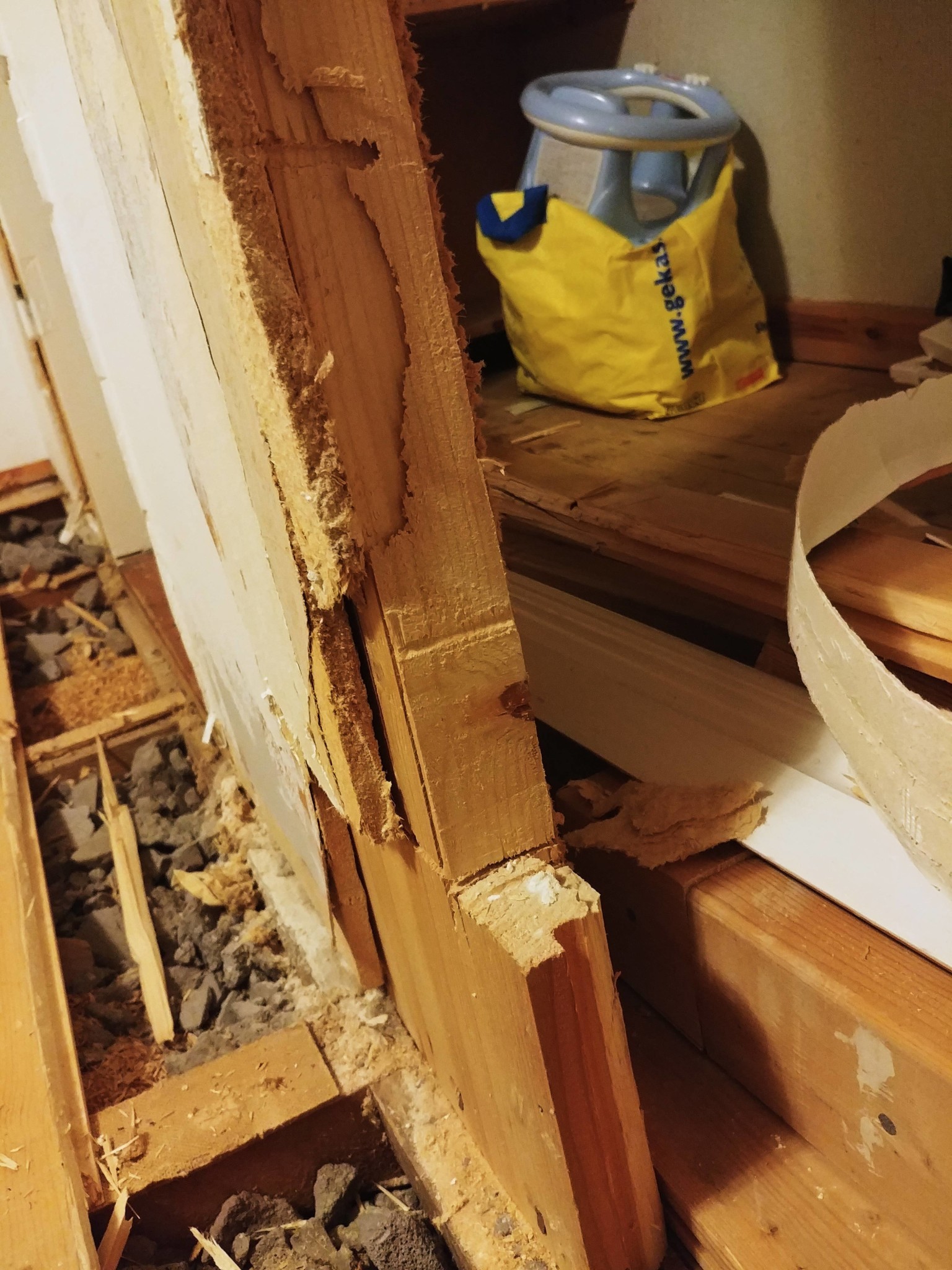
When I started removing the wall, I noticed it's directly on the beams, with some smaller beams between the actual beams, so to speak. (See picture) The old wooden floor was laid after the wall.
* We are considering removing the old floor and replacing it with chipboard and new flooring on top of that. Is this a good idea, or should we keep the old wooden floor and just lay the new floor on top? How would you do it? It's an old plank floor (the appearance differs between storage and bedroom as the bedroom's planks have been sanded and oiled, while the storage's look old and worn).
* Between the floor beams is what I believe to be some sort of lightweight concrete blocks (porous and with holes in them), can someone identify what type it is? (See picture). This lies along with sawdust.
Should this be removed and replaced with something better? Will it become extremely noisy if I just remove it and close it up? There is a ceiling on the lower floor with floor planks on the upper floor.
What do you think about my plan? Is it unnecessary to overwork and just let the current plank floor stay (though I'll have to solve something where the wall previously stood) and just lay new flooring on top? However, I'm the type who likes to do things properly from the start and clear out old scraps and replace with something better in the beams, etc. But that would involve carrying a lot of stones and sawdust...
How would you do it? =)
Grateful for any thoughts.
It will certainly get louder if you remove the stone. Interesting though to know what kind of stone it is, have you done any radon measurement? Possible content of blåbetong is the only thing that would make me remove it. And why replace fine untreated timber with laminated chipboard? I would have absolutely replaced where the wall stood with a new plank only and then laid new flooring on top. Or yes, I would have done - I HAVE done so
It will certainly be noisier if you remove the stone. Interesting though to know what kind of stone it is, have you done any radon measurements? Possible content of blåbetong is the only thing that would make me remove it. And why replace nice untreated wood with laminated chipboard? I would absolutely replace where the wall stood with new planks only and then lay new flooring on top. Or well, what I would do - I HAVE done so
Yes, radon measurement was done when we bought the house, and the whole house has very low levels. But it could be blåbetong. Nothing else in the house is built with it though (poured basement, not blåbetong).
One problem is that the current floor creaks quite a bit, it's not very even everywhere, and I would actually like to run some cables when we open it up anyway. But it will be quite a bit of work, of course...
But maybe it's overkill to replace the old plank floor; maybe it's better to just lay new flooring on top?
However, I'm tempted to go through the beams to see how everything looks and still remove the suspected stones... This is tough.
The stones may also be slag stone - a precursor to lightweight concrete that was used from the 1930s.
If you remove the stones and sawdust, you should definitely fill the ENTIRE space with new insulation. An empty intermediate floor will be like walking on a drum skin and every step upstairs will be heard throughout the house.
I also think it is slag stone. It should not be a primary interest to remove the filling unless needed for other reasons.
This is an excellent opportunity to think a little about the load-bearing capacity and deflection of the floor structure. I guess the floor joists are 3x7 inches. With today's deflection requirements, they can only handle a span of 3 meters. In your case, the span is probably longer. Here is a golden opportunity to reduce deflection and floor creaks. Feel free to measure the joists (cross-section dimensions and span) so you can get feedback on that.
The stones could also be slag stone - a precursor to lightweight concrete used from the 30s.
If you remove the stones and the sawdust, you should definitely fill the ENTIRE space with new insulation. An empty intermediate floor will be like walking on a drum skin and every step on the upper floor will be heard throughout the house.
Okay, yep, I understand that re-insulation is recommended.
Jjustusandersson said:
I also believe it is slag stone. It should not be a primary concern to remove the filling unless needed for other reasons.
This is a great opportunity to consider the load-bearing capacity and deflection of the floor structure. I guess the floor joists are 3x7 inches. With today's deflection requirements, they only manage a span of 3 meters. In your case, the span is probably longer. Here is a golden opportunity to reduce deflection and floor creaking. You might want to measure the joists (cross-section dimensions and span) so you can get feedback on that.
I measured two joists now, a bit tricky with all the stone and the paper that sits at the bottom up against the joist, but in any case, the room is about 4.40 meters, including the storage. I assume the joists stretch all the way.
The joists seem to be 75x180 or 75x190, somewhere around there I hit the ceiling on the lower floor when I push the folding rule down between the paper and the joist.
There's no noticeable deflection on the upper floor.
But if the joists are a bit too slender, what should I do? There's not much that can be done without removing all the slag stone, right?
75x175 mm, which corresponds to 3x7 inches, is an option, 75x187, which corresponds to 3x7.5 inches, is another. Only inch measurements were used at that time. 4.4 meters is actually too long of a span, especially to limit the deflection. The best solution is to screw and glue a 22 mm chipboard (plywood also works well) onto the joists and then put a new 14 mm wooden floor on top of this. If you do so, you will get a floor that you are satisfied with. Removing the slag stone and replacing it with a mineral wool board (not filling the entire space) reduces the load on the joists but has no effect on the deflection.
75x175 mm, which corresponds to 3x7 inches is an option, 75x187, which corresponds to 3x7.5 inches is another. Only inch measurements were used at that time. 4.4 meters is actually too long a span, primarily to limit the deflection. The best solution is to screw and glue a 22 mm flooring chipboard (k-plywood also works well) onto the joists and then lay a new 14 mm wood floor on top of this. If you do so, you'll have a floor that you are satisfied with. Removing the slag stone and replacing it with a mineral wool board (not filling the entire space) reduces the load on the floor structure but has no effect on deflection.
Thank you for the response!
I don't experience any deflection in this room, so it's probably not a problem. Since I'm at it now, I'd really like to lay some pipes between the beams where I can run some cables, including for new network outlets, etc. That's not possible unless you remove the slag stone since it needs to run from the lower floor through the ceiling.
If you place a mineral wool board, will the insulation be roughly the same as with this slag stone, or will it be worse/better?
I once checked the floor structure in another room (above the kitchen) with an inspection camera and couldn't see any slag stone. But I might have missed it; mostly looked like empty space though.
I assume it's a good idea to reduce the load on the beams by removing the stone? Is mineral wool board what is recommended in the floor structure?
Will any potential deflection improve with a 22mm chipboard floor compared to the current plank floor? We haven't really decided on a floor yet though. I'd prefer not to raise the floor too high so that it goes over the thresholds to the hall. The current floor, which is directly nailed to the beams, is about 28-30mm tongued and grooved plank floor.
There are some leveling pieces on the beams, probably to level the floor, what happens if you lay chipboard? Do you need to fiddle under a bunch of stuff to make it even then? Nothing seems to have been truly straight when the house was built (though that's probably true for all eras )
It is not certain that you have noticed the need, but improving the floor's properties in terms of bounce and deflection leads to increased comfort. To soundproof (airborne sound), place a 70 mm stone wool slab (density around 30 kg/m3) between the beams. Whether it is better or worse than the slag stone, I dare not say, but there is probably no dramatic difference.
A chipboard that is both glued and screwed to the beams cooperates with them and provides a significantly better result than regular floorboards. Then thin floorboards, about 14 mm, are sufficient on top. The advantage of 22 mm flooring chipboard is partly that it has tongue-and-groove joints, partly that it is cheap. Otherwise, construction plywood is a stiffer material. It is important that the chipboards are glued to the beams, so there should not be loose pieces in between.
It is not certain that you have noticed the need, but improving the joist's properties in terms of flex and deflection leads to increased comfort. To soundproof (airborne sound), you place a 70 mm mineral wool slab (density around 30 kg/m3) between the joists. Whether this is better or worse than slag stone, I dare not say, but there probably won't be any dramatic difference.
A chipboard that is both glued and screwed into the joists collaborates with them and provides a significantly better result than regular floorboards. Then thin floorboards, about 14 mm, on top are sufficient. The advantage of a 22 mm chipboard is partly that it has tongue-and-groove joints, and partly that it is cheap. Otherwise, construction plywood is a stiffer material. It's important that chipboards are glued to the joists, so there shouldn't be loose pieces in between.
Thanks for the input! Then I guess I'll have to remove the plank flooring and clear away the slag stone and sawdust even if it means some work. Then I can also run some new cables at the same time.
Another question:
If you take a nicer laminate flooring (now I might be blaspheming), it probably won't be 14 mm. Is 22 mm chipboard still enough? I'll have some problems then with 22 mm plus another 14 mm building a bit too high... And possibly foam on top of that...
Is it worth bracing between joists, in other words, cross-bracing between the joists? Does it make any difference?
Another question... If one ever needs to replace the chipboard or change something under the floor in the future, how difficult is it to remove glued chipboard?
We shoveled out the material from the space between the floors during renovation to level the floor. We actually had more sand/gravel and quite a bit of slag stone as well as various construction debris. Classic carpenter’s filling. Replaced with stone wool. Footsteps and impacts on the floor are louder now, while conversation, music, and other sounds are better muffled. It was a heck of a job to get everything out, though. Ended up carrying out a few tons in blue IKEA bags. We have slightly thicker beams. 80x220 if I remember correctly. No sagging over a 4.5 span, but then again, we’ve removed quite a bit of weight as well...
On top of the particle board, you can lay whatever you want. A laminate floor is certainly thinner.
Eeddiw said:
Is it worth reinforcing between the joists, meaning cross-bracing between the joists? Does it make any difference?
It might affect the flex slightly, but hardly in your case.
Eeddiw said:
If at some point in the future you replace the floorboard
I understand your point of view. Personally, I have a strong aversion to glue in houses. There's probably some tool you can use. Use screws with sensible heads, e.g., Torx.
The buoyancy requirements must be calculated. We humans are not sensitive enough. However, the requirements are based on studies with a very large number of participants.
Additional question:
If you take a finer laminate floor (I might be cursing in church here), it probably won't be 14mm. Is 22mm chipboard still enough? It becomes a bit of an issue since 22mm plus an additional 14mm builds up a bit too high.. And possibly foam on top of that

 I would have absolutely replaced where the wall stood with a new plank only and then laid new flooring on top. Or yes, I would have done - I HAVE done so
 fia_mstd said:
It will certainly be noisier if you remove the stone. Interesting though to know what kind of stone it is, have you done any radon measurements? Possible content of blåbetong is the only thing that would make me remove it. And why replace nice untreated wood with laminated chipboard?
