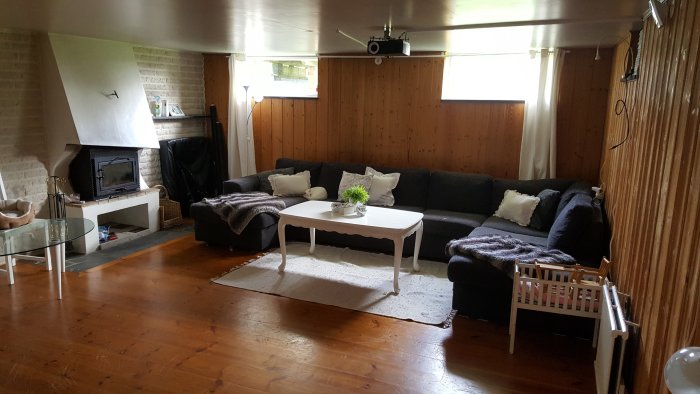
Had planned to renovate the basement and the recreation room. In the recreation room, we planned to lay tile flooring without any underfloor heating, and on the concrete walls, we were thinking of using metal studs with plasterboards painted with silicate paint and ventilation grilles at the bottom of the panels to ventilate the concrete walls, as well as ventilated baseboards. Also, to install a Mitsubishi mini ventilation system that ventilates without losing heat.
What do we think about this plan, is this the ultimate way??
If the slab is directly on the ground, the tiles can easily become very cold. What type of flooring is there today? In our den, there is a non-smooth slab -> 45x95 standing studs with lots of insulation in between -> masonite -> laminate flooring. There we will put leveling flooring like in the other rooms in the basement to ensure a capillary-breaking solution, but that assumes you have 50-60 mm to work with.
In the basement hallway, there was no raised floor, so we put balcony matting, with small rubber nubs underneath for ventilation, directly on the slab. It turned out really well, both warm and comfortable to walk on, cheap in comparison, and very easy to replace.
Using steel studs and drywall for the walls sounds sensible, unless you want to apply a skim coat over the entire surface instead.
Feel free to also provide ventilation for the space behind the gypsum up under the ceiling. This allows the air to circulate. There can be a high moisture load on basement walls (depending on the ground, etc.).
Okay, that sounds good. Aa I think it's slab-on-grade but in the rest of the basement, the concrete floor is painted, and it's not as cold as I thought it would be when we moved into the house. In the den there are wooden studs and a pine floor today. But before laying tiles directly on the concrete, should you lay a mat first?
I let my wall panel stop 2 cm below the ceiling and then mounted a crown molding 2 cm outside the wall. This creates an air gap all the way.
On the floor, I also have tiles, with a tile baseboard (10 cm high) against the concrete wall. The panel ends 8 cm above the floor, and the studs behind create a 1.5 cm gap between the baseboard and the panel. This also provides a gap all the way.
I also have tiles without underfloor heating in the basement. It's no problem with a chilly floor when walking, but if you sit still with your feet on the floor, you want a rug underneath.
Now I might be completely off with this statement, but why paint the plaster with silicate paint? Silicate paint is usually used when painting directly on concrete so that the walls can still breathe, but if you are framing out the walls and have ventilation of the space behind, I don't really see the purpose of that kind of paint
So save those pennies instead and paint with regular paint that costs significantly less
Exactly my thought.
Why not leave the last 3 cm towards the floor and ceiling without gypsum and put ceiling and base moldings on spacers so the air can circulate that way?
Silicate is completely pointless, you paint the foundation wall with it if you skip the gypsum.
A tip is to use hat profiles instead of steel studs, they only build 25 instead of 45, which is the minimum otherwise.
The levels solution is very practical if you have space. I, who have 197 cm in the ceiling, have 3 choices: cold feet, carpet, or a jackhammer.
What is your ceiling height in the lounge?
Okay then I'll skip the silikatfärg and go with regular. Today I have a 2m ceiling height but it will be more when I tear out the wooden floor and the joists underneath.