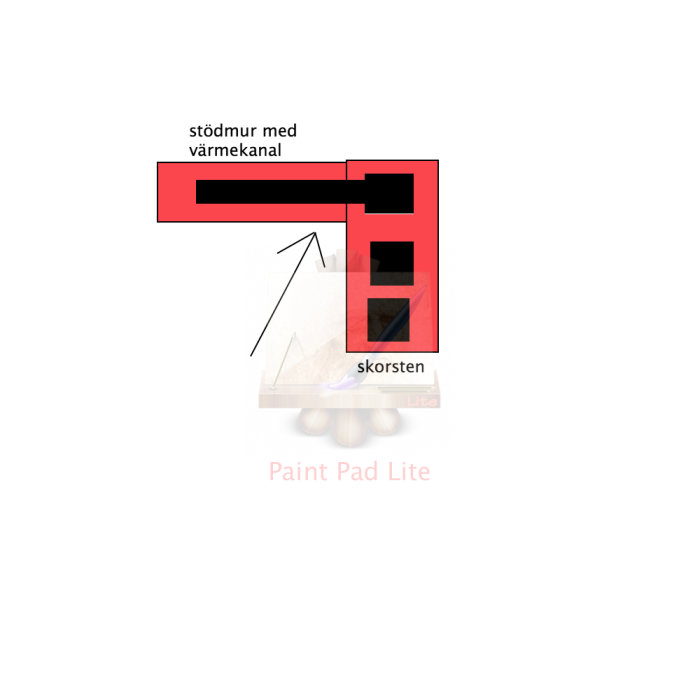
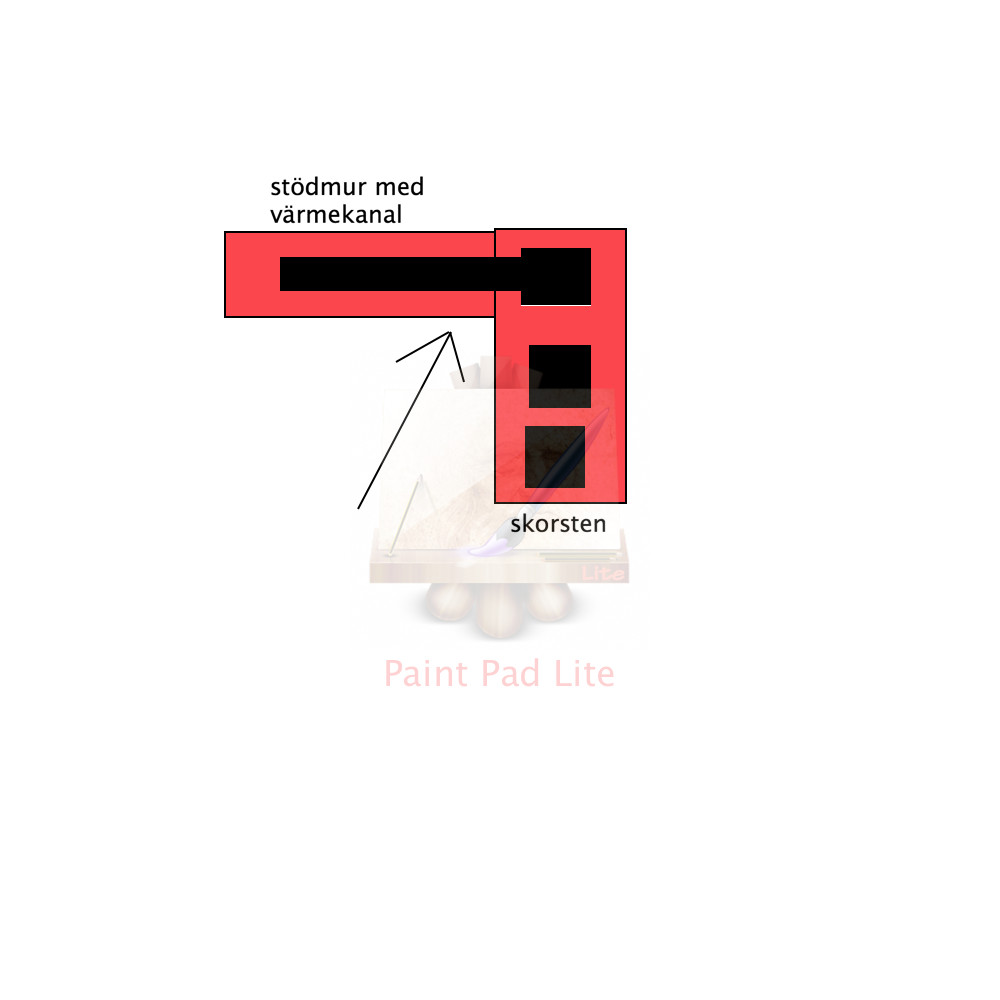
Considering knocking into the old flue at the arrow in the picture.
To do this, I need to remove stones in the "support wall" which has an integrated heating coil (black).
The question is what will happen if I first remove stones to access the flue in the chimney part and then to insert a 125mm pipe to the kitchen fan about 50 cm to the west in the picture.
It feels like everything could collapse when the support wall is only one brick wide on either side of the heating channel.
It depends on how the retaining wall looks/is constructed. That is, how much material there is to take from, and what loads the retaining wall bears. Likely, there are no issues, but as mentioned - it depends...
It depends on how the retaining wall looks/is built. That is, how much material there is to take from, as well as what loads the retaining wall supports. Likely, it is not a problem, but as I said - it depends...
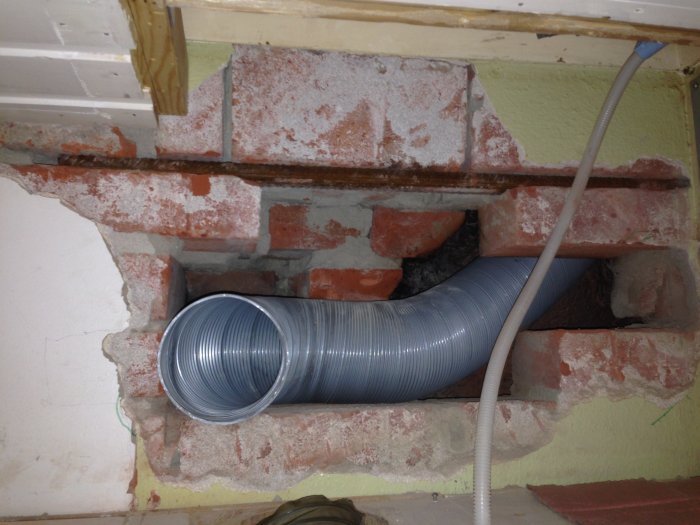
Now I've investigated a bit and unfortunately, as I suspected, where I want to remove stones, the wall is only one layer of stones wide, which makes me worried that the stones above will fall down if I start removing the stones needed to get the pipe in. I have found the flue, in any case, but it doesn't help much if it's not possible to run a pipe in the wall.
Above, there isn't much weight. I guess it's bricked up a bit into the joists as support for a possible stove on the upper floor.
So the question is again, do you think it will collapse if I remove stones? The mortar is very porous. I've chipped everything away with a chisel.
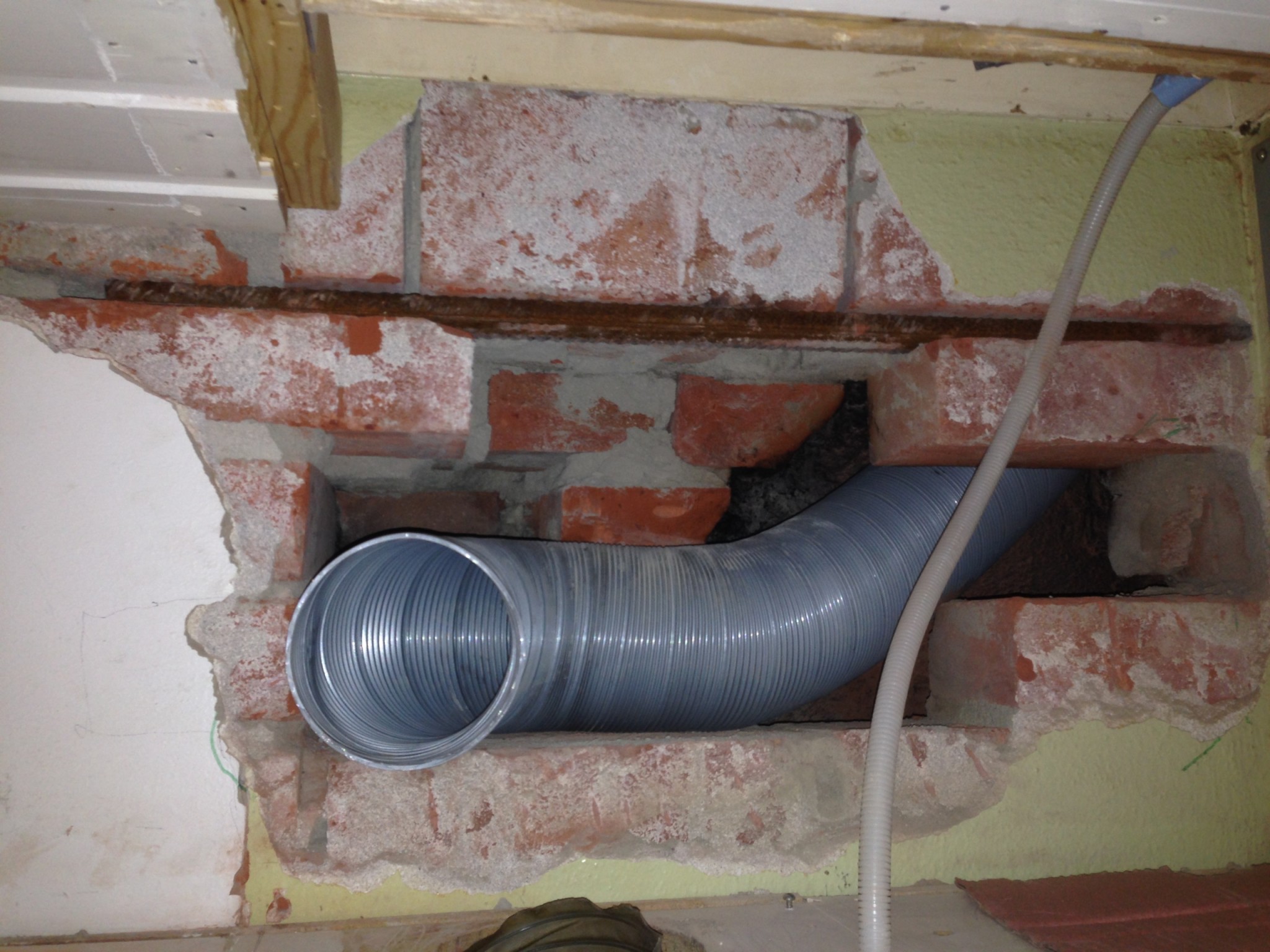
Attaching two pictures. One is the intended pipe route and the other a close-up of the hole into the flue.
Alright. I thought I had come up with a solution. To run the hose inside the old heating channel visible in the first post. BUT, when I removed the stone that breaks the green ring to the left and the stone above it, I see there's a partition wall just to the right of these stones. So, not a free channel over to the flue.
Anyone know the thickness of such a partition wall? I guess it's 70mm like a stone is thick but it's very hard to know.
I might have to call a mason so he can come and see what needs to be done.
It's very difficult to determine here on the forum. It would probably require many more pictures, and possibly drawings, as well as a clearer description, but it's still difficult in an old house. Getting an experienced mason is not a bad idea. Preferably a chimney mason accustomed to old chimneys. The flue pipe/channel also needs to be properly aligned inside the chimney.
The solution to potential collapses is complete. Inserted 4 pieces of 16mm thick and 800mm long rebar into a joint to keep the upper stones in place. Downwards, I have support from stones that are not at risk of coming loose. The new ventilation duct is also in place. All that's left is to brick up and plaster over the hole.
New question. Can I first brick up the stones and the hole and let it dry, and then finally plaster an outer layer of 1-2cm render, intending to use mortar C from byggmax for both bricking and plastering?
New question 2. For example, Weber Gypsum naturgips, is it possible to tile over this surface, or is it too weak?
Last edited:
Click here to reply
Vi vill skicka notiser för ämnen du bevakar och händelser som berör dig.