
6,273 views ·
24 replies
6k views
24 replies
Remove a section of interior wall for open floor plan
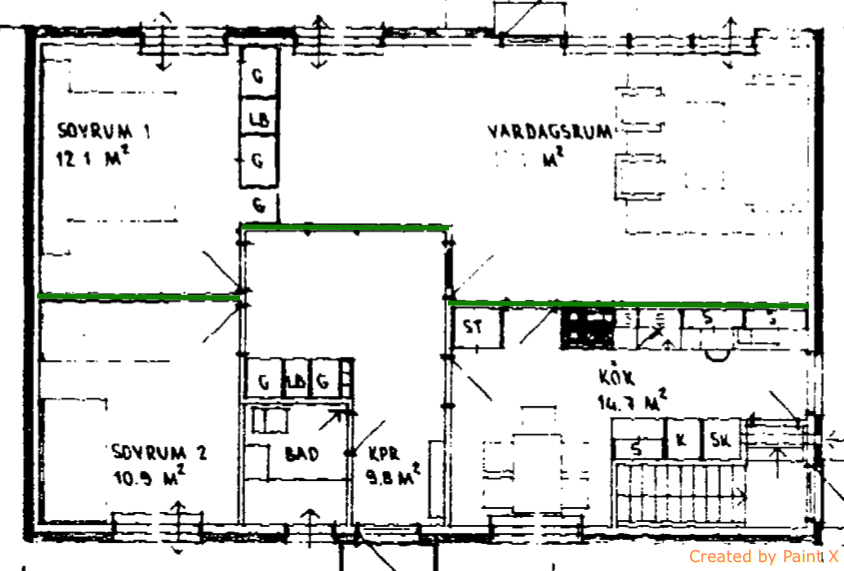
Just so I understand you correctly, you mean that maybe everything I've marked in green is load-bearing? And if yes, how does that work with the load-bearing basement wall? The load-bearing basement wall runs across the entire basement under the "offset load-bearing wall" if we are to call it that. Then the offset wall would be supported by the floor? Feels risky.13th Marine said:
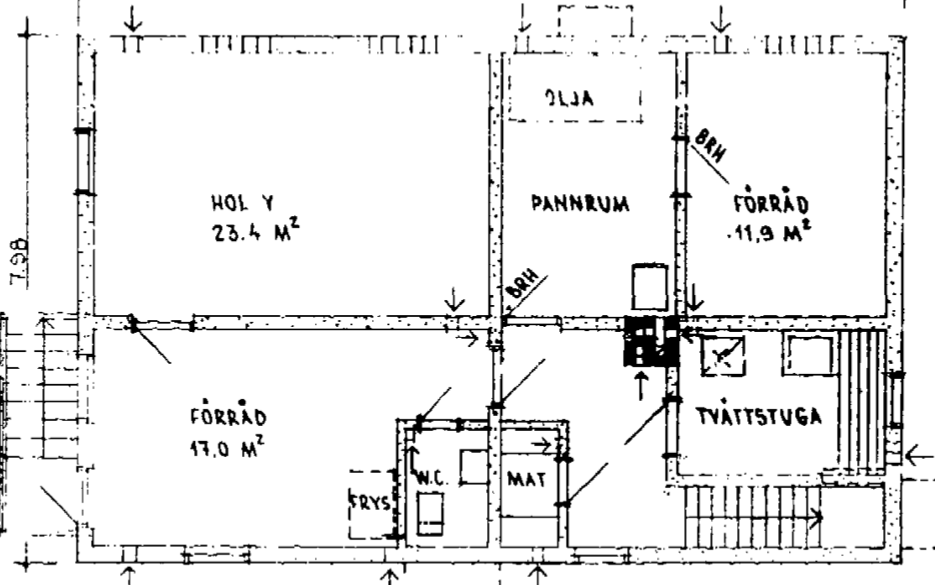
The basement:


Kan själv!
· Trelleborg
· 19 713 posts
Yes, that messes up my theory 

Member
· Västerbottens län
· 18 051 posts
Look at the section drawing where the partition wall goes up to the hanbjälke between the tension rods, it is not very good as a supporting structure. There should have been something in the roof truss that went from the wall up to the ridge.
It also states that the roof truss is self-supporting.
Protte
It also states that the roof truss is self-supporting.
Protte
How should I interpret your answer
as the wall is not load-bearing?Consulted an acquaintance who is a civil engineer. He says that the construction description is somewhat ambiguous. He says that free-standing roof trusses of the W-type are indeed free-standing. They are supported by the outer wall, and the "triangles" place their weight on the bottom beam, which in turn is dimensioned to handle the expected loads. However, he also reads in the construction description that there should be an interior wall in addition to the basement wall that is load-bearing. He thinks, without having been on site, that this is not correct if you consider the rest of the construction, where in that case the load-bearing wall would end in the middle or transition to an enclosed steel beam. He also finds it unlikely that the load-bearing wall would be displaced given that the basement's load-bearing wall beneath is straight.
So without having been on site and with the information about the roof trusses' construction, his assessment is that there is very little or no weight at all on that wall on the entrance level. At least, that is not the basic idea with free-standing trusses. But to give an exact assessment, a site visit is obviously needed considering the ambiguity in the construction description.
Can we be satisfied with that assessment ?
So without having been on site and with the information about the roof trusses' construction, his assessment is that there is very little or no weight at all on that wall on the entrance level. At least, that is not the basic idea with free-standing trusses. But to give an exact assessment, a site visit is obviously needed considering the ambiguity in the construction description.
Can we be satisfied with that assessment
?
I believe you can be satisfied with that statement
We have a similar construction and similar interventions with free-standing trusses and created an open floor plan. What could be the case is if it's an old house that has settled, so the trusses rest on the walls to some extent anyway. One idea is to "suspend" the trusses in the attic to counteract the settling and avoid cracks in the new large ceiling. If you have a good builder, talk to them on-site, and there are probably a plethora of options that suit you best
We have a similar construction and similar interventions with free-standing trusses and created an open floor plan. What could be the case is if it's an old house that has settled, so the trusses rest on the walls to some extent anyway. One idea is to "suspend" the trusses in the attic to counteract the settling and avoid cracks in the new large ceiling. If you have a good builder, talk to them on-site, and there are probably a plethora of options that suit you best
Regarding the writing about load-bearing vs. non-load-bearing interior walls, it could possibly be standard writing if it's from a home builder with many models. That seems to be the case with my construction plans from '74, where there's a description that load-bearing walls should be of a different dimension than the non-load-bearing ones.
It's just that there are no walls with the dimension of the load-bearing ones.
It's just that there are no walls with the dimension of the load-bearing ones.
It might be that from a structural strength perspective it is self-supporting, but you must accept the potential for deflection and associated cracks if you remove the wall without making accommodations. That's a tough situation to deal with, so making accommodations is probably wise after all. You might also skip the construction notification to the municipality since it states self-supporting in the building permit documents, so you're covered. However, involving a structural engineer is a good idea.
I thought that too, considering the type of truss, the wall is probably not literally load-bearing but it can be supporting.Karl_Pedal said:
The fact that part of it is shifted, so that it does not stand above the central wall in the basement, I don't necessarily think means it has no function at all - it seems to be quite common in small houses (especially slightly older ones) to make such small compromises in the construction, as long as it does not affect too many floor joist spaces in a row.
Click here to reply