
Hello.
Wondering what options are available to reinforce a wooden floor structure without adding too much weight.
We live in a townhouse from 1968 where the floor structure in the relevant room on the 2nd floor spans from side wall to side wall about 5300mm.
On the floor below, there is a wall and a glulam beam across the floor structure.
The reasons for reinforcement are that we plan to move a wall on the second floor to create two equally sized rooms. Additionally, the floor feels wobbly and has sagged slightly...
Any ideas?
Best regards,
/F
Wondering what options are available to reinforce a wooden floor structure without adding too much weight.
We live in a townhouse from 1968 where the floor structure in the relevant room on the 2nd floor spans from side wall to side wall about 5300mm.
On the floor below, there is a wall and a glulam beam across the floor structure.
The reasons for reinforcement are that we plan to move a wall on the second floor to create two equally sized rooms. Additionally, the floor feels wobbly and has sagged slightly...
Any ideas?
Best regards,
/F

It depends on the interventions you are willing to make. There are many good methods for reinforcement. A bit more information is needed. Dimensions of the current floor and planned maximum span.
Hi Justus.J justusandersson said:
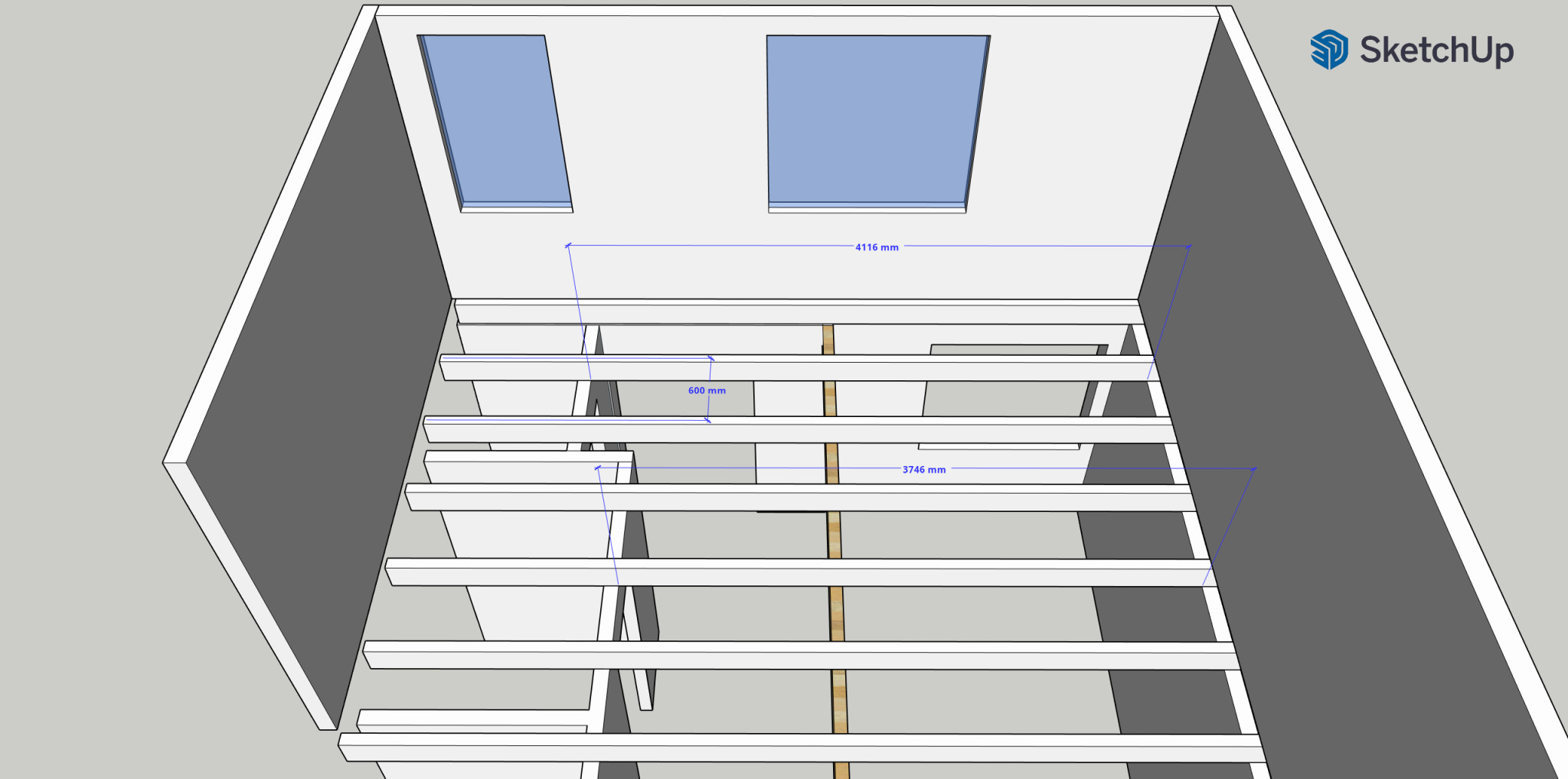
Thanks for the quick response. I'm attaching a simple sketch of the construction.
The dimensions of the beams should be 60-70 x 225 (I don't have documentation on this... I've tried to remember and looked at pictures from the times I've ripped up the tongue and groove and laid chipboard flooring). Assume 60 cm center-to-center on the beams.
As you can see from the attached sketch, the span is just over 4 meters at the longest point and closer to 3.75 on the shorter span.
Where there used to be a wall on level 1, there is a homemade wooden beam (marked on the drawing with wood color) that previous owners installed. I find it hard to believe that the original wall on level 1 was load-bearing.
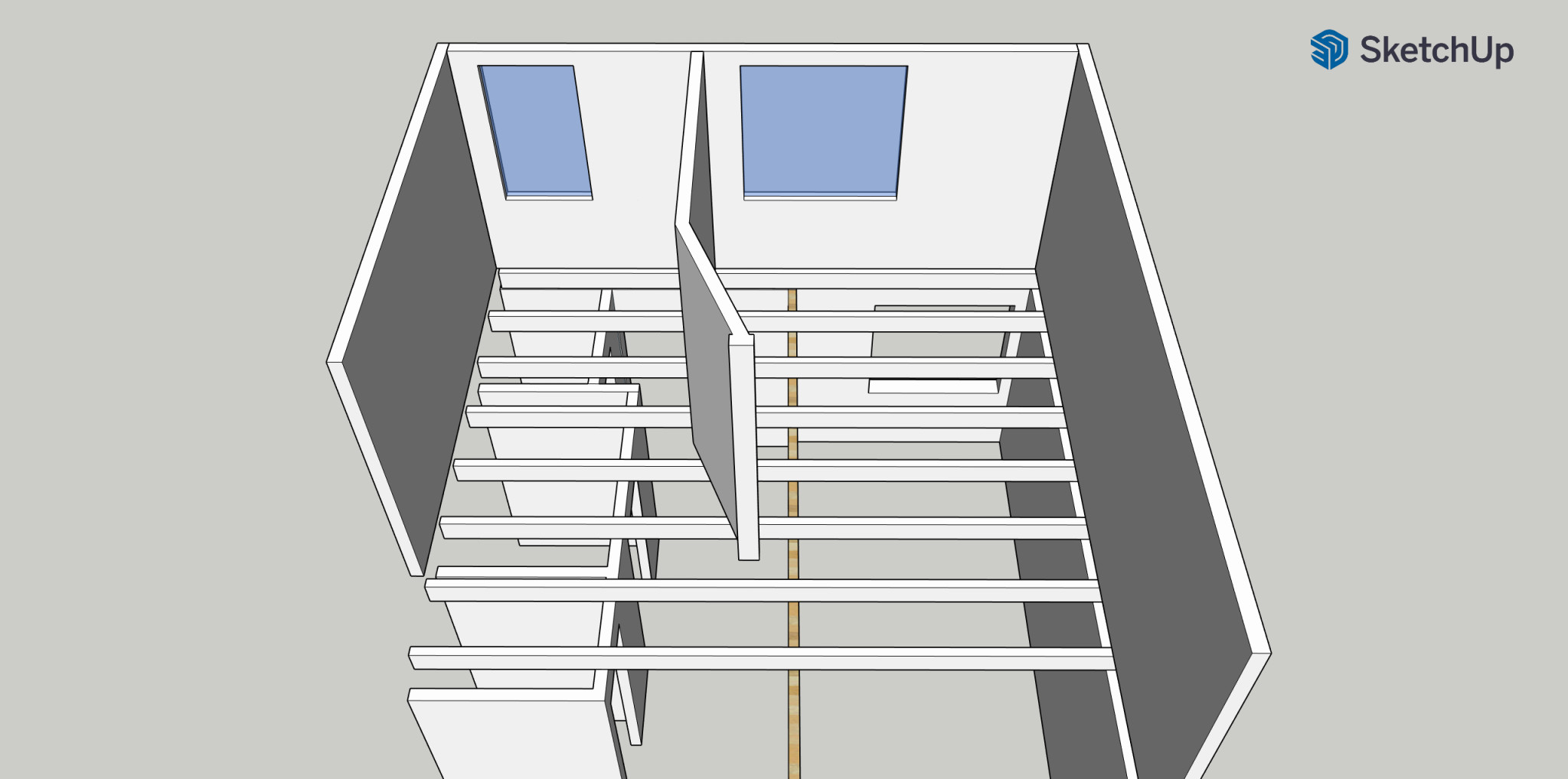
As I mentioned: The reason I want to reinforce the middle floor is that we are going to move a wall that is currently built more or less in line with the walls on level 1, but where the new wall will be more centered in the house. I'm also attaching a picture of the new wall's position...
Best regards
/Fredrik
In 1968, they were still using inch dimensions. I guess the beams are 2½x9 inches. In terms of load, they can probably handle the new partition, it's the floor weight that's the problem. There are two ways to reinforce. 1) Screw-and-glue chipboard or plywood to the beams under the floor's wear surface. Doing the same on the underside of the beams makes it even better. 2) Reinforce the individual beams by screw-and-gluing timber from the side. A clever way to do this is to attach 45x45 mm battens to both sides at the top and bottom of the beams so they look like I-beams. Only imagination sets limits. Both methods have pros and cons.
Hi...big thanks for your ideas!J justusandersson said:In 1968, dimensions were still measured in inches. I guess the beams are 21/2x9 inches. In terms of load, they can probably handle the new partition wall, it's the floor weight that's the problem. You can reinforce in two ways. 1) Screw-glue particle board or plywood to the beams below the wear surface of the floor. Doing the same to the underside of the beams is even better. 2) Reinforce the individual beams by screw-gluing timber from the side. A clever way to do this is to attach 45x45 mm battens to both the top and bottom sides of the beams so they look like I-beams. Only imagination sets the limits. Both methods have pros and cons.
Yes, the plan is to screw-glue floor particle board (replacing the tongue and groove) to get a creak-free and smooth floor.
Interesting thought to glue-screw a 45x45 on the side of each beam. Something to think about...
I had an idea of being able to put some kind of steel profile along each beam, but the weight (and probably cost) becomes a problem...
Regards
/Fredrik
It's quite clever. Significantly easier than working with timber that has the same height as the beams. Do both that and screw-glue the floor chipboard, and you'll have a floor that can withstand dancing on it. But only with the wife in these times...
Haha.J justusandersson said:
Yes...there won't be a big party...only the family gets to dance.
I also had an idea about leveling the floor since there's a little dip. Maybe it works to increase the dimension of the battens and screw-glue the battens to the side of the existing beams to get an even floor...
Best regards
/Fredrik
It is absolutely the right time if there are big differences.
A thought to consider (if the wind allows) is to reinforce the floor structure with a beam that lies on the truss's bottom chord along the new inner wall, which in turn reinforces the floor structure on the floor below through the inner wall. It admittedly requires some work but is sometimes done to reinforce a floor structure where strengthening from below is not possible. For load-bearing structures, calculations are of course required, but here it's perhaps more a matter of comfort, so it can be viewed a bit more simply.
There is no reason to overdimension here, it only risks being poorly executed. Add enough to the height so that the attachment surface to the original beams is at least 45 mm.
Yeah...M myrstack said:One thought to consider (if the wind allows) is to stiffen the floor by adding a beam along the bottom frame of the trusses with the new interior wall that stiffens the floor of the story below through the interior wall. It does require some work but is sometimes done to stiffen a floor where you can't reinforce from below. For load-bearing structures, calculations are obviously required but here it's probably more of a comfort issue so it can be viewed a little more simply.
It's probably a bit too much work for a poor townhouse property...

/F
Thanks for that.J justusandersson said:
Time to plan for purchases.
Eternally grateful for help with solutions and thoughts.
Best regards
/F
Hi David.David-O said:
Yes, I've been considering sigmabalk, but from what I've seen in a previous thread, it can be quite costly. (Of course, it depends on the beam's load-bearing capacity and design...)
A previous user received a quote of 900 SEK per beam and that two were needed per joist. That adds up quickly...
Best regards
/Fredrik
Click here to reply
Similar threads
-
Hjälp en nybörjare förstärka träbjälklag i badrum. Bilder finns
Badrum -
Reinforcing wooden joists with an additional beam
Building Materials and Construction Technology -
Förstärka träbjälklag
Golv -
Reinforcing wooden joists between floors
Building Materials and Construction Technology -
Reinforce wooden joists Bathroom...
Building Materials and Construction Technology