I am preparing to erect the frame for my future caravan garage and since I don't want to use diagonal braces, I was thinking of using perforated straps (40X2mm).
As I can't build more than 30m2 (Attefall), every mm is important and I want to maximize the opening and therefore need to stabilize the structure as well as possible without claiming space.
The building will be 8.57X3.5m and 4m high with a 3m high opening.
The exterior of the garage will be clad with vertical paneling (22X145mm + 22X95mm).
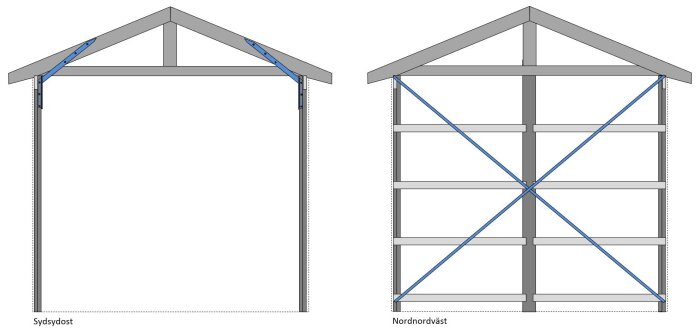
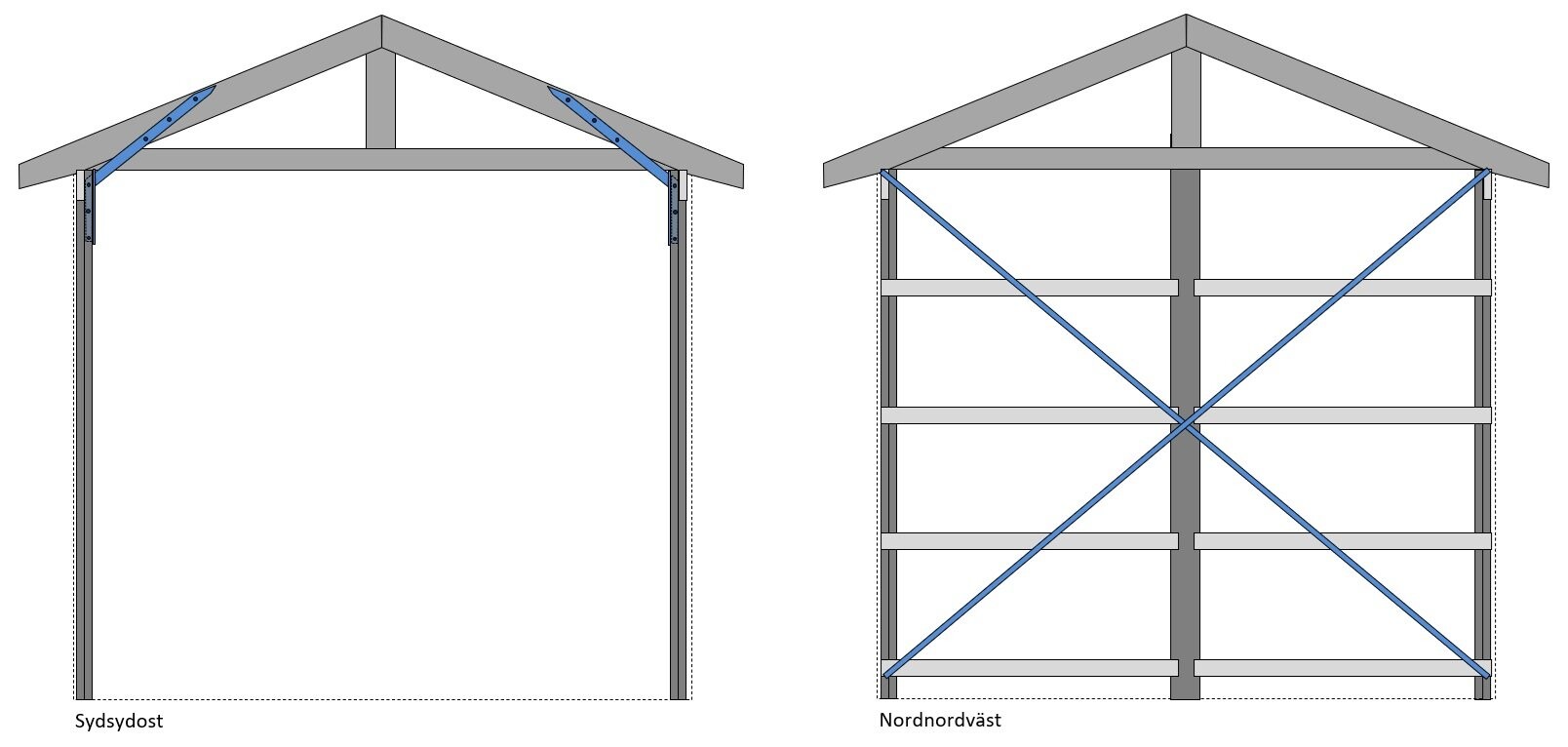
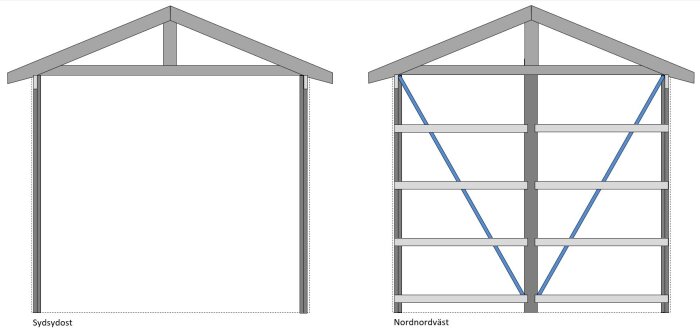
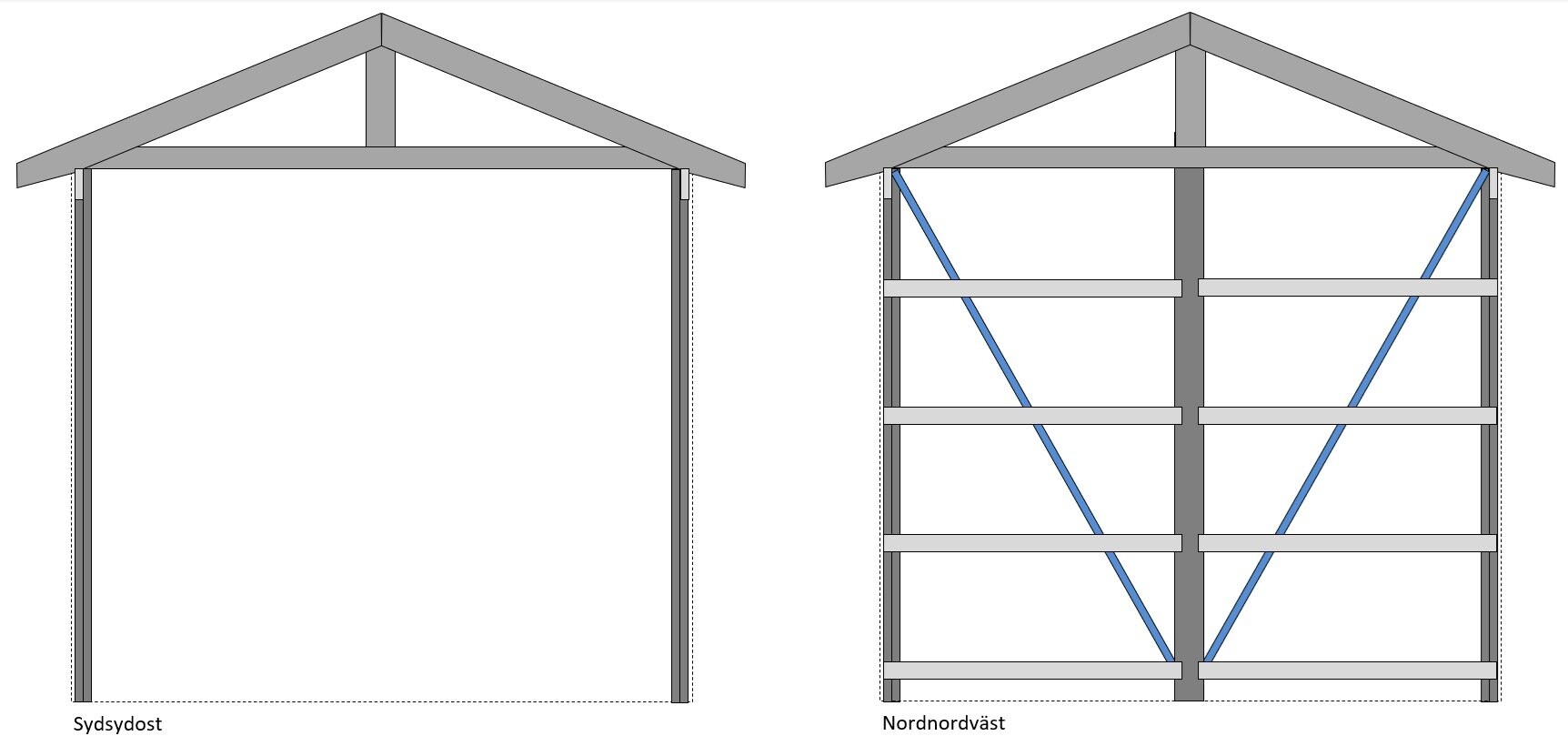
I'm thinking of bracing the rear gable like this and don't think there should be any problems:
(The perforated straps are the blue ones)
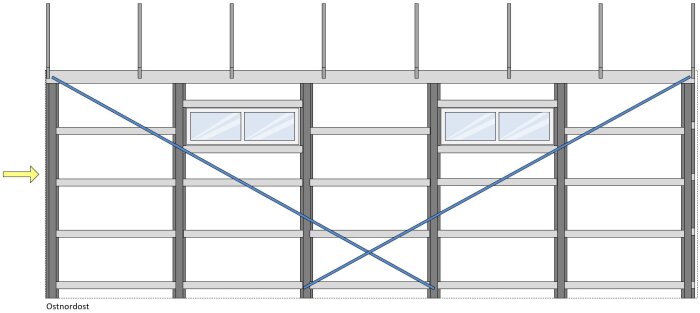
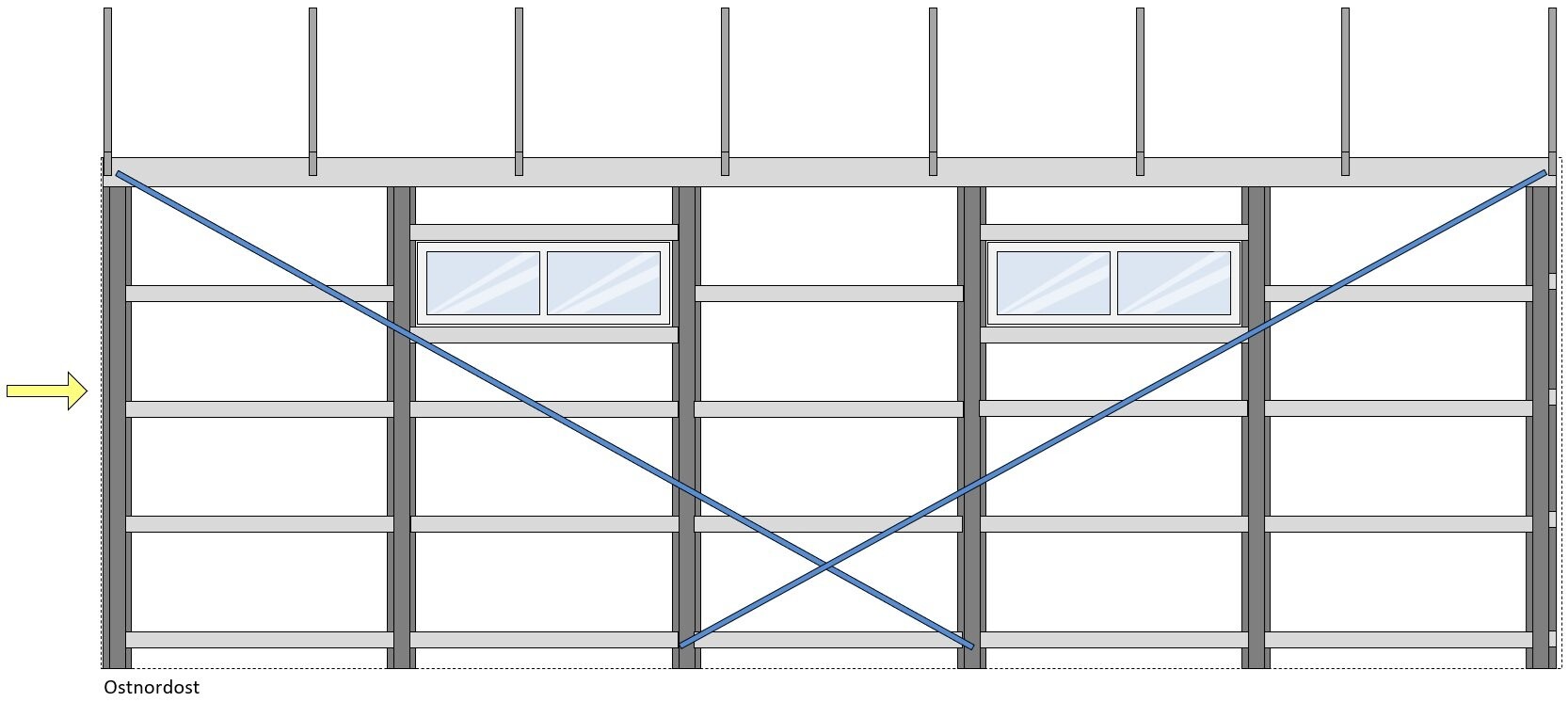
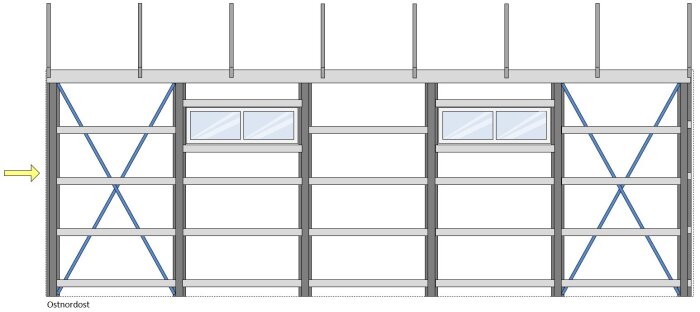
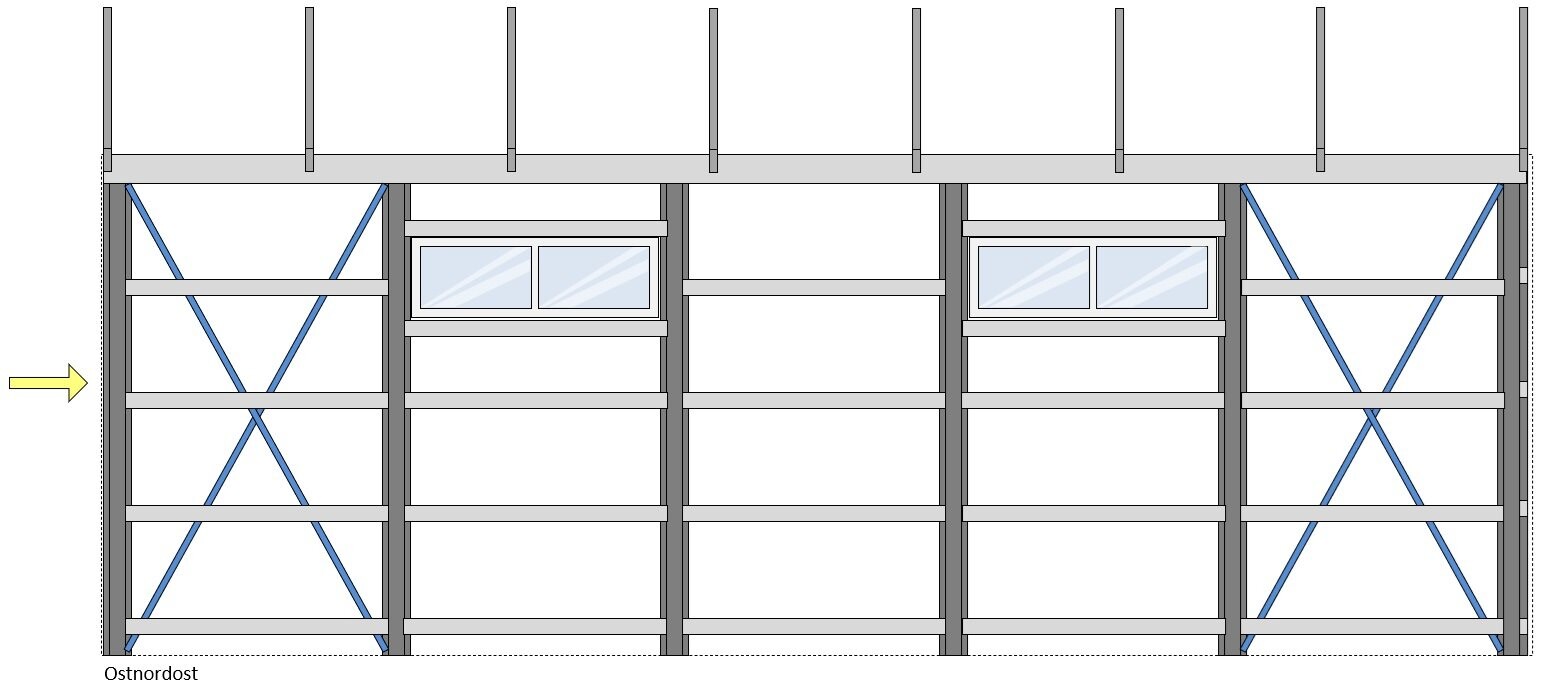
For the long sides, I plan to brace like this and the question is whether this is a reasonable solution:
(The perforated straps are the blue ones and the yellow arrow shows the opening)
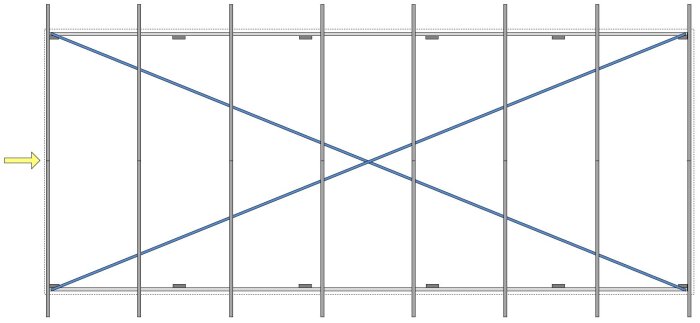
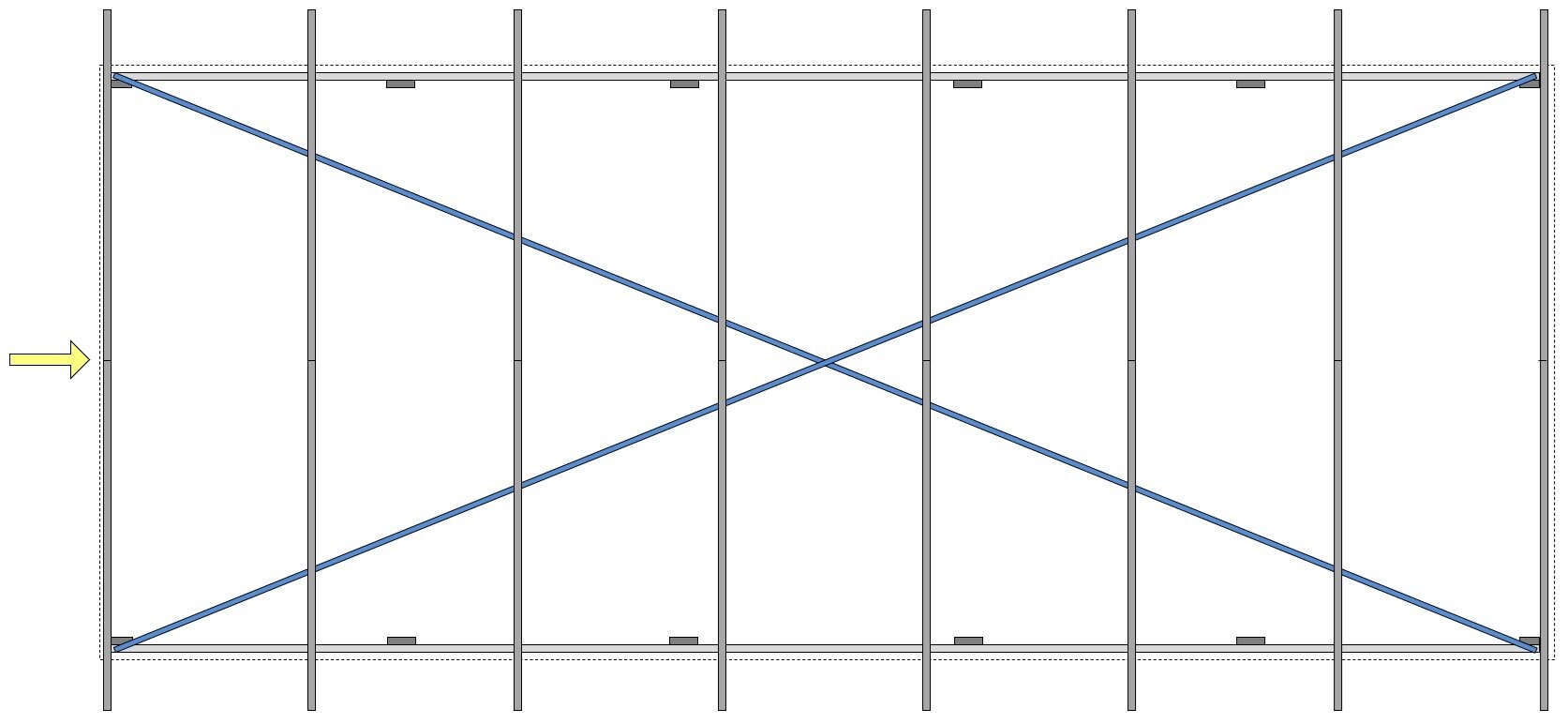
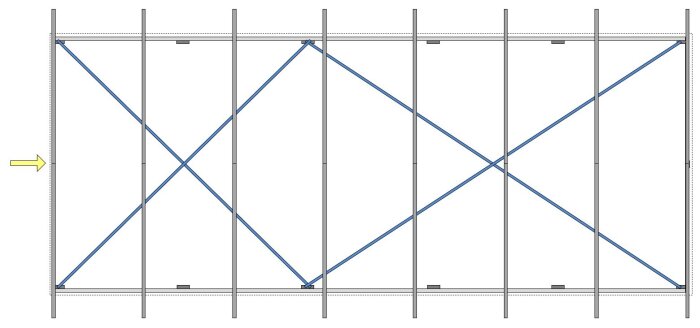
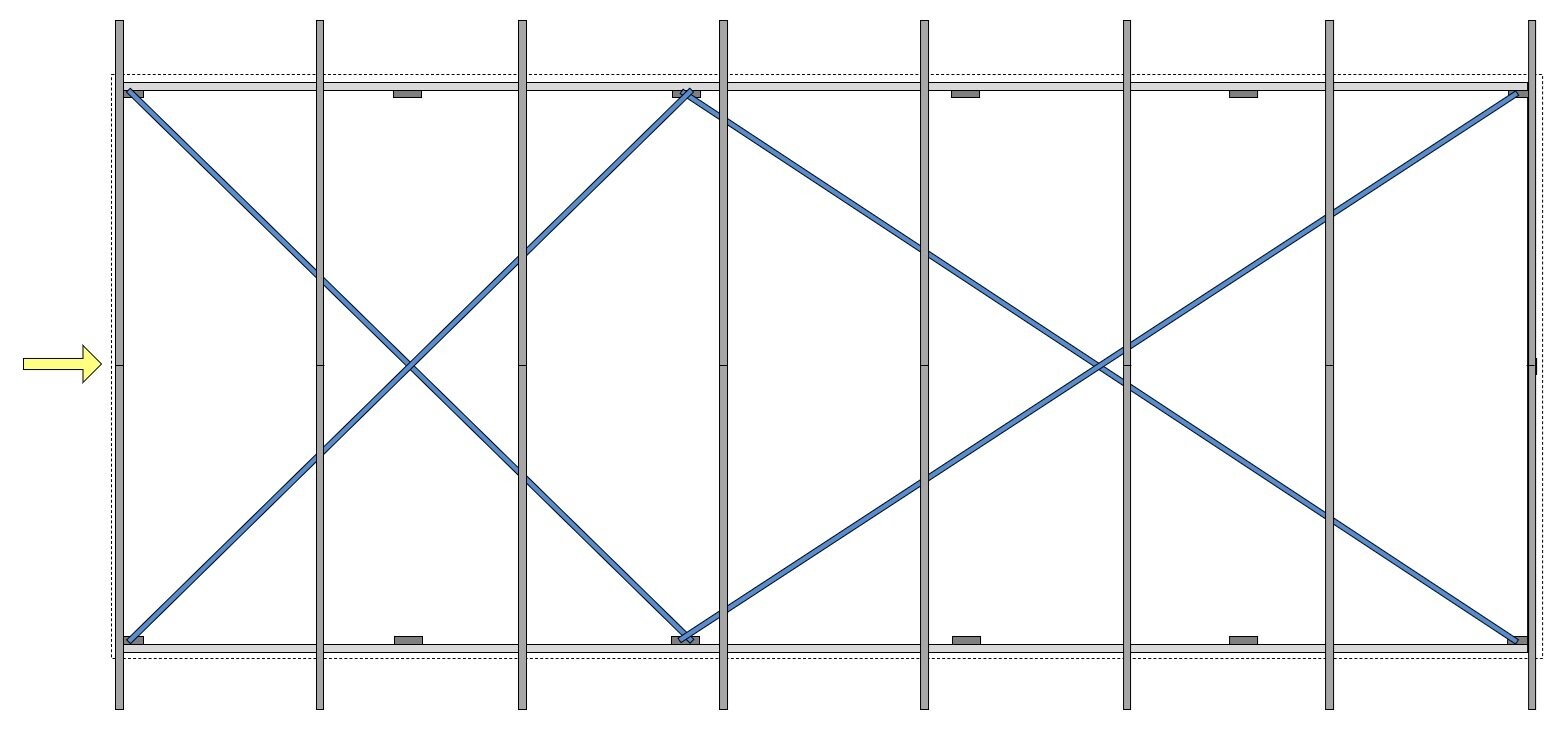
What I'm most concerned about is the lateral stability at the end with the opening and the question is whether to have a cross under the rafters running corner to corner or if it should be divided, e.g., like this:
(The perforated straps are the blue ones and the yellow arrow shows the opening)
I would appreciate inputs to find the best possible solution assuming the interior space is very important.
My input, apart from that I had looked at the ceiling material at the opening and back end of the ceiling for some extra unnecessary storage and reinforcement, is that I might have looked into whether it was possible to have two solid metal profiles manufactured to place in the corner posts against the roof trusses at the gate. Additionally, it's probably a good idea to put a door on the long side where the caravan's door ends up so that you have access to the caravan even when it is enclosed. This way, you can have doors that are reinforced for extra stability at that end.
My input besides that I would have looked at board material in the ceiling at the opening and the back end of the ceiling for a bit of extra unnecessary storage and reinforcement, and that I might have looked into having two sturdy metal profiles made to attach to the corner posts to the roof trusses at the gate. Additionally, it is probably a good idea to put a door on the long side where the caravan's door is placed so that you have access to the caravan even when it's tucked in. Because then you can have doors that can be locked for extra stability at that end.
Thanks for all the input.
Good idea there to make two sturdy metal profiles for reinforcement, and I'll think more about that.
We'll see how it turns out with space above the roof trusses because I think it’s going to be really tight up there, unfortunately, but space to put things is always needed.
I am preparing to erect the frame for my future caravan garage, and since I don't want to use diagonal braces, I plan to use perforated strap (40X2mm). As I can't build more than 30m2 (Attefall), every millimeter counts, and I want to maximize the opening while stabilizing the structure as much as possible without encroaching on the space. The building will be 8.57X3.5m and 4m high with a 3m high opening. The garage exterior will be clad with vertical panels (22X145mm + 22X95mm).
The back gable, I was thinking of stabilizing like this, and I don't think there should be any problems:
[image]
(The perforated straps are in blue)
For the long sides, I'm thinking of stabilizing them like this, and the question is whether this is a reasonable solution:
[image]
(The perforated straps are in blue and the yellow arrow indicates the opening)
What I'm most concerned about is the lateral stability at the end with the opening, and I'm wondering whether to have a cross brace under the roof trusses that goes from corner to corner or whether to divide it up, for example, like this:
[image]
(The perforated straps are in blue and the yellow arrow indicates the opening)
I would appreciate any input to find the best possible solution with the premise that the interior space is very important.
In general, you would want low-sloping braces to minimize movements.
That is, on the rear side, the braces should go from corner to corner. On the long sides, from the upper corner to as far down on the "sill"/post/pillar as possible without going over the windows or conflicting with any doors.
In addition to the wind bracing, the trusses should also be cross-braced. They are indeed low-sloping with relatively small wind load, but everything that can be braced should be braced since the garage is a weak construction as a whole.
Front/door opening is a very weak post construction completely without bracing wall pieces as it seems. That gable cannot take any wind load from the side at all without bending. The only thing preventing that is that the other three walls and the wind bracing are stable enough without the possibility of forming trapezoidal walls, and all parts are properly connected at the outer ends with each other.
So, the suggestion of reinforcing metal corners for the door/front is good. Otherwise, use as large diagonal braces/reinforcements as possible without preventing entry and exit.
Generally, you want low-sloping braces to minimize movement.
That is, on the rear gable, the braces should go from corner to corner. On the long sides, from the upper corner to as far down the "syll"/post/pier as possible without going over the windows or clashing with any doors.
In addition to the wind floor, the roof trusses should also be cross-braced. They are admittedly low-sloping with relatively low wind load, but everything that can be braced should be braced since the garage is a weak structure in its entirety.
The front/doorway is a very weak post construction completely without bracing wall sections as it appears. That gable can't take any wind load from the side at all without buckling. The only thing preventing it is that the other three walls as well as the wind floor are sufficiently stable entirely without the possibility of forming trapezoidal walls, and that all parts are thoroughly connected at the outer ends with one another.
So, the suggestion of reinforcing metal corners for the door/front is good. Otherwise, as large braces/reinforcements as can be set without preventing entry and exit.
Thanks for the very useful information.
If I understand you correctly, I should strive to have the braces as long as possible so in the roof they should go from corner to corner.
On the rear gable they should also go from corner to corner and have longer on the long sides.
I'll make some changes to my drawings.
After some useful input, I have made some changes to my drawings:
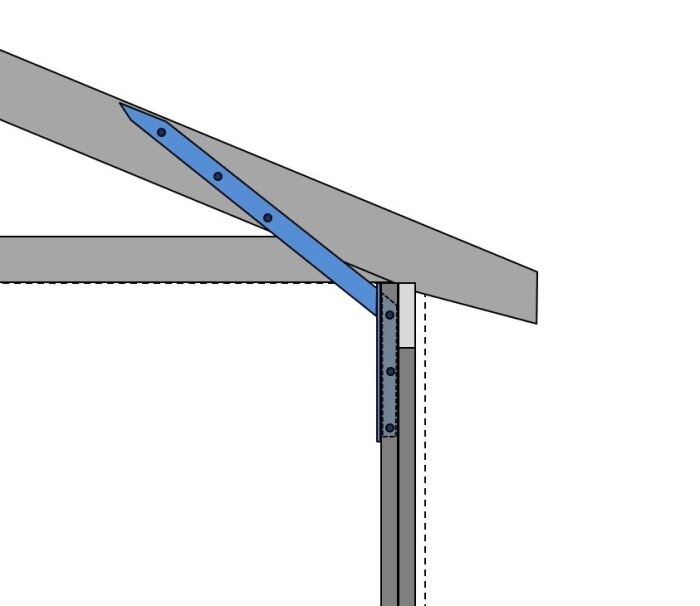
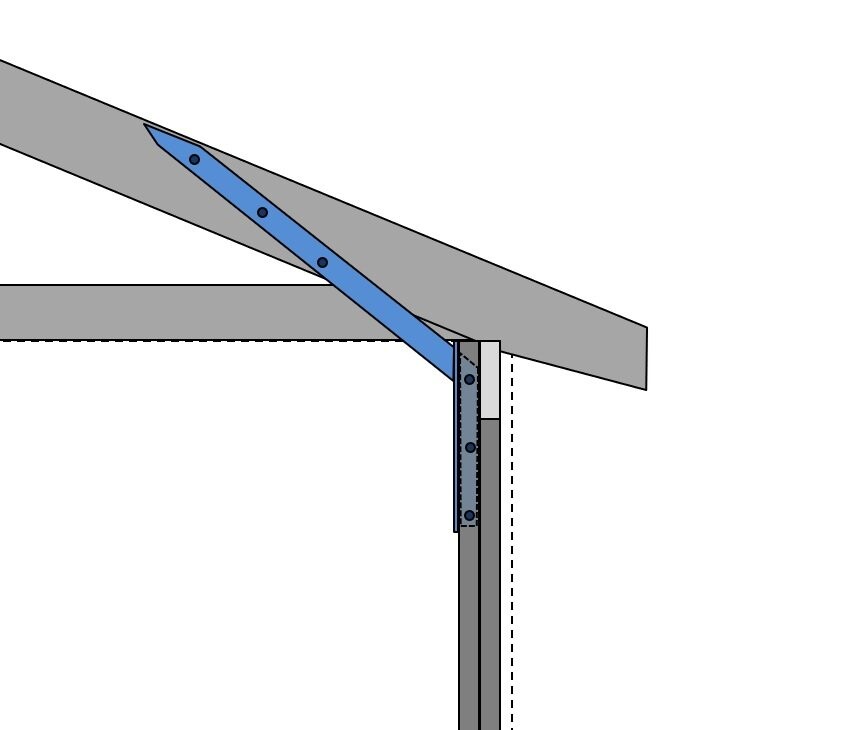
I also pondered a bit overnight about how to reinforce the short side with the opening and sketched my first idea.
The iron attached to the truss will continue into a groove in the post and be bolted together:
After some useful input, I have made a few changes to my drawings:
[image]
[image]
[image]
I also pondered a bit overnight on how the short side with the opening could be reinforced and drew up my initial idea.
The iron attached to the roof truss will continue into a groove in the post and be bolted together:
[image]
The open gable can be braced with 2 cross tension bands.
If you place a storage shed against the wall next to the gate, it becomes much more stable. But even two external braces provide peace of mind.
I was thinking more about trying to find a farmer/blacksmith/workshop (gas or water/laser) that could cut out 2/4 sturdy 90° angles from a +5 mm sheet that extends almost the full depth of the post and 70-80 cm from the corner. Just straight lines and a small radius in the angle make it possible to have minimal hassle. Post-work with an angle grinder depending on how much you care.
We have a construction company in Norrbotten that has failed with perforated straps and experienced collapses on several occasions. Perforated straps do not have particularly good structural bearing capacity, and a small damage to the strap somewhere is all it takes for it to fail catastrophically. Use sheet material instead, and you also get fire protection as a bonus. (A plywood sheet has almost the same resistance to fire as a gypsum board.) A garage might be worth having at least some fire protection. You will never be able to hang a spade on a perforated strap, but on a piece of plywood, you can easily attach a holder for the spade.
I understand your reasoning about wanting to maximize the space inside, but you still won't use the room above a baseboard. I've had a storage room built in a similar way, and it was completely hopeless to store items and machines there when the walls couldn't be utilized. I added panels again after a few months, and suddenly the storage room became larger. If you're only going to have the caravan there, you won't be stepping in and out through any door to any great extent (that's typically the use case for leaving the wall without interior paneling or sheets). But you might want a shelf for garden furniture or an awning.
Vi vill skicka notiser för ämnen du bevakar och händelser som berör dig.

VidarH said:
My input besides that I would have looked at board material in the ceiling at the opening and the back end of the ceiling for a bit of extra unnecessary storage and reinforcement, and that I might have looked into having two sturdy metal profiles made to attach to the corner posts to the roof trusses at the gate. Additionally, it is probably a good idea to put a door on the long side where the caravan's door is placed so that you have access to the caravan even when it's tucked in. Because then you can have doors that can be locked for extra stability at that end.P-plats said:
I am preparing to erect the frame for my future caravan garage, and since I don't want to use diagonal braces, I plan to use perforated strap (40X2mm). As I can't build more than 30m2 (Attefall), every millimeter counts, and I want to maximize the opening while stabilizing the structure as much as possible without encroaching on the space. The building will be 8.57X3.5m and 4m high with a 3m high opening. The garage exterior will be clad with vertical panels (22X145mm + 22X95mm).Oldboy said:
Generally, you want low-sloping braces to minimize movement.