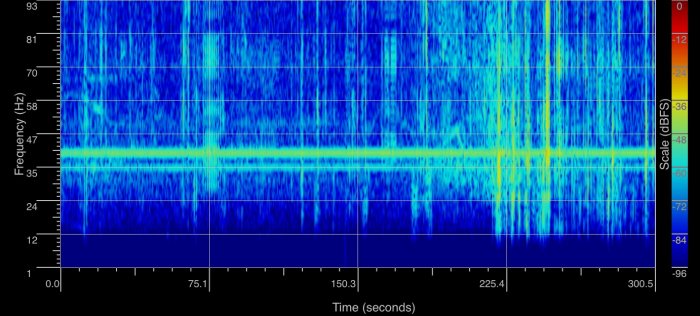
I am renovating a house from '73 and have noticed a low-frequency noise in the living room at about 40 Hz, believed to come from a nearby heat pump. I don't usually have major issues with the sound except that right now I have a cold that has led to temporarily more sensitive hearing, and these 40 Hz have caused my eardrum in one ear to flip out.
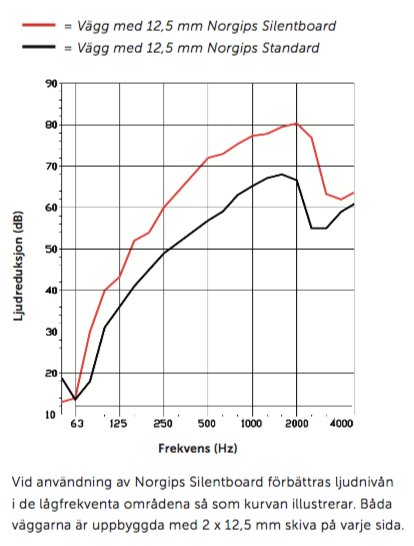
Since I am going room by room and changing the finishes, I thought I would try to reduce the noise as much as possible. I've understood that heavy materials are good for stopping low frequencies, and after some searching, I found Norgips Silentboard, which is supposed to be good at reducing low frequencies; it weighs in at 17.5 kg/m2 compared to a regular gypsum board at about 9-10 kg/m2. But when I look at their product sheet, it seems like it would perform worse than their regular board at just 40 Hz.
The current exterior wall consists of about 10 cm of glass wool and 13mm gypsum on wooden studs. How do I best stop extremely low frequencies in an exterior wall? Are two or three regular gypsum boards the best I can do for a reasonable price?
Hanging the VP on the wall
Trouble with attaching the heat pump to the house, it can cause a resonance in the house
Excavate and cast a slab or excavate and place concrete slabs 300X300 under the feet for a stand with a crushed base to solve the problem. There is always a little margin to move it, just measure properly.
Sounds a bit strange that something so far away affects you, nothing else you have like mechanical ventilation that could cause this, resonance is a bit tricky to find and can emerge a bit from the actual source through the building materials.
I can say this, you can never isolate/shield frequencies at e.g. 40hz, they go through everything. You have something that's vibrating, find it and you'll solve the problem.
I agree with Hasselnot, you can never dampen such low-frequency sound. This is mainly due to its wavelength, which is 8.5 meters. If it comes from outside, you might be able to change its direction by building an earth embankment. In the 1970s, it was a major concern with poorly designed ventilation systems that generated low-frequency noise. The solution was always to rebuild the systems. However, I find it hard to believe that the neighbors' LVP is the cause. Don't you have a wind turbine nearby?
The house has natural ventilation so mechanical ventilation shouldn't be the problem and we don't have any wind turbines within miles. I can see that the sound goes on and off at 5-minute intervals, similar to what an LVP might do, hence the suspicion. Cutting the power doesn't affect it, so I'm having trouble seeing what could be causing vibrations in the house.
But at least I know that drywall is not a solution and I'll have to live with it until I know more about the source.
What heat do you have, if it's water, check the circulation pump. If it's an old large one, it might be loose and then it can emit a vibration when the rotor and impeller move sideways. Sometimes it can even knock a little.
Sound can also occur with wind or similar, but doesn't sound like in this case. 20-40hz is more of a "feeling" than hearing, even if we can theoretically hear 20hz.
If it's in the house, you can measure where in the house the source is. But I wouldn't rely too much on a mobile phone.
This kind of thing can be a bit tricky. At 40 Hz, the sound is omnidirectional and therefore without directionality, making it difficult to locate. Due to the long wavelength, as previously noted, the sound "slips" over objects, such as fences, embankments, etc. It is absolutely possible to build constructions that dampen 40 Hz, but it requires some construction space. As mentioned before, the best thing is to first try to locate the noise source and see what can be addressed there.
Doubt that it is worth the time/cost to fix your problem. Consider the distance you can hear a truck passing by. Then I find it hard to believe that it is your neighbor's lfv causing your problems. I think, as someone else said, pump or something similar.
I'm struggling with a lot of noise and would also like to record for some analysis.
Is it any common free app you've used?
And how reliable are these apps?
Oxford Wave Research has made the one I posted a picture of. The recording is as good as your phone's microphone is, i.e., not the best. There are external calibrated microphones, but that's not something I've used.
Click here to reply
Vi vill skicka notiser för ämnen du bevakar och händelser som berör dig.