Have also posted in the building preservation thread as I am interested in answers from different perspectives.
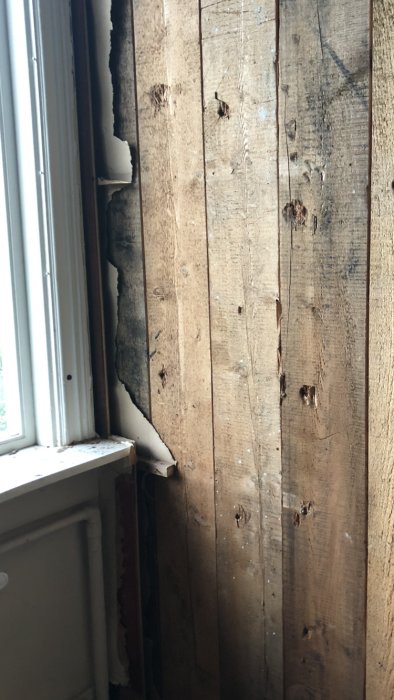
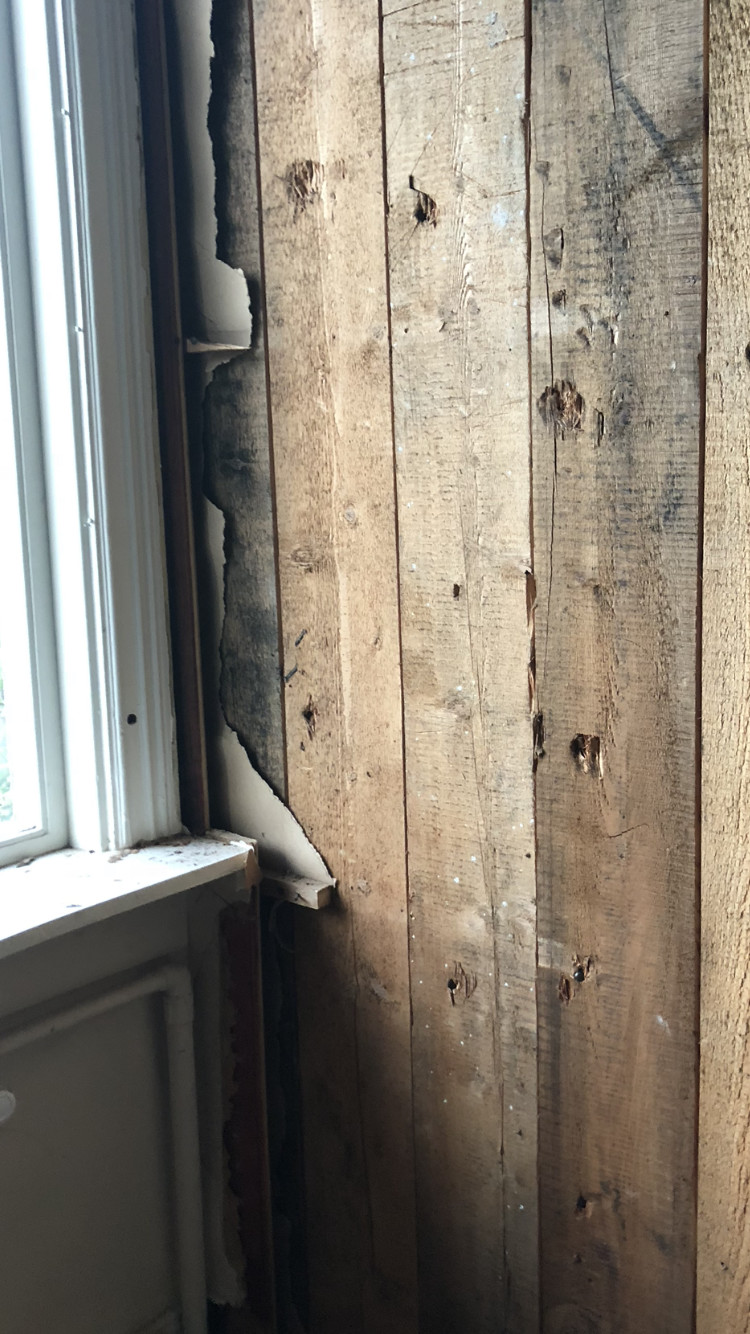
What do we do now? The builders (modern but very good builders) were a bit quick to tear down the old wall with paneling. They prefer to build on 9 cm for insulation and other reasons. We do not. Previously, there was brown paper (?), a 3 cm batten and paneling. What should we consider and how should the wall be built again?
It looks like a diagonally nailed plank frame. Such frames are normally 2-3 inches thick. The insulation capability is about 1/3 of mineral wool, meaning a 3-inch wall corresponds to about 25 mm of mineral wool. The plank wall also has some other good properties that a stud wall lacks. I agree that a 9 cm additional insulation plus paneling would make it look odd next to the window. Unfortunately, there is a lack of thin insulation materials, but an alternative could be to apply 2 layers of porous 12 mm thick wood fiber boards on the inside. Then a simple asphalt-impregnated paper (type AC 350) and then new beadboard. Absolutely no plastic foil, the plank wall is in itself quite vapor-resistant. The beadboard commonly sold is of poor quality, so you have to look a bit extra to find good beadboard.
Thanks for the tip! We were thinking of checking with Åttersta sawmill for beadboard.
Jjustusandersson said:
It looks like a slant-nailed plank frame. Such a frame is normally 2-3 inches thick. The insulation capacity is about 1/3 of mineral wool, i.e., a 3-inch wall corresponds to about 25 mm of mineral wool. The plank wall also has some other good qualities that a stud wall lacks. I agree that a 9 cm added insulation + panel would look odd next to the window. Unfortunately, there is a lack of thin insulation materials, but an alternative could be to put 2 layers of porous 12 mm thick wood fiberboard on the inside. Then a simple asphalt-impregnated felt (type AC 350), followed by new beadboard. Absolutely no plastic foil; the plank wall is itself quite vapor-tight. The beadboard that is usually sold is of poor quality, you'll have to search a bit extra to find good beadboard.
Thanks for the tip! We were thinking of checking with Åttersta sawmill for beadboard.
We ordered beadboard from Åttersta to get the same dimensions that previously existed in the house (95x25 if I remember correctly). I thought it was of good quality. Primed everything with white Shellac to avoid knots. Worked well, no bleed-through for four years at least. We have a similar plank frame at our place. Managed to fit in 70 insulation and used the same paper Justus mentions.
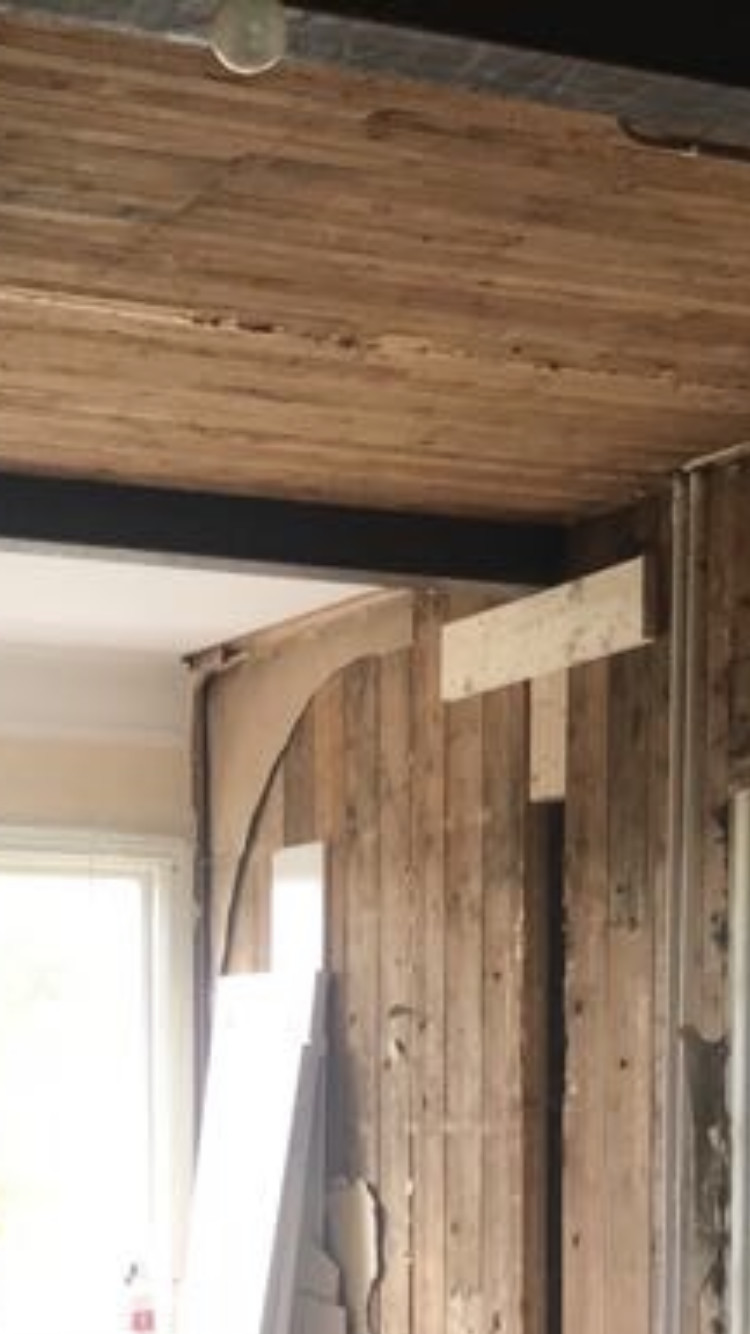
If we rebuild the wall as it was, we have another problem. The walls that have been torn down have now been replaced by beams resting on 45mm studs. If the wall is 35mm, how do we best conceal the studs?
Is it a temporary or permanent solution? If it's the latter, I would suspect that the carpenters don't really know what they're doing. The load from such a beam can amount to several tons depending on its length and what's above it. Is it the only support for the steel beam at that end? Has the wall replaced by the beam run in the same direction as the beam? I would like to see a floor plan to better understand the context. In any case, it can't look like this.
The beam should rest on a post that extends all the way to the floor (assuming the floor can support the load). It seems there is room for the post in the notch in the wall, otherwise the post will have to protrude into the room a bit, and the paneling should run up to the post from both sides.
Updated myself a bit. There will be posts for the beams. The outer edge will rest on the foundation wall. One beam rests at the other end on the chimney stack.
The problem with having a thicker part for the beam to rest on remains. Do we just make a small box?
HHåkan V said:
The beam should rest on a post that goes all the way down to the floor (provided the floor can bear the load). It seems there's room for the post in the wall recess, otherwise the post should stick into the room a bit and the wainscoting should connect to the post from both sides.
On roll
Jjustusandersson said:
Is it a temporary or permanent solution? If it's the latter, I would suspect that the carpenters don't really know what they're doing. The load from such a beam can reach several tons depending on its length and what's above it. Is that the only support for the steel beam at that end? Has the wall that was replaced by the beam gone in the same direction as the beam? I'd like to see a floor plan to understand the context better. Under any circumstances, it cannot look like this.
a thicker part that the beam rests on remains. Do we just make a small box?
I don't quite understand where you mean there will be a thicker part, up by the ceiling or down by the floor? If the beam isn't too short, nothing should stick out more than the post, I think, and if you choose to make the post out of glulam, it becomes so nice that it doesn't need to be clad.
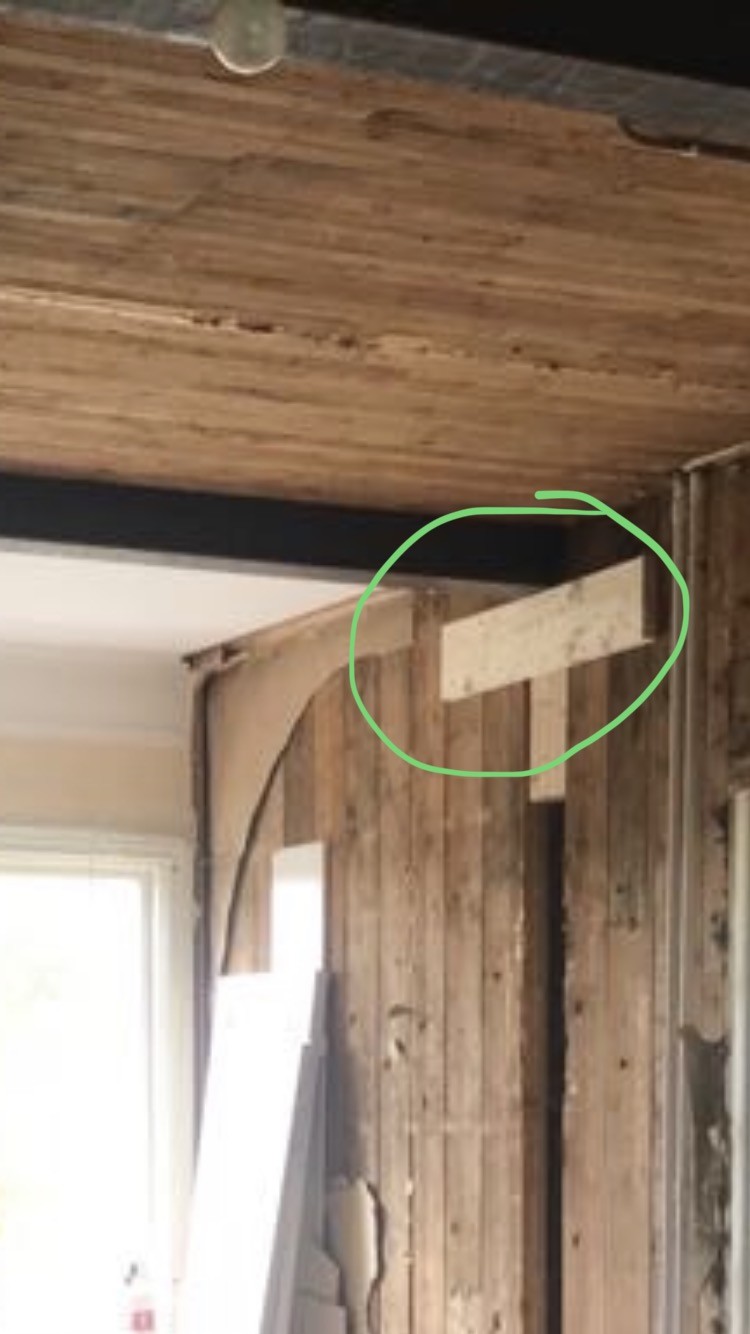
This part will continue to remain. It will probably be thicker than the wall. The shorter pieces below will probably be replaced with the post against the foundation.
HHåkan V said:
I don't quite understand where you mean there will be a thicker part, up by the ceiling or down by the floor? If the beam is not too short, nothing should protrude more than the post I think, and if you choose to make the post out of glulam beam, it will be so nice that it won't need to be covered.
[image] This part will continue to remain. It will probably be thicker than the wall. The shorter pieces underneath will likely be replaced by the post towards the foundation.
Then I would probably say that the beam is too short if it cannot rest on the post that stands in the recess in the wall.
If the board in the picture is intended to hold the post in place in the recess in the wall, the board can be replaced with one that is not thicker than the new wall.
Then I would probably say that the beam is too short, if it cannot sit on the post that stands in the notch in the wall. If the board in the picture is intended to keep the post in place in the notch in the wall, the board can be replaced with one that is not thicker than the new wall.
The beam goes all the way to the exterior panel, so it's probably not too short.
Vi vill skicka notiser för ämnen du bevakar och händelser som berör dig.