If you disregard the purely aesthetic aspect - which I find difficult to comment on since I haven't seen the house - there shouldn't be any major concerns? The cut in the eave only serves the function of directing downward force from the upper frame to tensile force in the lower frame. However, I would have chosen a brace instead of straight plywood sheets.
@justusandersson is usually never wrong when it comes to advice on constructions, but are you saying that's the case now?
I think it depends a lot on what material you plan to cover the wall with...
If you've seen the "dream house" with the gray house covered in granite ceramics, I understand that you might like the look it gives... And with that material, it probably works well...
I myself have a house with an extremely small "eave" (flat roof), and you can notice that sun and water take a toll on the paneling, doors, and joinery around the windows... Because the slightest breeze causes water to end up on the windows, they also get much dirtier on the outside...
It will weaken one of the truss's most important attachment points if you do it like that. It won't be good, and I can't see why someone would want to ruin a truss like that?
Of course TS should be allowed to build an ugly house if he wants.
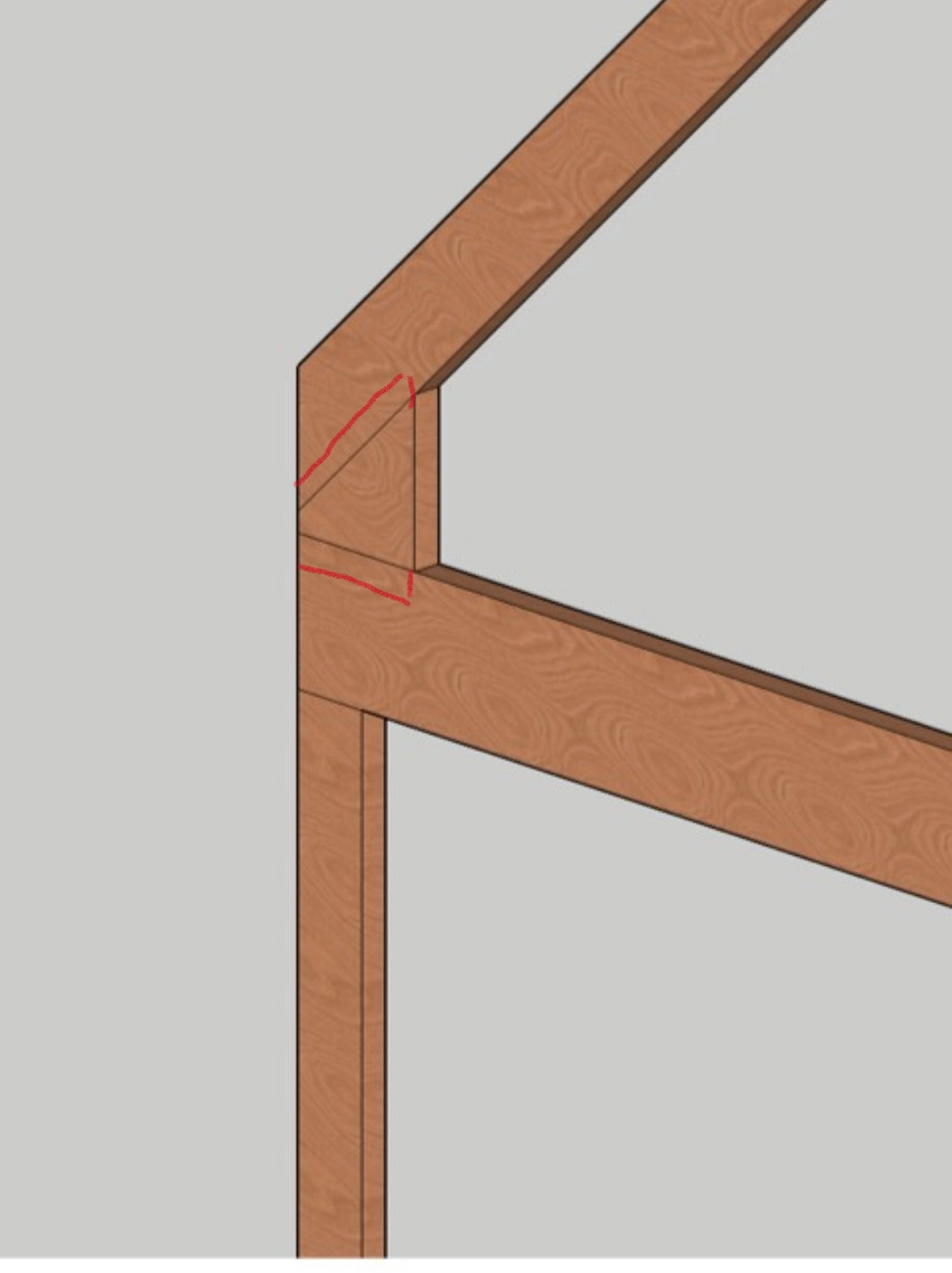
Would it be better if you recessed the section between the forearm and upper arm a bit? Like this?
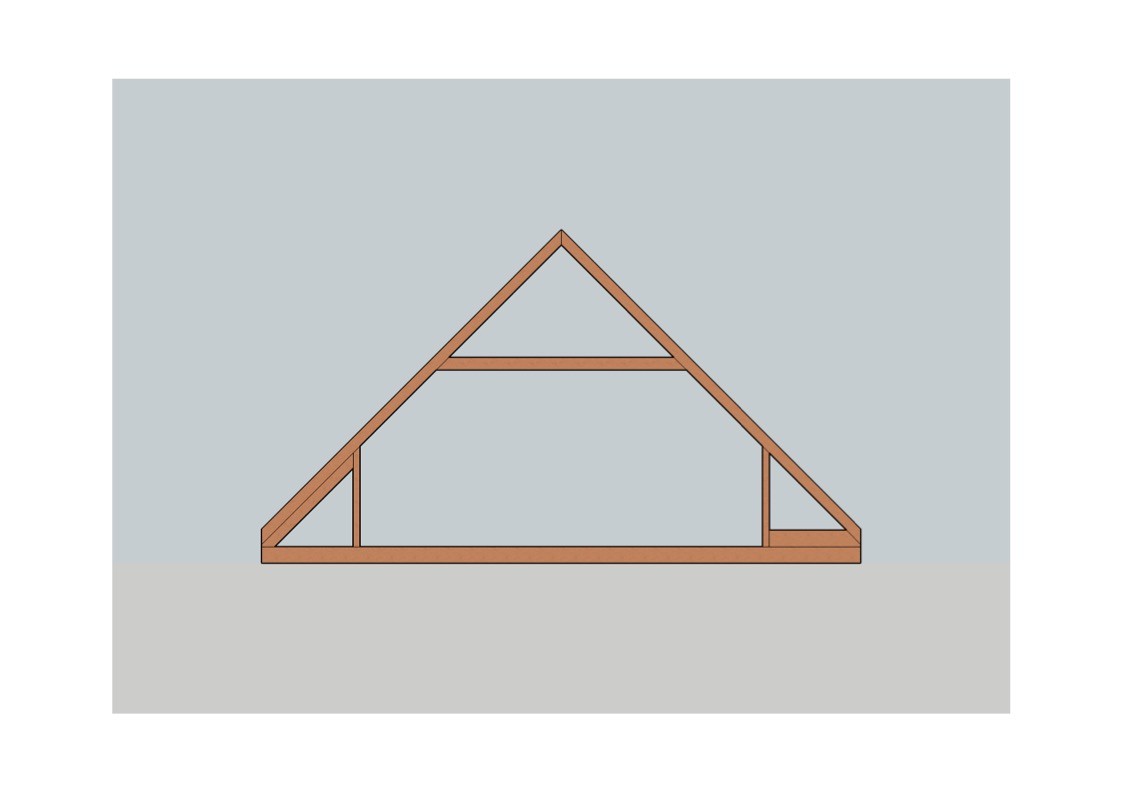
There are tensile forces in the bottom chord and compressive forces in the top chord.
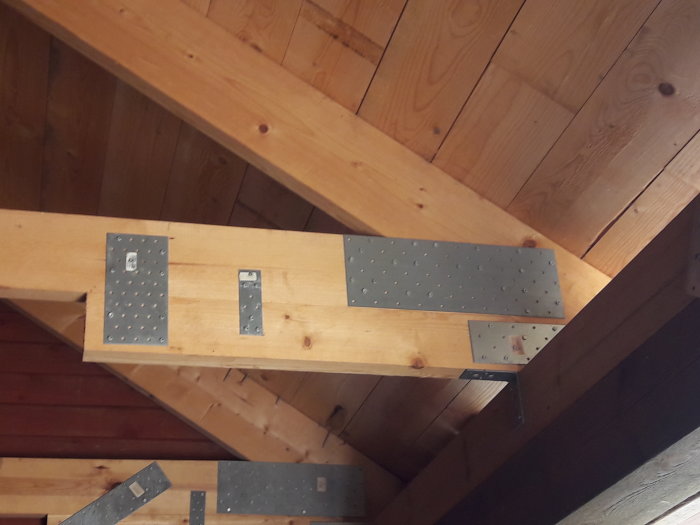
These should be connected, and this can be done with a wedge and a larger nail plate angled at 45° leaning outward to hold the top chord that wants to push the wall out.
Then the fact that this leads to other problems with water etc. is another matter.
See the picture of how I solved a similar problem.
/ATW
Unbelievable that TS wants to rebuild. An eave like the original works best for gutters and protects the upper part of the facade from rain. Even during heavy rain, the original is better if the gutters overflow due to heavy rain.
I agree with everyone else that it must look downright ugly. But as mentioned, everyone probably thinks differently. Still, I must advise against doing it; the house will probably remain when you no longer live there and having "ruined" a house doesn't feel good...
The reason I created this thread was to get some clarity on whether it's technically possible to shorten the truss as much as I want in some way. If my proposal doesn't work, I'm simply wondering if there are other options.
That the house will look ugly in some people's eyes is another thing; if I didn't think my idea was nice, I would never have asked for help here on the forum. It's the load-bearing capacity I want to know more about, not the design.
Do you have any tips on a company that can help me calculate how I might be able to do this?
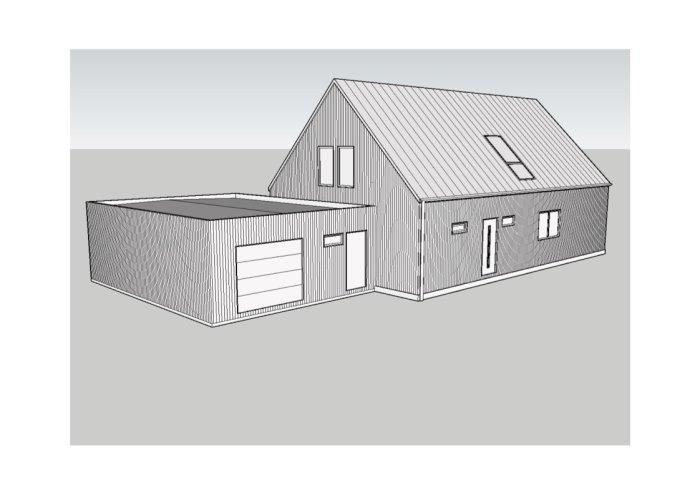
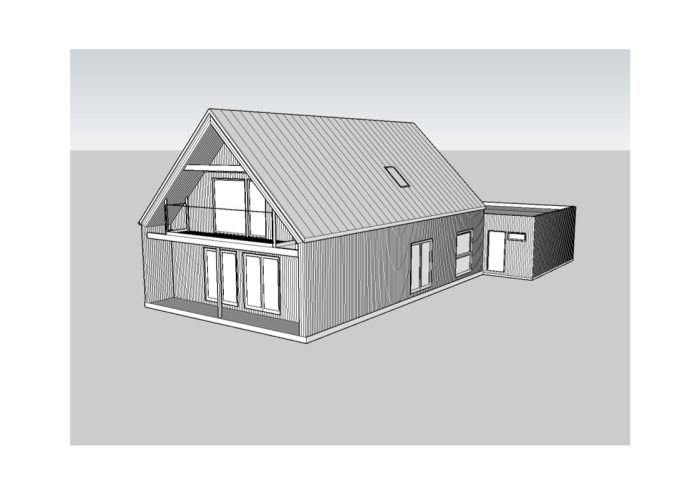
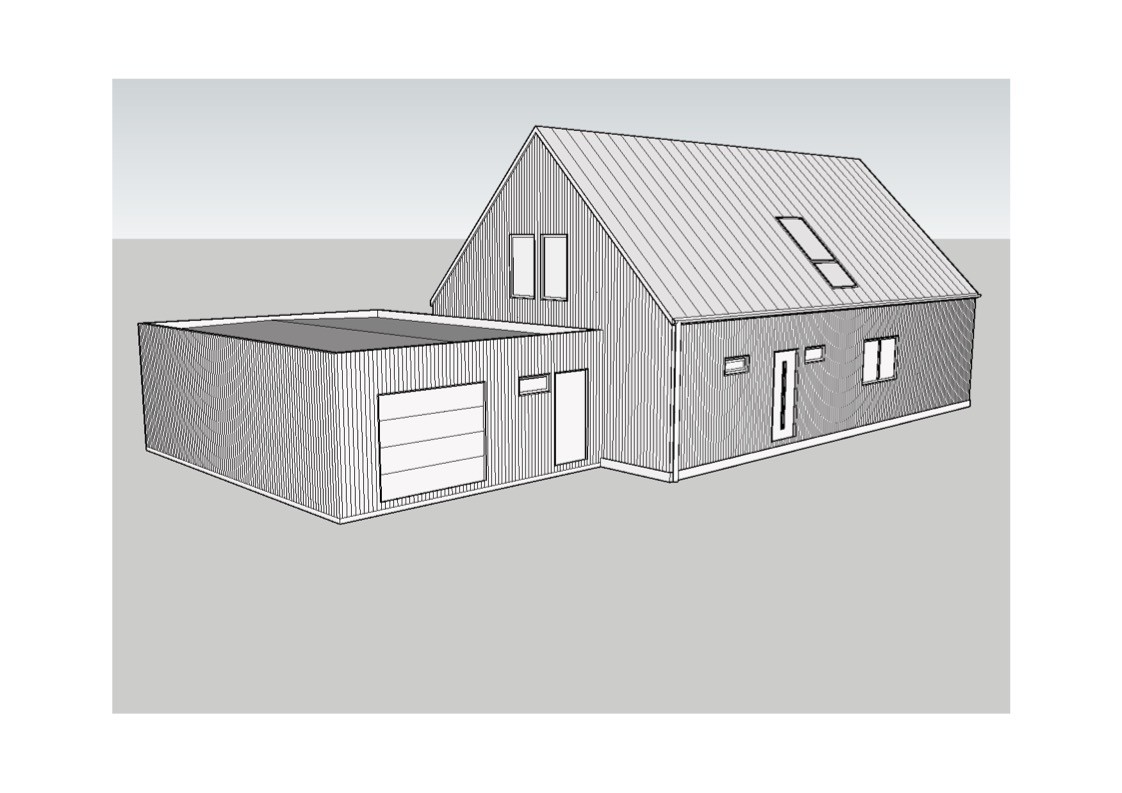
I also want to clarify that there will be a small overhang, and drainage will be done as usual with a gutter and pipe. I’m posting an image of the proposed design, but I want to clarify that the details are not final, so if the eave can come out a few cm or so, it's not set in stone; it just needs to work before it's put into use.
But anyway, here's a picture of our "Ugly" proposed house.
Would these two options work better? I am thinking both with nail/screw plate or alternatively screw-glued k-plywood.
I have the entire attic space to work with, so I can make any changes there if it helps.
Apologies for my absence in the thread, but I was actually kicked out. Probably by the automatic know-it-all function. Per Eskilsson has been kind enough to allow re-entry. I wrote that I assessed TS's proposal as unstable and meant against lateral forces, e.g., wind. It is possible that one could solve it with a diagonal brace from the support leg's attachment to the end of the high leg, in the style of a so-called "svensk takstol". Otherwise, you have to adjust the high legs so they land correctly, but then you'll have to rebuild the roof. A third option is to extend the wall studs moment-stably. Then you have to cut the wall plate next to each affected stud and attach it with angle brackets instead.
Apologies for my absence in the thread, but I was actually kicked out. Probably by the automatic know-it-all function. Per Eskilsson has been kind enough to admit me back. I wrote that I assessed that the original poster's proposal was not stable, and I meant against lateral forces, e.g. wind. It is possible that one could resolve this with a diagonal brace from the support leg's attachment to the end of the high leg, like a so-called "Swedish truss". Otherwise, you need to adjust the high legs slightly so they land properly, but then you need to rebuild the roof. A third option is to extend the wall studs moment-stably. Then, you would need to cut the tie beam next to each affected stud and attach it with angle brackets instead.
I haven't kicked anyone out because I don't know how to do it .
And I think you provide good comments; the fact that the answers haven't been as I hoped for is not your fault.
But I like your latest comment, it gives me hope that this can actually be sorted out in some way.
A diagonal brace from the support leg's attachment to the end of the high leg, how? Shouldn't it be like on the right in my latest post?
In a Swedish truss, the brace slopes so that it goes between the end of the rafter and the attachment of the prop in the floor beam, which is more stable than the variant in your sketch above, although the latter might work as well.
In a Swedish truss, the brace slopes so that it goes between the end of the rafter and the connection of the post to the floor beam, which is more stable than the variant in your sketch above, although the latter might work too.
Welcome back from your little trip in the cold
Can't you show with a simple sketch?
Just a few pencil strokes will probably suffice.
In a Swedish roof truss, the diagonal brace is angled so that it runs between the end of the king post and the attachment of the strut to the floor joist, which becomes more stable than the version in your sketch above, although the latter might also work.
I think it will be difficult to achieve any angle at all on the diagonal brace since the space between the king post and the floor joist is so small, just a few cm apart from each other.
Vi vill skicka notiser för ämnen du bevakar och händelser som berör dig.









 .
.