
6,263 views ·
13 replies
6k views
13 replies
Railway tracks to reinforce floor against upper floor?
Hello
I have a very sagging floor on the upper floor of my summer cottage. An old cottage with sparse/weak timber.
I'm considering using 4 railway beams from a narrow gauge to lift the joists - it's 5.4 meters from wall to wall, and the "I-beam" is 4.5 cm wide, 7 cm high, and weighs 16 kg per meter. I thought that the outer edges of the beams should rest on standing WOOD studs that stand on the concrete block on which the sill rests - I will relieve the standing wood studs by simultaneously attaching them to the log wall.
Am I thinking wrong? Is the iron beam too weak? Or is it even "overkill" to use rails?
As mentioned, I thought of using 4 rail irons between existing weak wooden beams. Today, I have 1 m between the nail heads in the ceiling, so I suspect that's where the beams are. I thought of placing the irons 1.2 m apart.
Hoping for a quick response, best regards
Peter
I have a very sagging floor on the upper floor of my summer cottage. An old cottage with sparse/weak timber.
I'm considering using 4 railway beams from a narrow gauge to lift the joists - it's 5.4 meters from wall to wall, and the "I-beam" is 4.5 cm wide, 7 cm high, and weighs 16 kg per meter. I thought that the outer edges of the beams should rest on standing WOOD studs that stand on the concrete block on which the sill rests - I will relieve the standing wood studs by simultaneously attaching them to the log wall.
Am I thinking wrong? Is the iron beam too weak? Or is it even "overkill" to use rails?
As mentioned, I thought of using 4 rail irons between existing weak wooden beams. Today, I have 1 m between the nail heads in the ceiling, so I suspect that's where the beams are. I thought of placing the irons 1.2 m apart.
Hoping for a quick response, best regards
Peter
Last edited:
I would say that rails are way too flexible. You need a significantly stiffer iron construction. If you think about the c/c measurement of sleepers, you see that rails require support from underneath in a completely different way than you are aiming for.
Thanks - yes, this might be something I've missed, especially considering the weight of the rails.C Chentin said:
On the other hand, there's a bit of a difference between supporting a locomotive and a floor with furnishings weighing a maximum of 200-300 kg. It's a cottage we're talking about - with a rather steep roof and low ceiling height (read: un-furnishable).
But I think you're right - I'll check the rails before buying, they're really narrow/small despite their weight. However, I don't know how to calculate the load-bearing capacity of the rails
 also, the load-bearing capacity of the rails might have deteriorated over the years.
Again - thank you so much for your response.
What I mean is that the railway track is not particularly torsionally stiff, as it is designed to withstand extremely high point loads, with proper support from below.P p.newbranch said:Thanks - yes, this might be something I've missed, especially considering the track's weight. On the other hand, there's a bit of a difference between carrying a locomotive and carrying a beam structure with interior at a maximum of 200-300 kg. It's a cottage we're talking about - with a pretty steep sloping roof and low ceiling height (read: unfurnishable).
But I think you're right - I should inspect the railway track before purchase, it is indeed very narrow/small despite its weight. However, I don't know how to calculate the load capacity of the track
Again - thanks a million for the response.
When replacing tracks, the new ones are usually placed alongside the existing track. Then you can see that it looks like "brown spaghetti" lying on its side, as they lay "limp" on the ground. (I work as a train driver).
On the other hand, when you look along the rail, the impression is different than if you look a few meters from the side. But such a thin rail is not optimal for the ts floor. But if he gets it cheaply, it may be worth testing.C Chentin said:What I mean is that the rail is not particularly torsionally rigid, as it is designed to withstand extremely high point loads, with proper support from underneath.
Before changing rails, the new ones are usually placed alongside the existing rail. Then you can see that it looks like "brown spaghetti" lying on the side, as they lie "slack" on the ground.
(Working as a train driver).
Staffan
No, it's not even worth trying. As @ArneTW writes above, the deflection will be extreme.Staffan2000 said:
Completely pointless.
I now realize that there are better solutions. It's not good to have a "quick fix" of this kind.
They would cost me 600 SEK per rail - and I would have needed about 5 of them. But - shipping home on a boat trailer would cost a couple of thousand more since it involves quite a few miles.
A thousand, thousand thanks for sharing your expertise and thoughts.
They would cost me 600 SEK per rail - and I would have needed about 5 of them. But - shipping home on a boat trailer would cost a couple of thousand more since it involves quite a few miles.
A thousand, thousand thanks for sharing your expertise and thoughts.

Anyway, an interesting way to solve a house-building problem!P p.newbranch said:
We actually had some rails in our first house, a fisherman's cottage in the Gothenburg archipelago built sometime in the 1800s, which we bought in 1975.
The living space was on the upper floor, as the ground floor had served as a store for a couple of decades.
There was a kitchen with a kitchen counter and wood stove at one end, and a living room with a stove at the other end.
So the chimney stack was extended about 3 meters between the kitchen and the living room, and in between, the bricks rested on two railway rails.
And it was fine to have fires both in the kitchen and the living room.
Then we renovated, moved the kitchen downstairs, and made bedrooms upstairs.
And we tore down the chimney and found the railway rails.
And then it became a simple modular chimney for a new stove on the ground floor.
And where the chimney had spread out on the upper floor, it became space for four closets


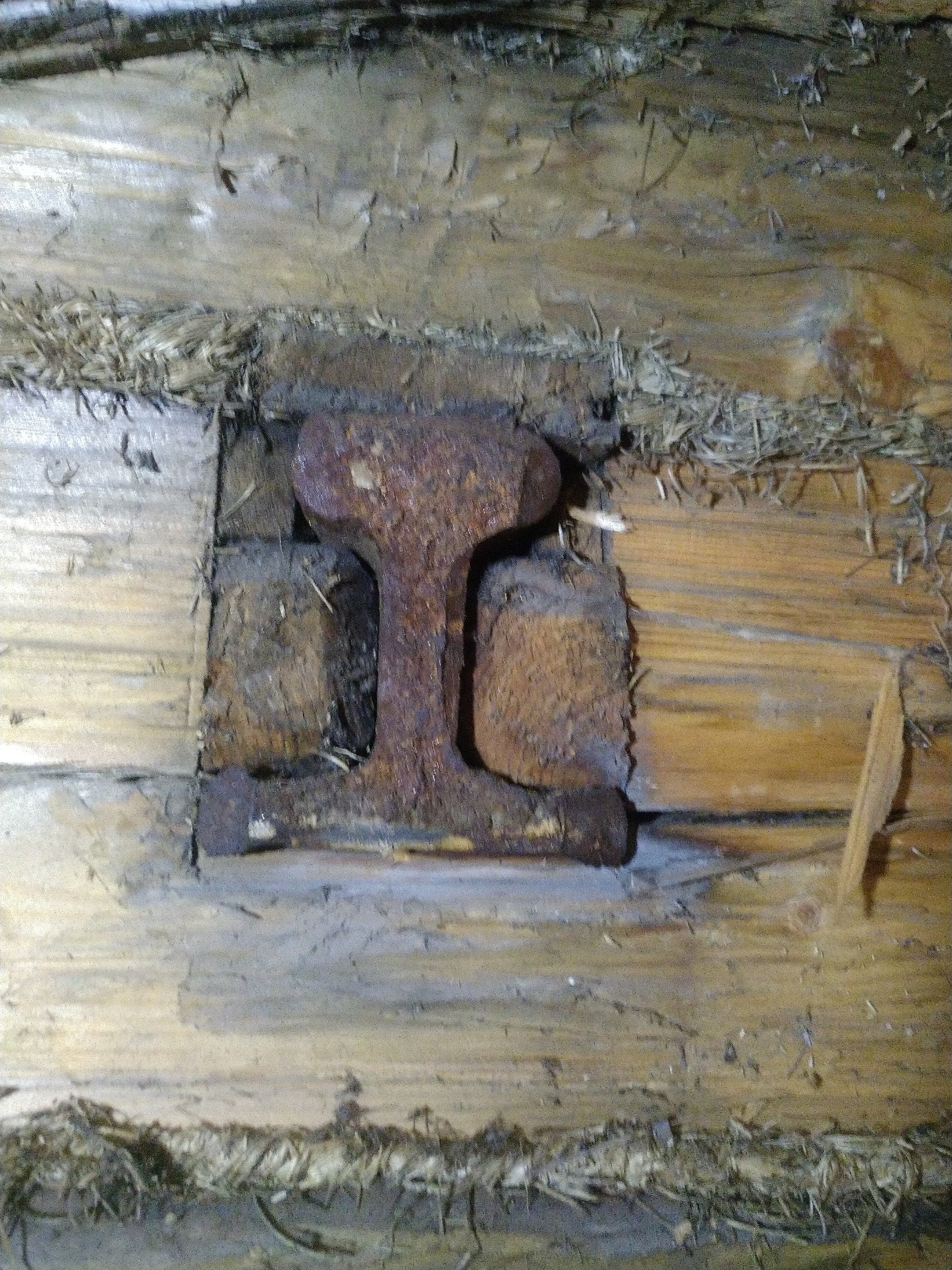
The tiled stoves in the apartment buildings were supported on rails or other steel beams across the chimney.KnockOnWood said:
Anyway, an interesting way to solve a house-building problem!
We actually had some rails in our first house, a fisherman's cabin in the Gothenburg archipelago built sometime in the 1800s, which we bought in 1975.
The living area was on the upper floor, as the ground floor had served as a shop for a couple of decades.
There was a kitchen with a kitchen counter and a wood stove at one end, and a living room with a stove at the other end.
So the chimney stack was extended about 3 meters between the kitchen and the living room, and in between, the bricks rested on two railway rails.
And it worked well to have fires both in the kitchen and the living room.
Then we renovated, moved the kitchen to the ground floor and made bedrooms upstairs.
And we tore down the chimney and found the railway rails.
And then it became a simple modular chimney for a new stove on the ground floor.
And where the chimney had spread out on the upper floor, there was room for four wardrobes
The TS. problem is the large span and the unusually thin rails, which compared to today's 60-80kg/m are not much to speak of.
Staffan
Interesting discussion for all railway enthusiasts. What makes railway rails particularly unsuitable for construction purposes is the profile, which provides a low moment of inertia. With a narrower web and equally wide flanges on top as at the bottom, the same amount of steel could produce a significantly stiffer beam. A rail weight of 16 kg is not much. It seems to be Decauville rails. On which railway has it been used? I can't find the current profile in my table of railway rails.
Click here to reply