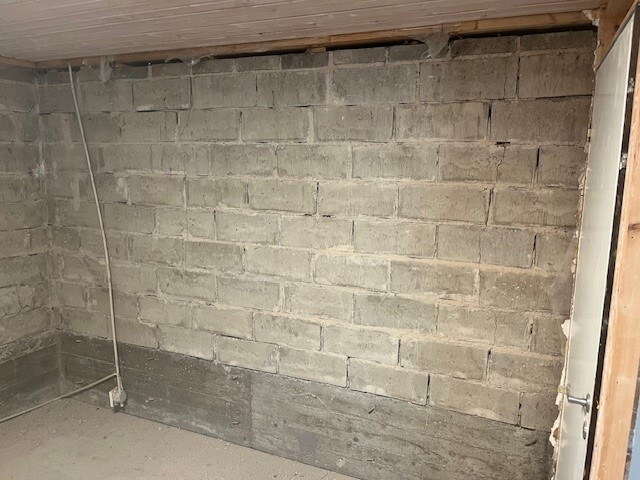
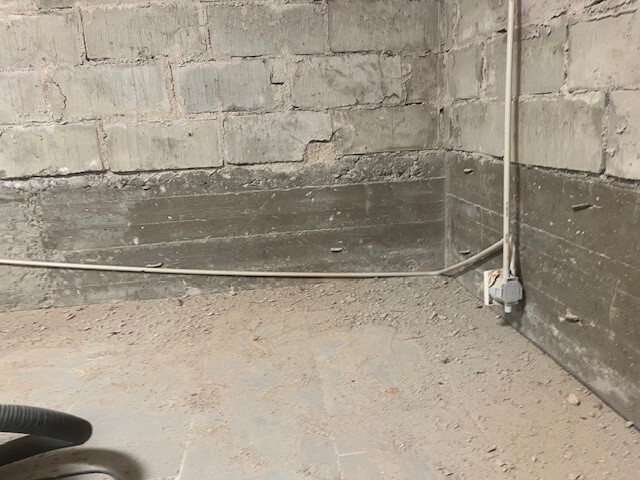
I have 4 questions regarding plastering a basement wall.
Starting with Conditions:
1) The basement is heated and not particularly humid.
2) The house is from 1976.
3) The room will become a pantry with a refrigerator and freezer.
4) 13 sqm wall.
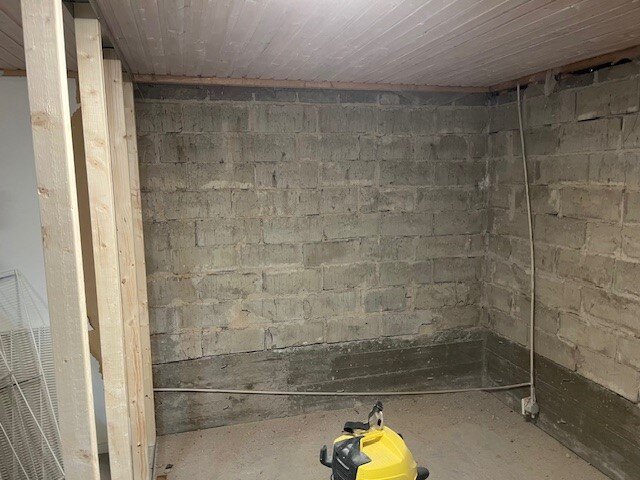
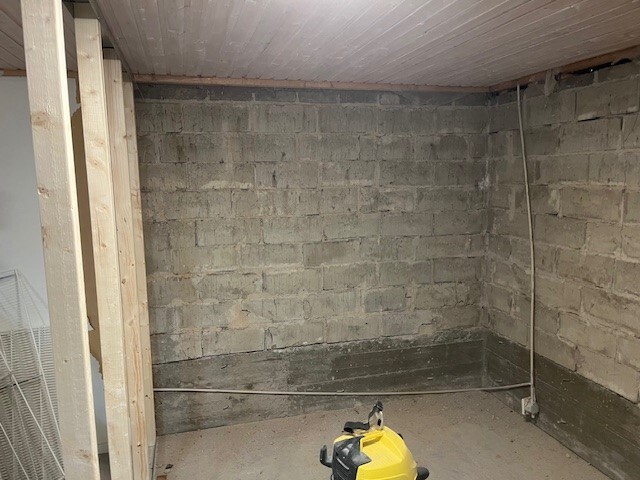
4) The wall is entirely underground and is divided into a poured section of about 50 cm and a section with cement blocks of 180 cm.
Questions:
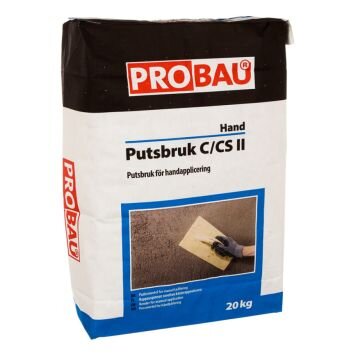
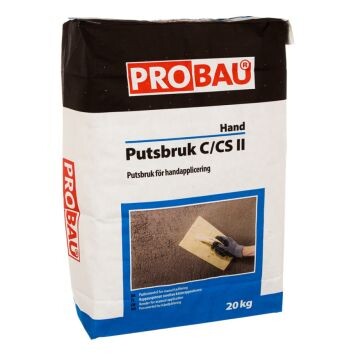
1) Can I use the recommended plaster mix, 14 bags?
I was recommended by Bauhaus staff to use PUTSBRUK COMBIMIX PROBA, see picture.
2) How do I handle the uneven wall?
Between the poured section and the concrete blocks, there is a difference of up to 15 mm, i.e., the concrete blocks protrude 15 mm from the wall compared to the poured section. There are concrete blocks with 15 mm gaps between them as well.
3) Do I have to prime the poured section?
4) When it says "Thickness per application 5–10 mm," is that per "layer" or does the plaster not hold more? Or can I plaster 10 mm + 10 mm?
5) The mortar between the blocks is sandy, do I have to remove it completely or? I have scraped with a masonry hammer and brushed with a hard brush. When I brush, the sand never stops coming. Does that mean I have to remove it completely?
I have 4 questions regarding plastering a basement wall.
Starting with Conditions:
1) The basement is heated and not particularly humid.
2) The house is from 1976
3) The room will become a pantry with a fridge and freezer
4) 13 sqm wall
4) The wall is completely underground and is divided into a cast part about 50 cm and a part with cement blocks 180 cm
[image]
Questions:
1) Can I use the recommended plaster mortar, 14 bags?
I was recommended by Bauhaus staff to use PUTSBRUK COMBIMIX PROBA, see picture.
If it's Combimix that manufactures the mortar, then it's good..
Vvictorpajas said:
[image]
2) What do I do with the uneven wall?
Between the cast part and the concrete blocks, it can differ up to 15 mm, i.e., the concrete blocks protrude 15 mm from the wall compared to the cast part. There are concrete blocks that have 15 mm gaps and between each other.
You need to fill in all depressions that are a bit more than, say, 5 mm a day in advance..
Vvictorpajas said:
3) Do I need to prime the cast part?
No, you don't need to prime regular plaster mortar..
Vvictorpajas said:
4) When it says "Thickness per application 5–10 mm" is it per "layer" or can the plaster not take more?
Or can I plaster 10 mm+10 mm?
Yes, 10 mm is usually the maximum application per layer, so you'll need to plaster the concrete part first as it is recessed..
The walls look very dry, it's good to pre-water with something like a low-pressure sprayer a little before applying the mortar, but it shouldn't have running water, just dampen it so the mortar doesn't dry too quickly..
The walls look very dry, good if you pre-water with, for example, a low-pressure sprayer a little before applying the mortar but it shouldn't run water, just dampen so that the mortar doesn't dry too quickly.
I have seen this instruction that I plan to follow [link]
Is it reasonable?
Yes, studying is always good; read Finja's and Weber's plastering tips.
One thing to keep in mind if you're going to plaster 2 layers with, for example, 10mm, is not to make the first application too smooth, or else you'll have problems with the adhesion of the second layer.
Many times, you use a notched trowel on the first layer because then the surface layer adheres incredibly well.