I don't speak Swedish very well, hope that English is okay!
First of all, I hope I am in the right section, and apologize if I am making a mistake, or breaking a rule, it is pretty hard for me to understand Swedish at this point (working on it).
So ... I have a wall.
I hate this wall. So. Very. Much.
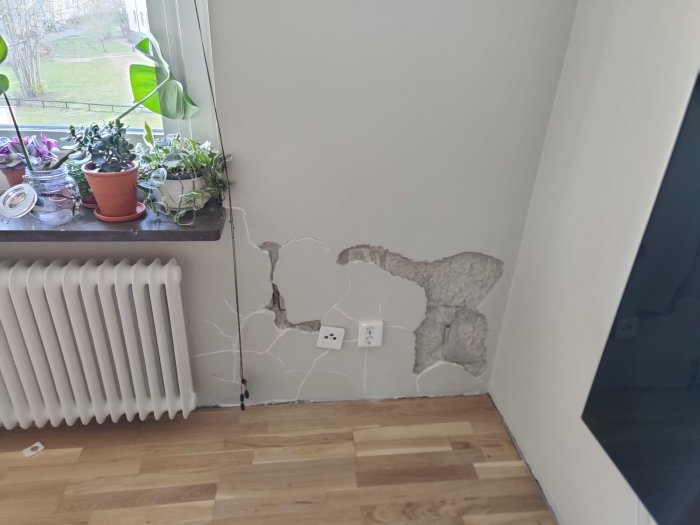
When I removed wallpaper from it the first time, a section of it ... came off. I was in a rush, tried to fix it quickly, messed up, called someone to spackel everything. Done.
Couple of months later, I get some ... cracks (who would have guessed). This time I am more patient, and I decide to fix them properly. I start opening the cracks, and removing any moving part and ... I keep doing that.
Here is the result right now:
And I have .... more to remove (especially lower left part).
It is really obvious that some of the layer between the concrete block and the spackling is ... cracked/sandy/loose.
My idea was to apply Husfix between the recesses first, and then in layers until I feel comfortable spackling everything.
My questions were then:
How fucked am I?
Is Husfix the right product for this application?
Should I be doing something completely differently?
Again, I am really sorry if I am asking something wrong, and I apologize for it.
I don't speak Swedish very well, I hope English is okay!
First of all, I hope I am in the right section, and apologize if I am making a mistake, or breaking a rule, it is pretty hard for me to understand Swedish at this point (working on it).
So ... I have a wall.
I hate this wall. So. Very. Much.
When I removed wallpaper from it the first time, a section of it ... came off. I was in a rush, tried to fix it quickly, messed up, called someone to spackle everything. Done.
Couple of months later, I get some ... cracks (who would have guessed). This time I am more patient, and I decide to fix them properly. I start opening the cracks, and removing any moving part and ... I keep doing that.
Here is the result right now:
[image]
And I have .... more to remove (especially lower left part).
It is really obvious that some of the layer between the concrete block and the spackling is ... cracked/sandy/loose.
My idea was to apply Husfix between the recesses first, and then in layers until I feel comfortable spackling everything.
My questions were then:
How fucked am I?
Is Husfix the right product for this application?
Should I be doing something completely differently?
Again, I am really sorry if I am asking something wrong, and I apologize for it.
I thank you very much for looking at my thread
Husfix will work, but is expensive. Gipsputs or cementbaserad puts is cheaper. Read the instruction for the product. It may be so that you should damp the wall before applying the plaster. And remove everything that is loose.
Husfix will work, but is expensive. Gipsputs or cementbaserad puts is cheaper. Read the instruction for the product. It may be so that you should damp the wall before applying the plaster. And remove everything that is loose.
Welcome to the forum, you’re not the first one asking questions in English, no worries
First of all, you should give the wall a good going over with a hammer, to make sure that all that’s going to come off will come off. Feel free to bring out your aggressions at this point
Secondly, I’d like to know why the grout is falling out. Damp? Is there a leak somewhere?
Then, you could either use gipsputs or cement-based plaster like @Tompafix says, or, if you really hate the wall and want to do something radical about it, cover it with drywall/plasterboard or perhaps even hardboard that you paint or paper over or whatever. Think of it as your chance to get a serious change done
There’s this "renoveringsgips" that’s thinner than ordinary drywall that you can whack straight onto the wall if you like, although fastening it onto stone might be a problem, especially if the rest of the wall is porous too. What material is it exactly?
Otherwise, you might have to use steel latches and ordinary plasterboard, but that’s going to build into the room.
Either way, whenever working with putty, get some fibreglass in there first for the putty to hang on to. Otherwise, it will crack in all directions, sorry to say.
Yeah, as @ricebridge says, figure out why it's falling off here.
It could be that it's just a lousy wall that has waited for any excuse to make your life miserable since it was built due to poor adhesion from the start. But it could also be a sign that there might be a leak from a pipe or from the outside due to some poor weatherproofing.
And in that case, it might be something that isn't your responsibility, but the association's insurance that should pay someone to fix it permanently (after fixing the underlying cause).
But, if it ends up as your responsibility the three main things to do to ensure that this is the last time you fix (this part of) the wall in my opinion is:
1: Remove *everything* that might loosen up after some time. Hit it with a hammer, perhaps not with all your built-in feelings for the wall, because it might be frowned upon if you make holes all the way through. But make sure that you really get everything where it sounds hollow or at least not completely dead and solid.
2: Primer. The concrete behind the wall is really dry, when you apply the layer of puts it will try to suck as much moisture out of it as it can otherwise. Then you end up with a layer of dry sand between the concrete wall and your puts. And you don't need those therapy bills.
3: I would actually consider a rather drastic approach just to make damned sure that this will be the last time:
Since you have a fairly thick layer of puts you could actually drill a number of holes in the concrete and add plugs and screws that hold a putsnät or some chicken net in place. That net should end up within the puts and hold it together. This last step *should* not be needed if step 1 and 2 are done correctly.
Tack till alla som har svarat för att hjälpa mig! Det gör mig mycket mer säker på att jag kan lösa det här problemet!
Imma wack that wall idag.
Angående det underliggande problemet tror jag att jag har en gissning, det finns ett hål som leder ut någonstans (uttagen kan bli... blåsiga). Och jag antar att regnvatten/luftfuktighet under åren sakta har tagit hand om den här väggen.
Det är mitt första riktiga renoveringsprojekt, så jag är inte 100% säker på vilket material som använts, det verkar bara mycket skört, gulaktigt och har små stenar i sig.
Men vill du veta den reeeeaaaal anledningen till varför jag hatar den här väggen mer än något annat?
Ser du uttaget till vänster? Antena/TV/Internet? om jag flyttar det för mycket, kapar jag internet till halva byggnaden
Stop!
If there is a draft and a possible leak from the outside, that must be fixed first, otherwise you will keep this task as a yearly tradition!
And it's nothing that you should have to fix, it's for the homeowners association to solve and they should also take care of the damage done to your apartment.
I.e., contact the board and let them know about the issue and they should then take it from there.