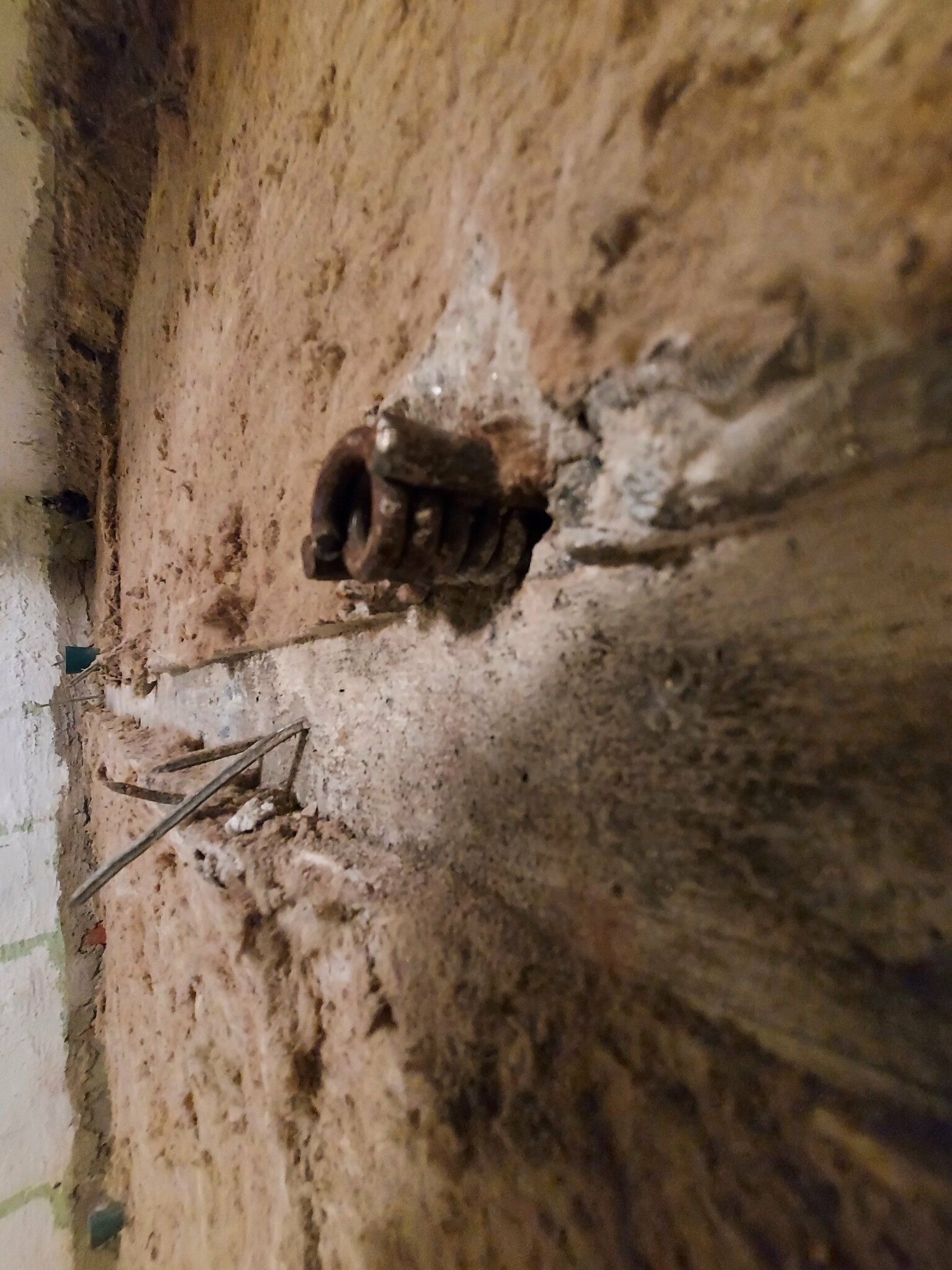
Have torn down studs inside the outer wall in the basement of our 70s house and then pipes/spacers appear according to the picture. Does anyone have any idea what it is? These are all over the wall, though a bit difficult to see in the picture.
 
  • Exposed pipe or spacer in basement wall after removing studs, showing vintage construction detail in a 1970s house.
  • Close-up view of two blue hexagonal bolts embedded in an old wall with insulation material, from a 1970s house basement renovation.
  • Exposed wall with brown insulation and visible pipes or spacers in a 1970s house basement, showing damaged and uneven surface.
O Oskaris said:
I have torn down studs inside the outer wall in the basement of our house from the 70s and then pipes/spacers appear as shown in the picture. Does anyone have any idea what it is? These are present all over the wall, although a little hard to see in the picture.
In the sleeves are probably the remains of the reinforcement bar that went through the formwork. The purpose of the rods was to hold the form together during the casting process.
I have only seen smooth reinforcement bars, but perhaps there was a threaded variant given the design of the sleeve.
 
  • Like
Oskaris
  • Laddar…
S Spikrätaren said:
In the sleeves, there are probably the remains of the bistål that went through the mold. The task of the bars was to hold the mold together during the casting itself. I've only seen smooth bistål but maybe there was a threaded variant considering the design of the sleeve.
I looked at the pictures again and became very doubtful about my assumption. I can't quite make sense of the wall construction itself. It would be fun if someone knows...
 
  • Like
Oskaris
  • Laddar…
Looks like insulation of the type Rockwoll Elefantmatta is there, if so, there are spacers to avoid compressing the insulation with the wall material when it is fastened in place.
 
  • Like
Oskaris and 1 other
  • Laddar…
Took some closer pictures and if you unscrew the casing, there's a spring the casing is screwed into, seems complicated😅
 
  • Close-up of a hand unscrewing a blue sleeve from a wall, revealing a spring mechanism underneath, on a textured surface.
  • A close-up of a threaded socket in a rough wall with the cover removed, revealing a spring inside, indicating a complex mechanism.
??? Fjäder. Can it be that the outer wall cladding should be able to move then. How was it attached from the beginning of your job. What does the wall consist of that the springs are attached to, or is there some kind of bracket that it's attached to, and the bracket in turn attached to the wall. You can cut out a piece 150X150 mm and lift it out, just put it back then.
 
J jonaserik said:
??? Spring. Could it be that the outer wall cladding needs to be able to move then. How was it attached from the start of your job? What is the wall made of where the springs are attached, or is there a bracket that it sits in, and the bracket in turn is attached to the wall? You should cut out a piece 150X150 mm and lift it out, just
They appear to be cast in the concrete, was planning to cut them off and then either plaster or frame the wall, but now I'm unsure if they hold something on the other side which is actually underground so nothing should collapse 😅
 
  • Close-up of a small pipe or hole in a concrete wall, possibly for structural support or utilities.
  • Rusty metal rods appearing to be embedded in a concrete wall, possibly used for structural support. The wall surface looks rough and aged.
O Oskaris said:
They appear to be cast in the concrete. I was thinking of cutting them off and then plastering or framing the wall, but now I'm unsure if they hold anything on the other side which is below ground, so nothing should collapse😅
Originally, it was cladding made of what I believe was Masonite and vertical studs attached to the semi-cast horizontal studs.
 
Click here to reply
Vi vill skicka notiser för ämnen du bevakar och händelser som berör dig.