I have marble countertops in the windows. I had to cut these myself for an optimal fit. The mistakes I made are in the boiler room and storage. The light granite countertops delivered to the kitchen had one piece a few millimeters thicker and were replaced since I would be living with this kitchen for decades.
In one room, I sawed slabs of cobblestones and clad them around the chimney. That's truly natural material. You might think the chimney is made of cobblestones and the joints follow suit.
Many hours are spent getting that little extra. If you have a customer who demands that little extra and is willing to pay dearly for it and comes to see a sloppy job, you can safely expect the invoice to be disputed.
I had someone who was supposed to help me with the bathroom, whom I threw out after four hours because he was incompetent. If I'm going to get help with something, they shouldn't do a worse job than me.
If it is the end customer and architect who have chosen the material, it makes sense to send the question back there when the selected supplier doesn't seem able to deliver the expected quality.
This should be about a computer-controlled water jet cut product. I am more surprised that the variation is so large. It is definitely not difficult to achieve good precision even with natural stone.
This should be about a computer-controlled water jet cut product. Then I'm more surprised that the variation is so large. It's definitely not difficult to achieve good precision even with natural stone.
Could the base material be cracked and brittle so that chips break off during cutting? Then there's a high risk that the tiles will crack even during normal use as floor tile?
If it is the end customer and architect who chose the material, it is appropriate to send the question back to them when the chosen supplier does not seem able to deliver the expected quality.
This should involve a computer-controlled water jet-cut product. I am more surprised that the variation is so large. It is definitely not difficult to achieve good precision even with natural stone.
As it stands right now, the customer and architect will take over the dialogue after the Christmas break. We have done our part in a way. But I am very surprised by the response from the store. Many amusing email conversations with one excuse after another as to why the tile is actually okay, despite its damage. "Natural traits in the stone" 4 mm chip missing. Well, you live and see many different things; we can agree on that at least.
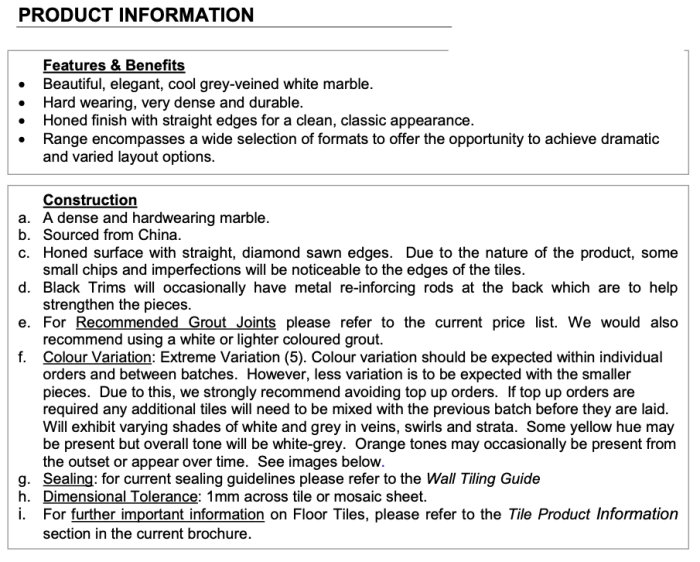
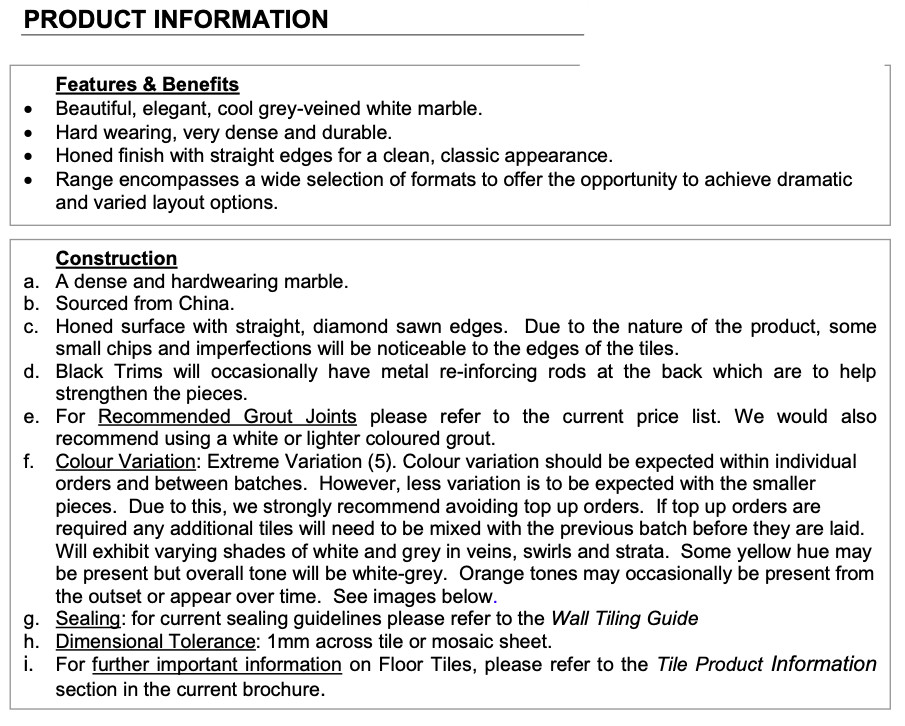
I dug a little deeper into the papers that came to us after our complaints were sent. Here you can read about the types of deviations that are acceptable. The picture shows something that, in my opinion, is as far from Class 1 tiles as you can get. Maybe the tactic in the store is to only display the best tiles. When the issue arises with some aware customers, they then present this material to set expectations.
Below is a clip from the email:
“The product is not faulty, nor poor quality.
It’s impossible to cut marble to produce perfect lines, this is the nature of the product and its manufacturing process. Water jet cutting is the only way, which results in an extremely expensive product.
"With Bianco Carrara marble you get the best of Italy." Yeeeehh right!
Good guess, but unfortunately wrong. This store is "a notch" more expensive for the same tiles. We chose the exclusivity and Class 1 tile. Then you would choose from them.
Good guess, but unfortunately wrong. This store is "a notch" more expensive for similar tiles. We chose the exclusivity and Class 1 tile. Then one would choose from them.
Good guess, but unfortunately wrong. This store is "a notch" more expensive for the same tiles. We chose the exclusivity and Class 1 tile. Then you would have to choose from them.
But who said they were exclusive? All sellers probably claim they have fantastic products, but was there anyone else with insight who referred to them?
And furthermore, the seller might not know anything about tiles and may not even like or care about them. There's a risk that it's just a reseller. Then it becomes trouble and excuses.
But good that you've backed off, it sounds strange that you should choose what someone else wants in their bathroom...
Could the base material be cracked and brittle so that splinters come off during cutting? Then there's a high risk that the tiles could crack even under normal use as floor tiles, right?
Once the tiles are laid (evenly!), the risk of damaging them is small. They are fragile to edge impacts when they are loose (when there are "open" edges), but once they are laid and grouted, there are no such edges (if done correctly).
Natural stone is simply natural stone, with some variations in both shape and color. As someone mentioned above, this is a pattern on mosaic stones that are normally made in ceramic stone, but now with modern technology, it's possible to achieve it in marble, although variations may occur. But... from what I can see from the pictures, it's all these chipped stones that are the major flaws = not acceptable! However, that the stones are slightly differently/somewhat unevenly laid on the sheets is completely normal, whether it's expensive or cheaper stone. I've installed many mosaics, both in marble and regular ceramic, and the differences between the stones is precisely the charm of natural stone. I've installed bathrooms with both large and small marble stones, but I've never experienced all stones being perfect. Regarding the grout widths on the mosaic, they can be adjusted when the stone is set in adhesive that softens the net, nothing unusual for a professional; it's also important to install the tiles in white adhesive! After grouting, these small variations in the mosaic are not visible. I'm sure that overall this is a bad batch, but in my eyes, it's mostly all the chipped tiles that are bothersome! If you want everything 100% perfect, then you shouldn’t choose natural stone!
Vi vill skicka notiser för ämnen du bevakar och händelser som berör dig.



 Have you measured any difference?
Alti said: