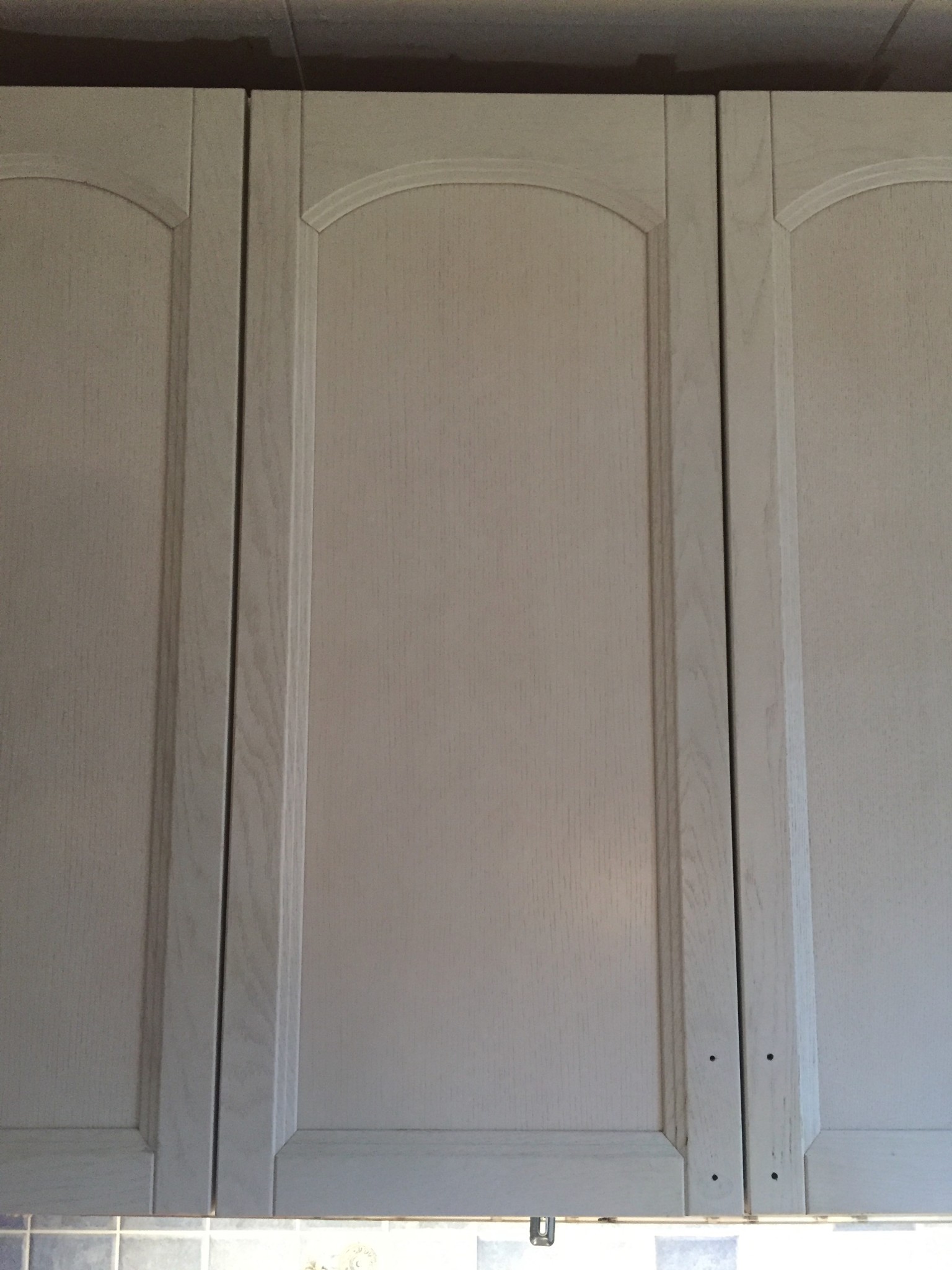
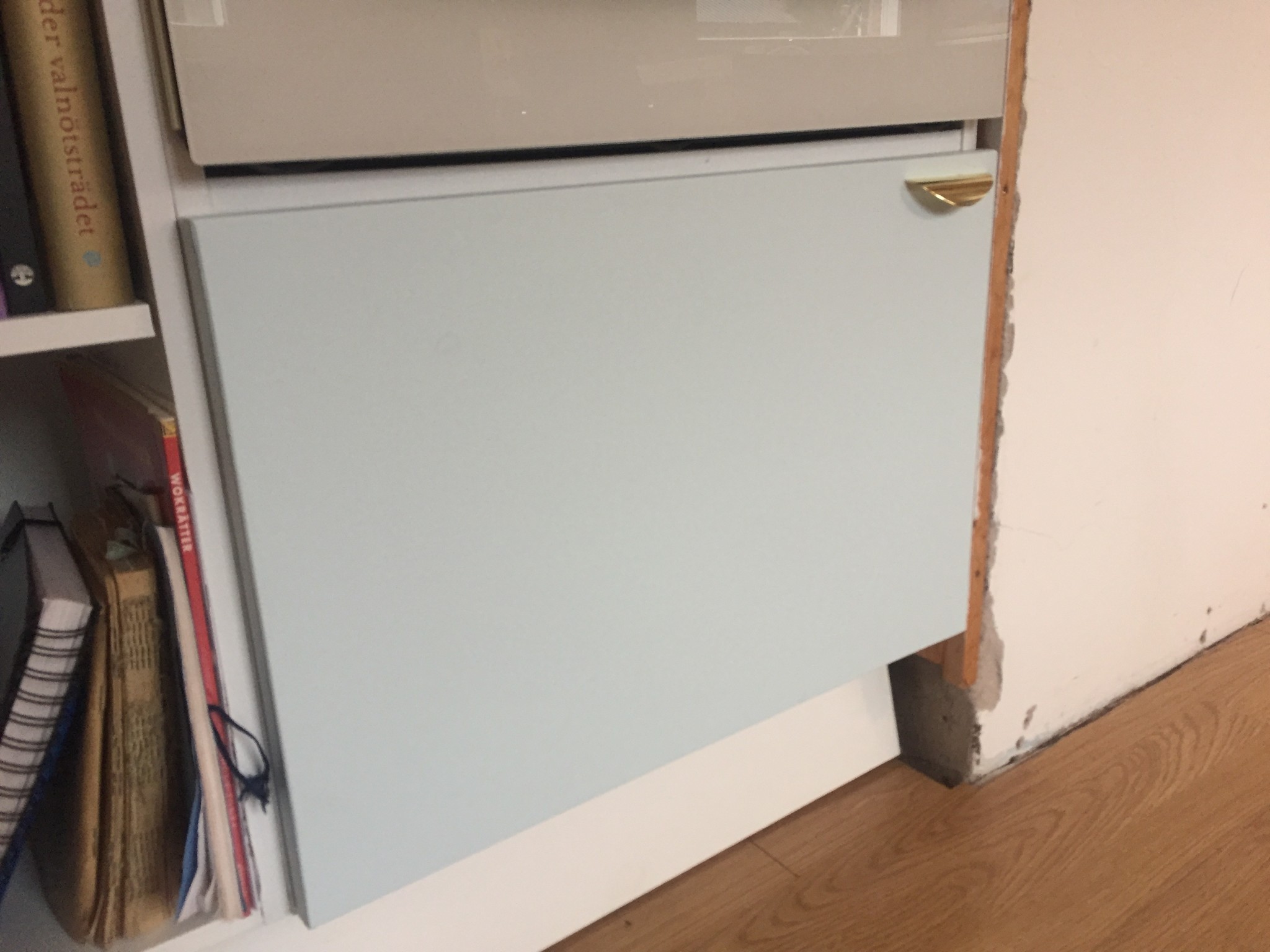
We are in the process of budget-renovating our kitchen which is in good condition but feels a bit outdated. Unfortunately, the previous owner, who built the kitchen, chose mirror doors with an arch at the top which is not particularly attractive.
I have had many thoughts on how I could achieve smooth doors, everything from colored plexiglass (expensive) to putty (not a good idea for many reasons). Then I thought of hardboard. It's smooth, very cheap, and easy to work with. So I tried gluing on a 1.5 mm hardboard from the "good-to-have" box which worked well. I primed it and have now painted it twice.
Now I discovered that the door is a bit warped. My first thought was that the hardboard had swollen from the moisture in the paint, but then the door should have become convex as seen from the painted surface, not concave. So it feels like the hardboard has shrunk. I'm not 100% sure that the door was straight to begin with, this was a door we found in the attic leftover when the kitchen was built, but it feels like it's the hardboard that's caused it to warp.
Does anyone know if there's a way to prevent this?
If this is to be done on the "real" doors, it will be 3 mm hardboard. It seems to be the thinnest available at the usual building depots. I glued the board with regular wood glue and painted with water-based paint.
Putting hardboard on both sides is not an option, as the doors would become far too thick, and it would likely cause problems with the hinges too.
Now I don't know what budget your renovation has, but ordering new flat doors from your local joinery won't cost a fortune. Gluing a panel onto one side of a panel door will warp and skew the door. If you have access to a veneer press, it can be done, but you need to put panels on both sides if it's going to last long-term.
If you plan to stay, perhaps new doors are an inexpensive way to make the kitchen yours.
The idea is to completely renovate the kitchen in the future, but we have lived with and suffered from the kitchen for five years now, so something had to happen. It's not just about the budget, but also a bit of fun to see how much it’s possible to transform what is there.
If you're a bit handy and think it's fun, it's not particularly difficult to make your own doors out of 16mm MDF. However, it probably won't be much cheaper than having a local woodworking shop do it unless you have the necessary tools.
I can provide an explanation of why the panel bends. When you glue a masonite, you wet it with the glue. This causes the masonite to swell a bit. When the glue sets and the moisture dries out, the masonite shrinks back. That's why the panel warps.
As already pointed out, the usual method is to reinforce the backside by gluing it in the same way on both sides. You don't want to do that because it would be too thick.
There is a method that might work. In this case, masonite will not do; instead, you should buy 3mm MDF (slightly more expensive than masonite).
The trick is to prime both sides of the MDF before attaching it to the panel. Then glue it with a cartridge adhesive like ms-polymer. A bead a few centimeters from the edge and a bit here and there inside.
More hassle, but it has a greater chance of success. The idea is not to wet the board you attach during installation.
Moreover, it is probably easier and cheaper with new flat panels as someone already suggested, but it's more fun to do it yourself.
Creating your own doors in 16 mm MDF could be an option, but I think it might be a bit too complicated to get the hinges right...
I would like to use 3 mm MDF instead of masonite, but I haven't been able to find it anywhere... Wouldn't it be possible to use the same method with the masonite, meaning priming both sides before glueing them? I was thinking of using an adhesive since it retains some elasticity, which might absorb some of the tensions.
I find it hard to believe it would be cheaper with new doors. We have 17 doors in various sizes and 6 drawer fronts, as well as some spacer pieces, so it will likely cost quite a few thousand kronor in the end. If I can make it work with masonite, I think it would cost a fraction of that. Obviously, it's a lot more work, but I don't mind that, and I have the time.
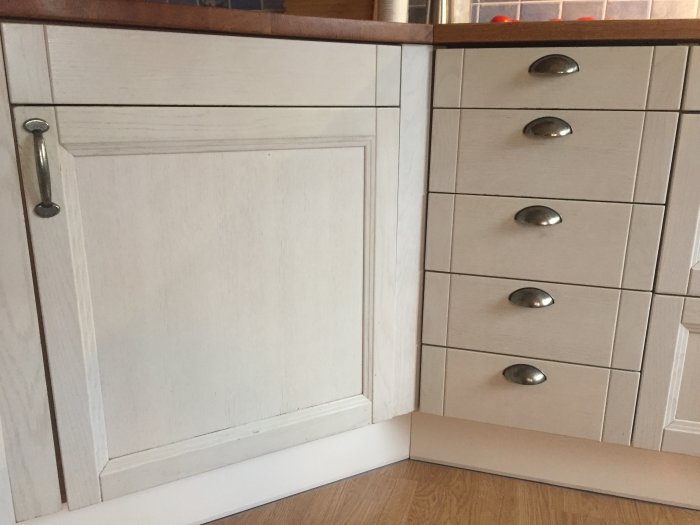
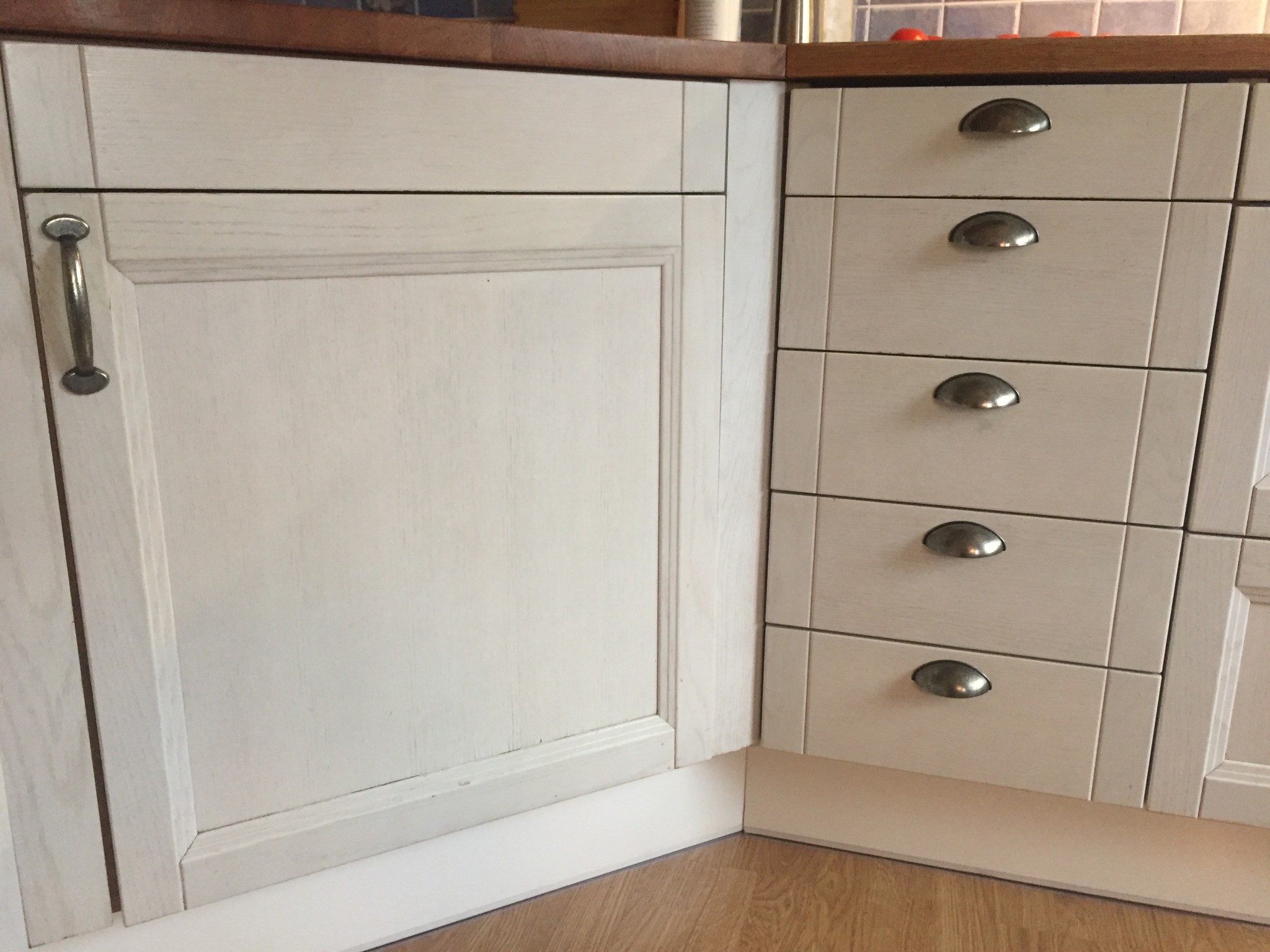
This is what the doors and drawer fronts look like:
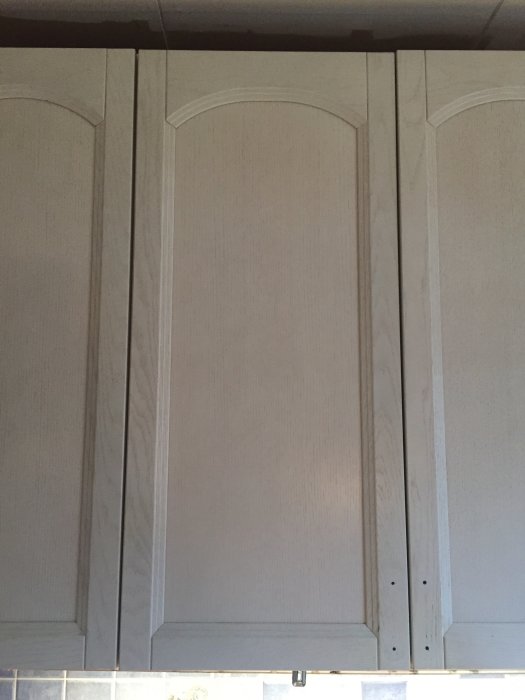
The top cabinet doors are quite a bit longer, so the warping will probably be even greater there:
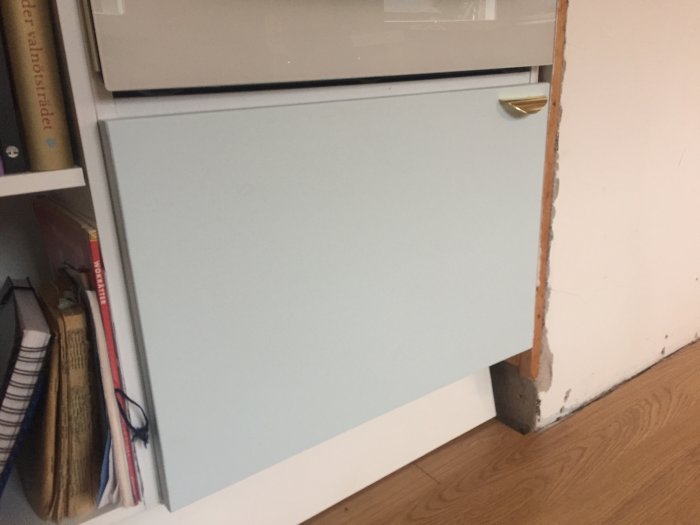
Here is the test door:
This was really just a proof of concept, so I haven't put much effort into making it look nice. I placed the door on the garage floor with a piece of countertop on top, weighted down with a few car batteries. The paint I used after priming was a leftover wall paint from the bedroom. It should obviously be a shinier paint, and probably a different shade (wife decides).
To stabilize the masonite and reduce the risk of drumming, I placed a 10 mm thick pine board from an old dismantled kitchen drawer in the panel before I glued it. I believe this is especially important for the top cabinet doors since they are so long. My idea is to get 10 mm plywood and jigsaw pieces according to the panels' shape. Maybe that will help reduce the warping too?
I thought the same when we bought the house. However, my wife has never liked them, and now, after five years, I completely agree with her.
There is also an overall impression that doesn't come across in the pictures, which makes us feel that we need to make a change. Just painting the frames and shelves white instead of faux oak has made a big difference... but it also makes the doors look very shabby, and since we aim to modernize with a nod to the house's 60s style, the rural style doesn't work at all.
We have 17 doors in various sizes and 6 drawer fronts, as well as some filler pieces, so it will probably cost quite a few thousand in the end.
We have a similar number and bought "custom-made" doors and fronts. It was over ten years ago, but I recall it cost just under 15,000 SEK in total, including some accessories like drawer inserts, light strip, and hinges. I thought it was surprisingly cheap, but it is naturally quite a few thousand and considerably more expensive than some MDF or hardboard. Still, it might be worth checking out if you feel the "thin board route" isn't working well.
I have looked further into it and have now found a product that I think can solve the problem with the glue causing the board to swell. It is called "Lacquered board" and is available at Hornbach. I have business there tomorrow anyway, so I'll take a look at it and see if there's anyone there who knows the product.
I have also found that OSB boards are available in 10 mm, which is cheaper than plywood but should work just as well to fill the mirror space.
Lacquered board is not the solution either. It must be a symmetrical solution, i.e., board on both sides. And why do I know this? I've made the mistake myself. I also have trained carpenter friends who say the same thing.
The method with garage floor and car batteries is a bit risky; it doesn't take much for a gap to form between the door and the hardboard, and then what do you do, filler?
I support previous suggestions about new doors, either DIY from MDF or order custom-cut.
I was thinking of seeing if I could revive the thread, I'm about to do the same thing with similar oak kitchen cabinets from the 1980s. How did this turn out?
There is oil-hardened masonite that reasonably shouldn't swell and shrink and cause the door to warp?



 Wouldn't it be possible to use the same method with the masonite, meaning priming both sides before glueing them? I was thinking of using an adhesive since it retains some elasticity, which might absorb some of the tensions.