
6,789 views ·
8 replies
7k views
8 replies
Pressure-treated wood to support the subfloor?

I've discovered that the carpenters have used pressure-treated wood to support the subfloor in the ceiling for the bathroom. The conditions are a bit tricky for the bathroom since a section in the middle under the bathroom is not excavated, while the rest is a basement. This had led to the floor joists from 1929 in the unexcavated area being bad and needing replacement. To address the unexcavated part, it was chipped away so that this area was lowered and a Platon mat was placed as a barrier between the ground and the floor joists.
Since part of the bathroom extends over the basement, I was able to see today how they chose to build it and saw that between the floor joists and the Platon mat, they have used pressure-treated wood to hold up the subfloor panels. Unfortunately, they've already managed to install the plumbing and water, insulate, and lay the floorboards before I saw this.
It's said that pressure-treated wood stinks terribly if exposed to moisture in enclosed environments, and I don't want to have to tear down the bathroom in five years because of the smell.
I'll talk to the carpenter tomorrow but I'm wondering if I'm overreacting on a Monday evening like this. Should I have a taste of my new Talisker and forget everything, or should I prepare the carpenter to rip up the floor tomorrow?
Since part of the bathroom extends over the basement, I was able to see today how they chose to build it and saw that between the floor joists and the Platon mat, they have used pressure-treated wood to hold up the subfloor panels. Unfortunately, they've already managed to install the plumbing and water, insulate, and lay the floorboards before I saw this.
It's said that pressure-treated wood stinks terribly if exposed to moisture in enclosed environments, and I don't want to have to tear down the bathroom in five years because of the smell.
I'll talk to the carpenter tomorrow but I'm wondering if I'm overreacting on a Monday evening like this. Should I have a taste of my new Talisker and forget everything, or should I prepare the carpenter to rip up the floor tomorrow?
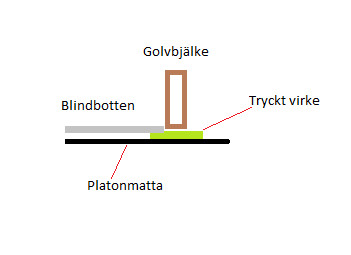

Well, we'll see what we come up with tomorrow. In total, it's probably no more than an estimated 5-6 pieces of 22x95 at 130 cm each, of which maybe three are just above the unexcavated space while the rest are in the ceiling joists for the cellar.
Personally, I wouldn't have used treated wood, but the question is whether that's reason enough to tear everything up and redo it.
Personally, I wouldn't have used treated wood, but the question is whether that's reason enough to tear everything up and redo it.
I probably could have opened my new Talisker yesterday. Googled in the early hours and found from Boverket that pressure-treated wood of class NTR A is allowed in joist constructions, for example as a sill.
It's completely idiotic to use pressure-treated timber as a sill plate. I'm currently replacing the sill that was put there 10 years ago. Moisture + Pressure-treated = phenol gases. It smells almost like mold and permeates the entire house. They've also extended the living room floor with pressure-treated timber in the floor structure. I hope it doesn't smell too much. Otherwise, the next project will be tearing up the floor from the inside and replacing the entire floor.
I saw this was 2 years ago. How did it go?
I saw this was 2 years ago. How did it go?
if your sill was installed 10 years ago, it shouldn't cause odor problems, at least not because of the impregnation. When you read about it, you seem to conclude that it was pentachlorophenols in the impregnation agents that created odor problems, and this was banned sometime in the 70s.totte_79 said:It is completely idiotic to use pressure-treated wood as a sill. I'm currently in the process of replacing a sill that was installed 10 years ago. Moisture + Pressure-treated = phenol gases. It almost smells like mold and permeates the entire house. They've also extended the living room floor with pressure-treated wood in the floor joists. I hope it doesn't smell too much. Otherwise, the next project will be to tear up the floor from inside and replace the entire floor.
I saw that this was 2 years ago. How did it go?

Member
· Västerbottens län
· 18 064 posts
If the moisture problem is now addressed, then the treated timber will not become damp and smell. If it becomes damp, your floor joists will rot.
However, placing platon directly against the slab, I would prefer to have it ventilated and the membrane against the ground.
Protte
However, placing platon directly against the slab, I would prefer to have it ventilated and the membrane against the ground.
Protte
Click here to reply
Similar threads
-
Ground mount for solar panels in pressure-treated wood 3D model
Building Materials and Construction Technology -
Tryckt virke som mark-ram till växthusets grund, istället för murad?
Attefallshus, friggebod, garage, förråd & utedass -
Varför blir tryckt virke dåligt under takfoten?
Utbyggnad och tillbyggnad