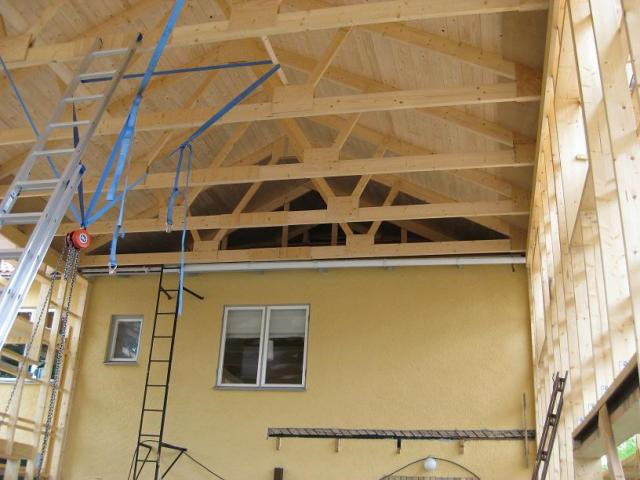
I have a plan. Whether the plan is realistic is another matter that I hope to get help with here.
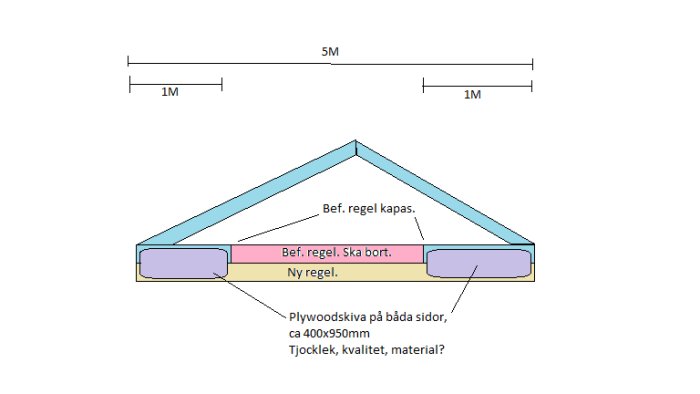
The plan is to lower the ceiling in the cabin to gain a bit more space in the loft. The idea is to attach a new horizontal beam (light yellow 45x220) under the existing roof truss (light blue about 50x190), splice the existing horizontal beam with the new one using plywood sheets (purple), and then cut part of the existing horizontal beam (pink). All according to the neat paint drawing.
The question is whether this can be done at all? My gut feeling tells me it's not a problem at all but self-preservation suggests I should at least inquire. The question is then (assuming it can be done) what type of sheet should be used. Thickness, material, quality?
Additional info...
Roof slope about 20 degrees, metal roof, snow zone 2.5.......
Without any guarantees. It should work. But the joint I would make with the same wood as underpinnings or multiple thick screws through with a nut and washer.
Of course, I understand that no one can provide any guarantees, after all, I am not paying for the advice.
There are two reasons why I don't want to use regular timber. First, it would be extremely thick where it joins, 135mm. At least on one end, the timber and thus the joints will be partially visible, and it's easier to hide 2x18mm than 2x45mm. Secondly, I believe, like vectrex, that plywood is actually stronger in this case since the entire sheet at 400x950mm becomes homogeneous, which would have been impossible with regular timber. Plywood is simply better at absorbing shear forces (or whatever they're called) between new and existing timber. It might have been even better to use 3-4mm nail plates of the same size, but god knows if they exist???
Then I've heard that birch plywood is stronger than spruce or pine or whatever the alternative is, is that correct? Where can I find birch plywood in the right thickness then?
Plyfa should work. But I would also run it through, i.e., between the studs. The underlayer primarily handles tensile strength, and I don't know if plyfa alone can handle that.
You have drawn your lower yellow beam extending all the way to the eaves. I assume that it will actually be placed against the hammer beam and not on this?
But regardless of that, plywood 18-20 mm, glue, and a lot of screws, I firmly believe will work excellently.
Villa vista; do you mean from top to bottom? That could be solved actually. You could sink it from underneath so it's not visible... You can buy threaded rod by the meter at places like Jula...
MathiasS; both yes and no. I have made notches in the new rule for the top plate and then placed the new truss rule on a new standing wall plate (trusses and wall plates were not necessarily in the exact same place before). The interior wall is therefore gone and the new wall plate (and truss rule) is against the exterior wall's panel.
As I see it, gluing plywood and using screws is really good, not necessarily piles or lots of them; per dm2 is probably perfectly fine. There's probably not much that could be negative with the solution you have in mind; one shouldn't make it more complicated than it is, and asking is a good start if you're hesitating.
I am not a designer, but I don't believe in threaded rods or bolts through the middle at all. The tensile forces will want to split the beam where the threaded rod goes through because there will be tensile forces along the wood grain. Glued and screwed plywood is definitely stronger.
A major reason why plywood is better than a beam on the side is that plywood has wood grain in all directions (the veneer layers are twisted relative to each other). I believe in construction plywood P30, 18mm or more.
The only weakness I can see is if you don't get a good contact between the plywood and the beams. The old beam might very well be a bit warped, and then it becomes difficult to get the plywood to adhere. Then you lose a lot of the strength in the joint, so watch out for this!
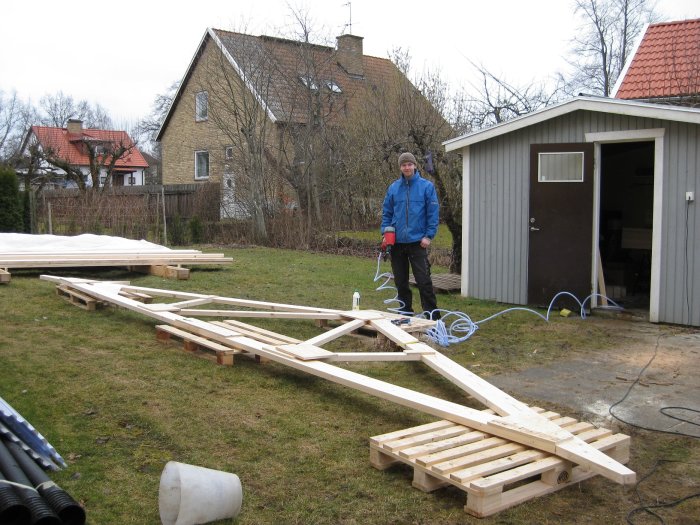
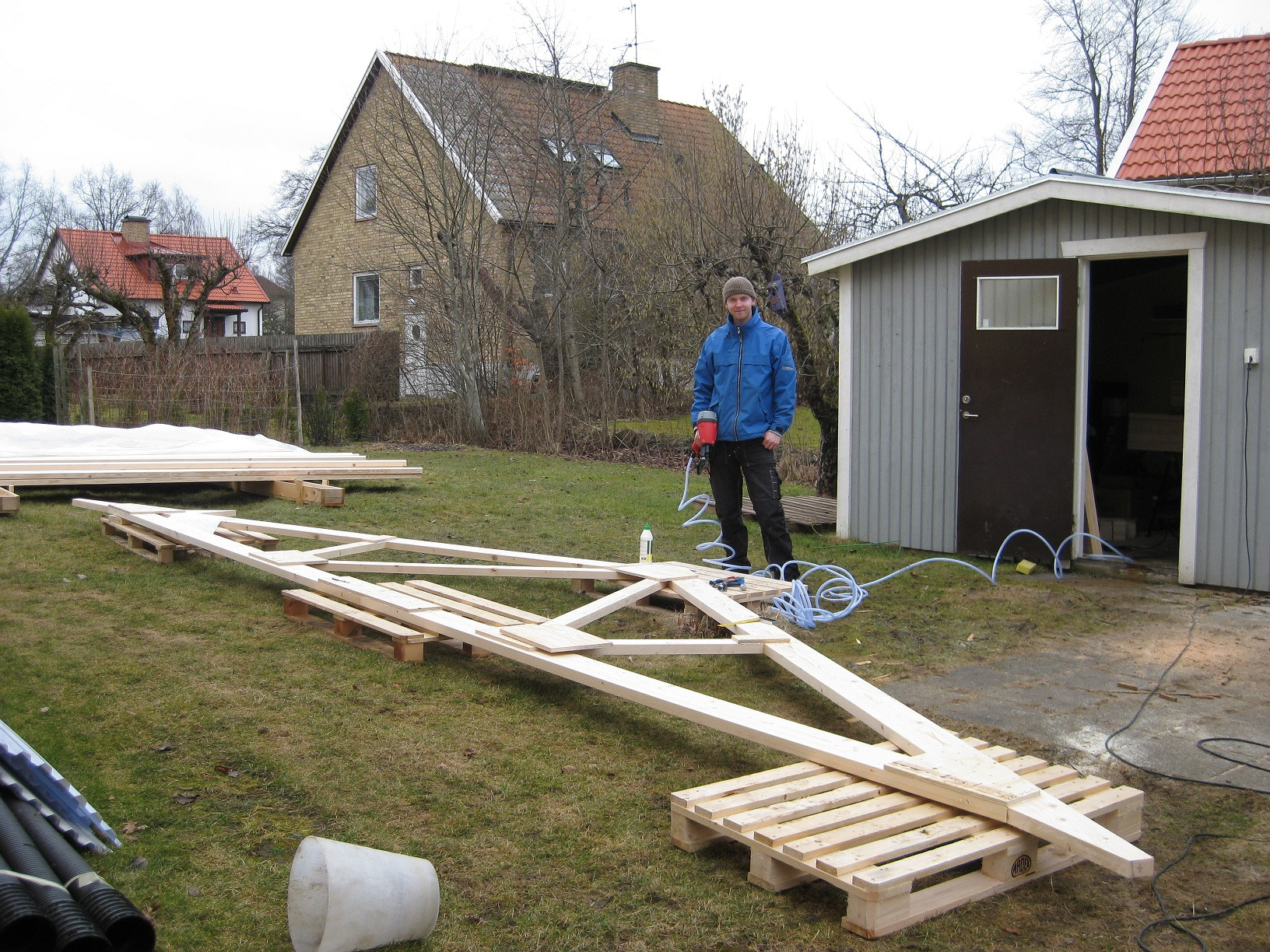
I have built significantly larger trusses than these (type W-trusses) and used "regular" 15mm plywood for all joints. The plywood pieces were attached with glue and a nail gun. These managed, in addition to concrete tiles, even the record winter of 2010/2011, when there was over a meter of snow on the roof.
Large nail plates can be purchased at the real hardware store, i.e., optimera/fredells/XL-Bygg, etc. But like others, I believe more in plywood, preferably 12mm on each side, rather than an 18 instead.