I cast a pier last year, the first pier I've cast. Difficult conditions since I cast the pier under an existing house, so it was hard to reach. The idea was to reinforce the existing pier foundation.
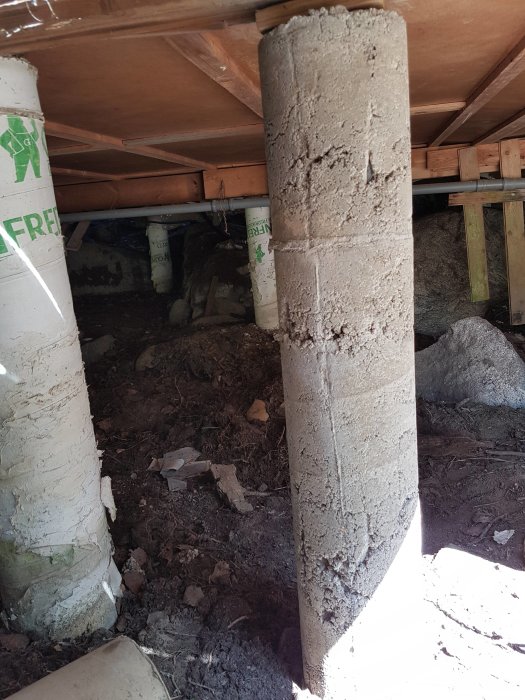
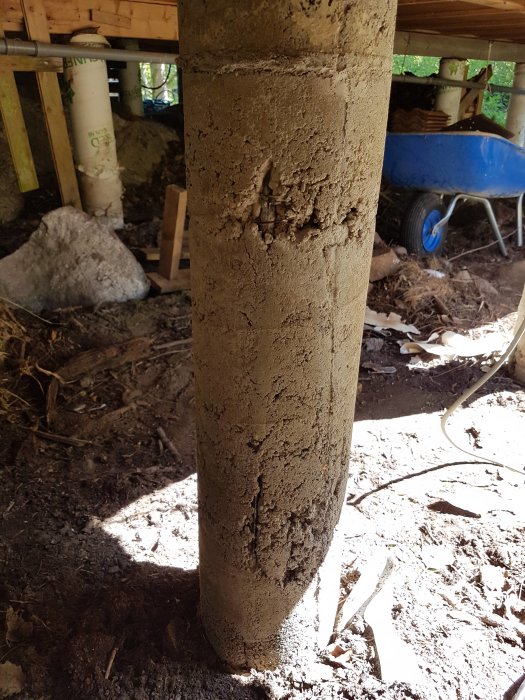
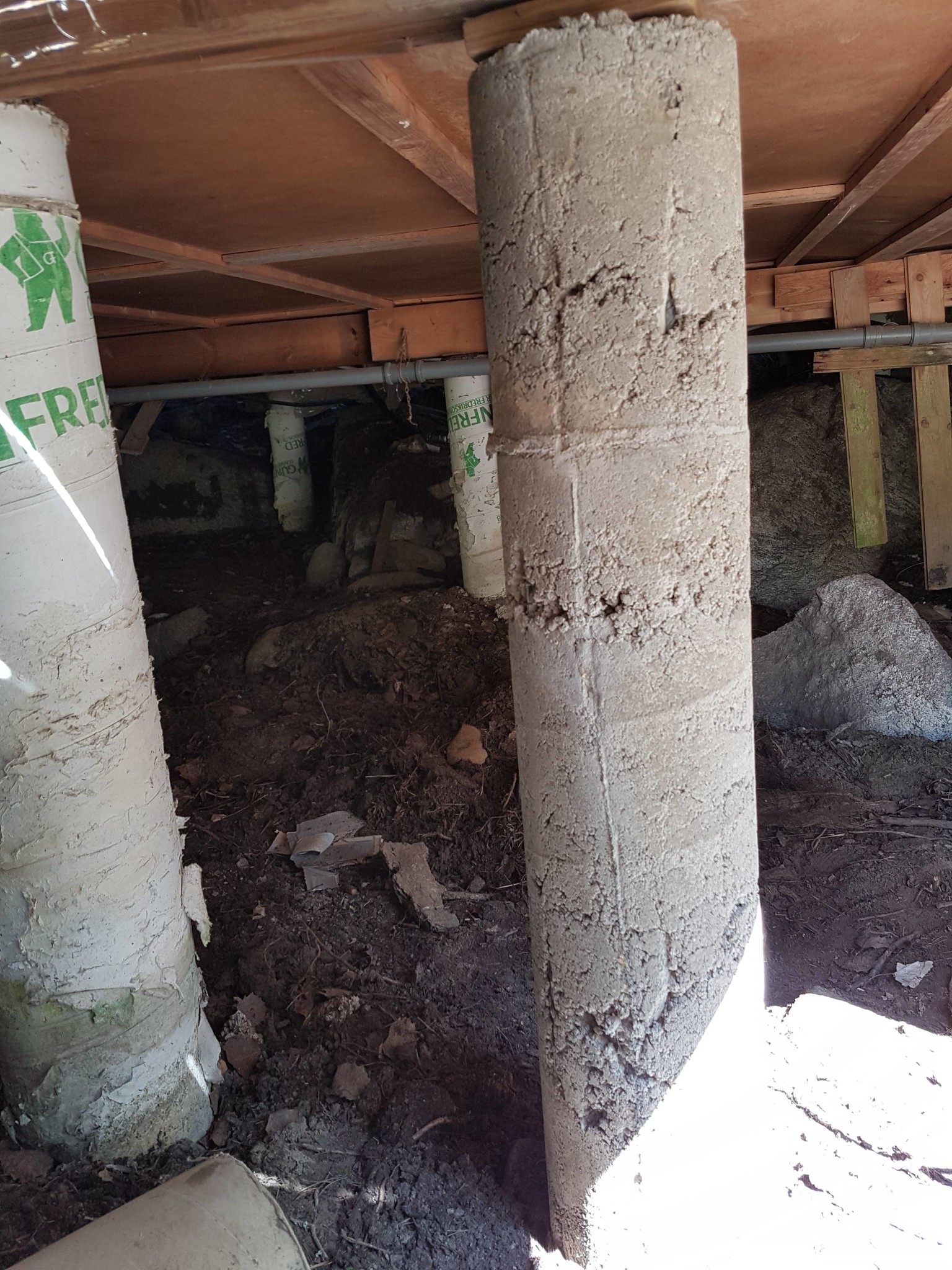
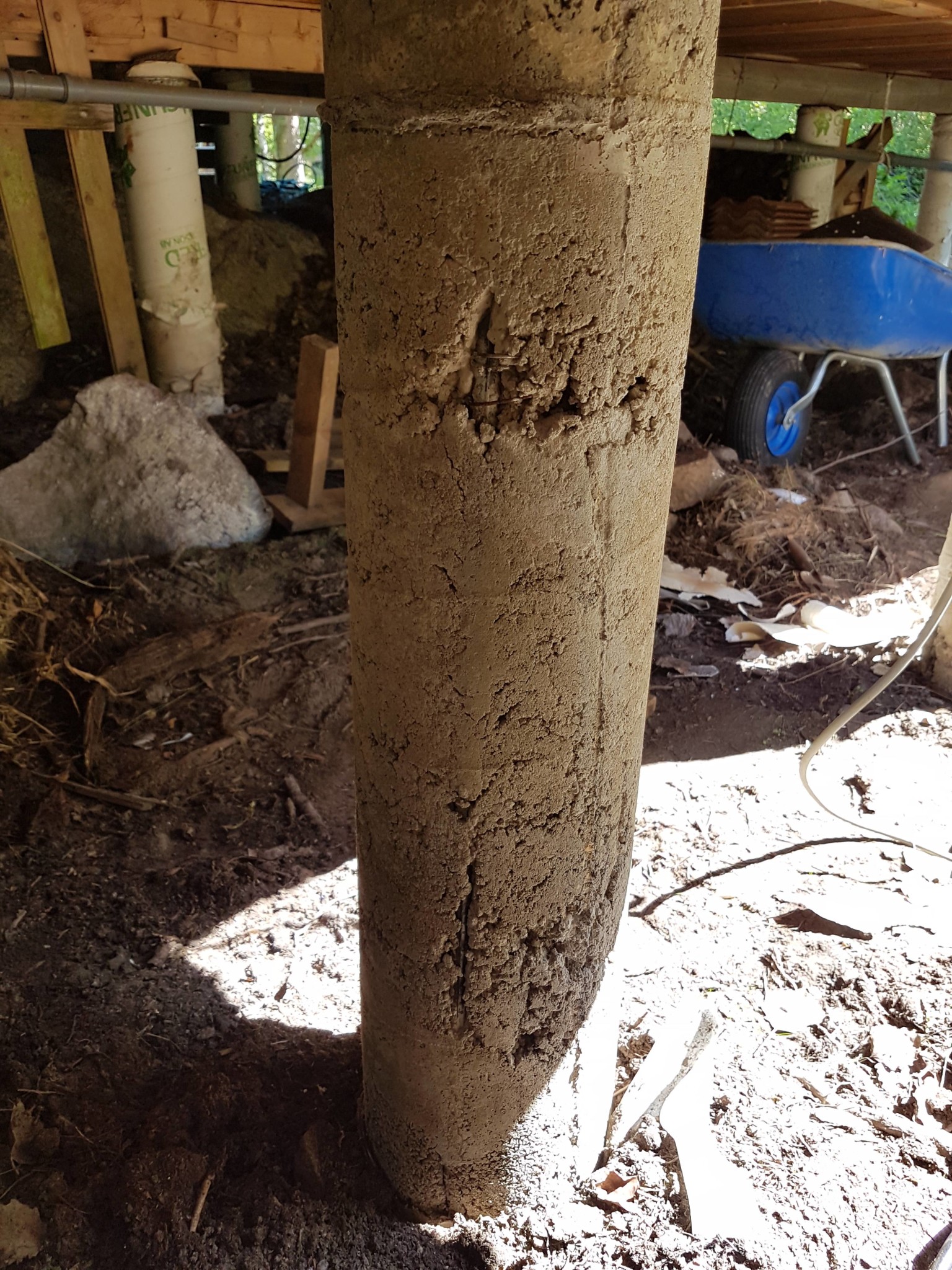
I removed the paper tube today and saw that it is rough. It also shifts a little sideways (not yet attached to the house) if I hit the pier fairly hard with my hand.
What did I do wrong?
Conditions.
Height: about 120 cm
Reinforcement: 3 pcs 10 mm, anchored in rock with anchor compound. Connected with binding wire.
Concrete: Finja concrete that I mixed until it seemed to be a good paste. Used 3 liters of water per 25 kg bag, as instructed. Mixed with a mortar mixer for about five minutes, I believe it says 10 minutes. I think I mixed one bag at a time/per bucket if that matters.
Paper tube: Cast in two stages because it was so difficult to reach. First about 90 cm, then directly after I placed a 30 cm paper tube on top of the other and taped it on.
Potential mistakes:
1. Is the reinforcement too close to the edge of the paper tube?
2. Insufficiently vibrated concrete? I only shook the tube after approximately half of it was filled. Couldn't reach from above with a plank or similar and didn't have access to a concrete vibrator. Only afterwards did I realize one could use a grinder against the mold or similar.
3. Insufficiently mixed concrete?
4. Another mistake?
I think you've already answered the question yourself, in points 1 and 2 ...
(will the base fulfill its purpose anyway? Most likely.)
Thank you!
And it doesn't matter if it gives a little sideways when I strike it? I've understood it as the strength for bases is mainly high for pressure from above, but was/am unsure about how much sideways they should be able to move, if they are doweled into rock.
Now I have bought a concrete vibrator from Jula with 1,600 w and a 3 m hose, so I hope that problem no. 2 will be solved =).
Regarding the reinforcement. Then I should simply move the reinforcement slightly into the pipe, how far from the cardboard pipe should the reinforcement be? I have used 19 cm and 25 cm pipes.
Now I have bought a concrete vibrator from Jula with 1,600 w and a 3 m hose, so I hope that problem no. 2 will be solved =).
Regarding the reinforcement, I should simply move the reinforcement a little bit inside the tube, how far from the cardboard tube should the reinforcement be? I have used 19 cm and 25 cm tubes.
Approx. 3 to 5cm in is suitable for the reinforcement so it doesn't rust.
I am not an expert, so take my advice with a large pinch of salt. I imagine the big issue is the risk of rust in the iron, which in turn bursts the concrete. How great that risk is, I dare not speculate.
I was on a consulting assignment in India a few years ago. Near where I lived, they were building a cluster of 22-storey buildings, which looked to be about 2000 square meters per floor. The construction seemed to be load-bearing walls made of brick, with cast concrete slabs. There might have been some steel structures hidden in the bricks that I didn't see.
When I walked by, they were demolishing a mold for the edge of a floor slab on the 3rd or 4th floor, and you could see many enormous air bubbles. About the size of a clenched fist. It feels a bit scary to think that 19 floors are supposed to stand on those air bubbles.
I was initially considering demolishing the pier and building a new one, but you wouldn't have done that (except for the concrete filler)?
There is another (older?) pier quite close, will it remain?
I would have left it as is unless some building-related circumstance (like you plan to build a full-scale replica of the Kaknästornet right there) requires a perfect pier exactly there. It doesn't seem like there's a lack of space underneath either?
Now I don't know much, but is that type of mold/formwork really supposed to protrude so much above the ground? Isn't the idea that most of the footing should be below ground level and only a smaller part should protrude above the ground?
Looks like a plinth that does what it's supposed to do, why do you need to do something to the plinth? Jack underneath and lift the house a few mm. Then wedge something between the plinth and the beam so that the house's weight is on the plinth. I think the concrete becomes smoother and better mixed if you add a bit more water than stated in the instructions, but that might just be something I've come up with.
Now, I don't know much, but is that type of casting mold/form really meant to protrude that much above ground? Isn't the idea that the larger part of the pillar should be below ground level and only a smaller part rises above the ground?
/Krille
Yes, it's quite normal to use them so they stick up well over 1 meter. Not pretty, but often not visible anyway. Of course, they should also go into the ground so it's frost-free and well anchored so they stand steadily. But if you have rock like you do and dowels, they’re anchored anyway and stand steadily.
There's another (older?) post quite close by, will it remain?
I would let it stay unless some construction-related circumstance (like if you're building a full-scale replica of the Kaknästornet that needs perfect footing right there) requires a perfect post, in that exact spot. It doesn't seem like there's a lack of space underneath either?
The post nearby is probably in good condition but the frame rule on the house is outside the post (probably poorly done from the start), and that's why I'm making new posts, as this is the case with some other posts too.
Leave that poor plinth alone now and start with the next one instead. It will outlive both you and the house whether the reinforcement rusts to crumbs or not.
Click here to reply
Vi vill skicka notiser för ämnen du bevakar och händelser som berör dig.