
7,858 views ·
2 replies
8k views
2 replies
Polyurethane insulation in a 1920s house in the attic
I am in the process of converting the attic into living space and now need to insulate it. The rafters in the attic section are about 4 meters long, and there I have removed the sawdust, but the rafters continue to the floor below for another 4 meters, and there the sawdust remains (without an air gap). When I removed the sawdust in the attic, I found patches of black mold on the roof boards, covering about 2-4% of the surface. The house was built in 1926. I am not inclined to tear up the lower 4 meters of sawdust, as I have already renovated that floor. I am considering insulating with polyurethane foam in the attic section. Is there any issue with the attic section of the roof being insulated with polyurethane while the lower part of the roof is insulated with the old existing sawdust, and how do you manage the transition, with a board or something else? Alternatively, I am considering insulating the attic section with mineral wool and a 2 cm air gap and using ventilation hardware both at the ridge and below (in the attic section); would it be worth installing an additional vent at the eaves as well (i.e., 3/rafter at 0.4 and 8 meters)? Will a vent at the eaves create any ventilation in the densely packed sawdust, or will it just draw in moisture? Currently, there is no ventilation in the sawdust insulation.
Do you have any good tips on how to remove the black mold from the roof boards? Once it is removed, can polyurethane be sprayed directly onto the roof boards?
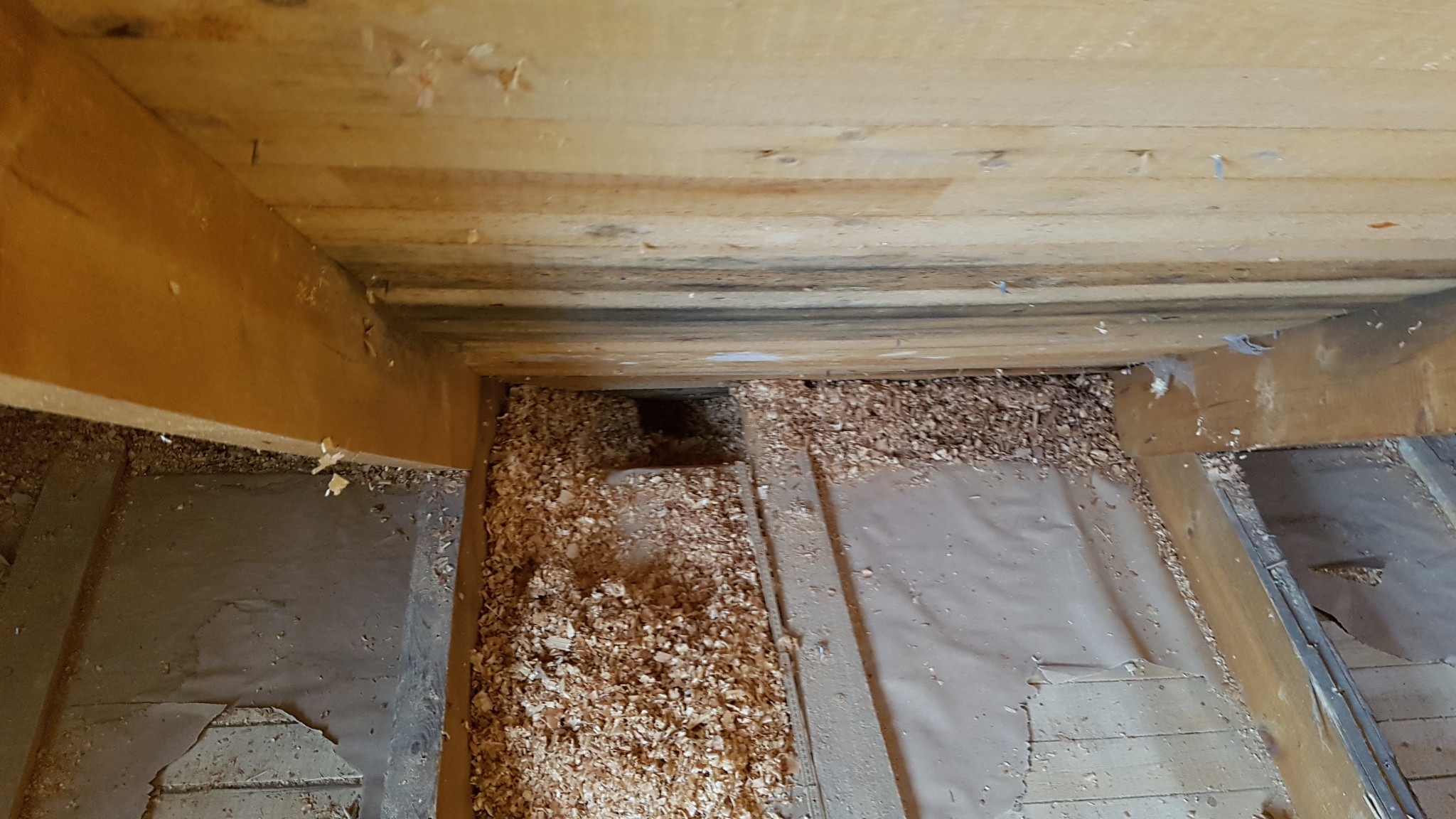
The photo shows the transition between the removed sawdust in the attic section and where the sawdust continues for another 4 meters down the rafters to the lower floor (I have dug a bit into the left compartment).
Do you have any good tips on how to remove the black mold from the roof boards? Once it is removed, can polyurethane be sprayed directly onto the roof boards?
The photo shows the transition between the removed sawdust in the attic section and where the sawdust continues for another 4 meters down the rafters to the lower floor (I have dug a bit into the left compartment).

Generally, I think one should be cautious with new relatively untested methods. Polyurethane insulation might be good, but new things always tend to attract fortune seekers. It seems very important how it is mixed and sprayed. I would never risk having the home suffer from a "fishy smell"

The technically superior solution would have been to replace the paper on the roof with diffusion-open fabric, and then insulate without an air gap using mineral wool or cellulose fibers. Since I assume that solution is not within the budget, insulating with an air gap with ventilation devices in the upper and lower outer roof is the next best option. What I've read about polyurethane foam makes me very hesitant to use it in this context. There are some scientific reports available online.
Click here to reply