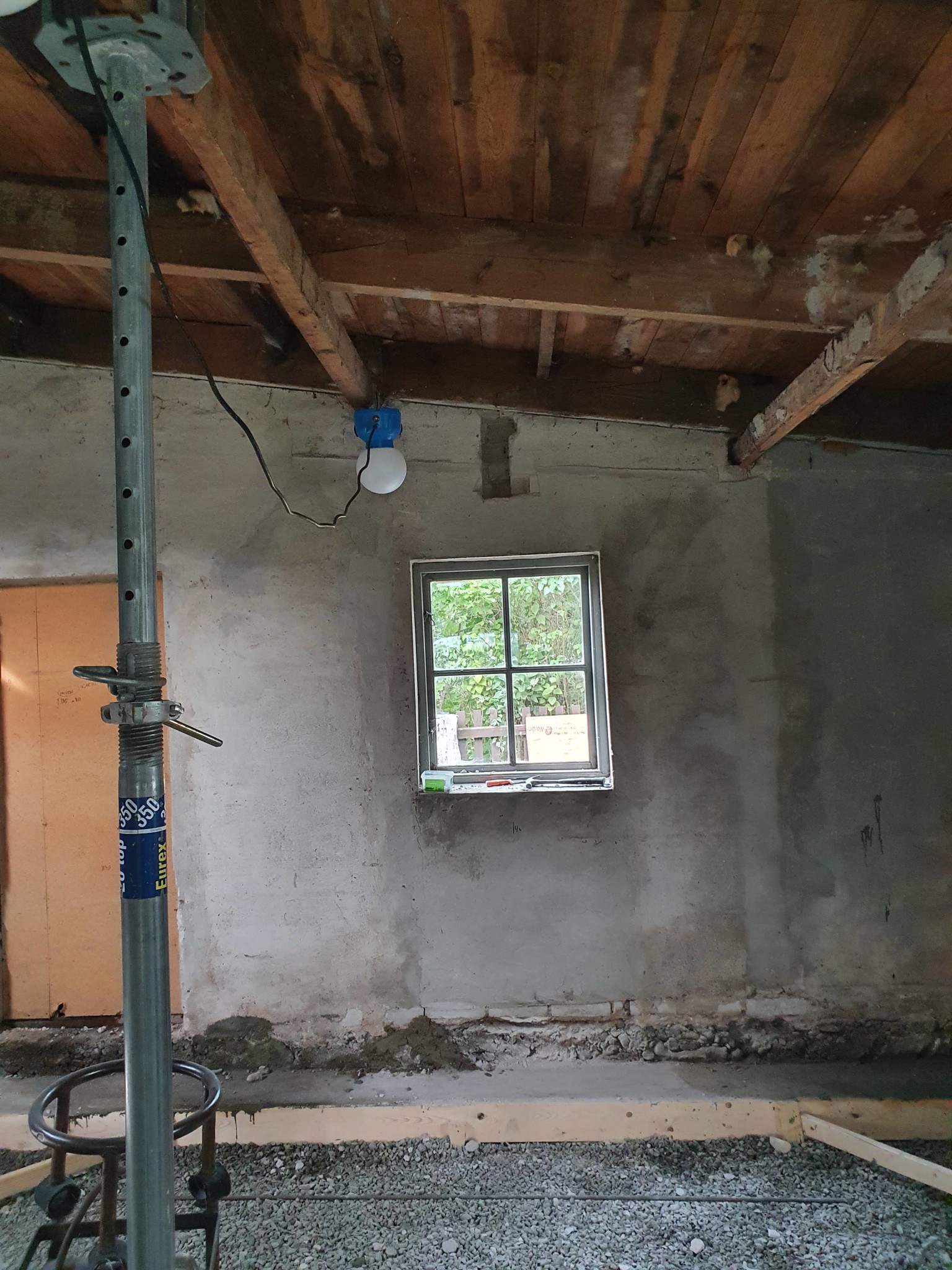
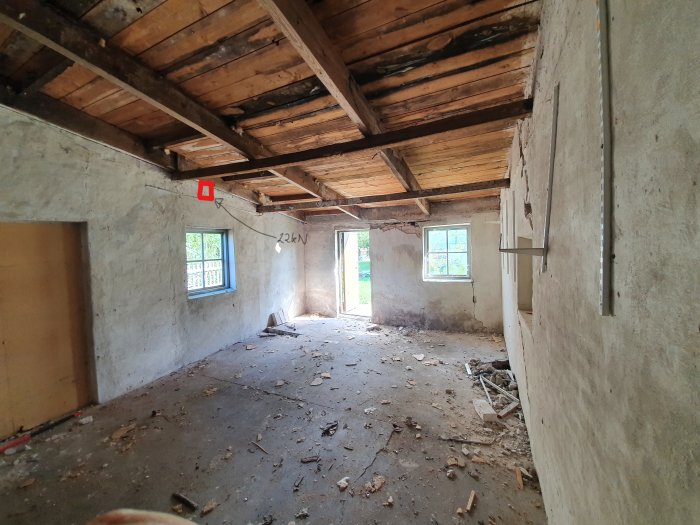
I have tried to size our existing shed roof and its loads.
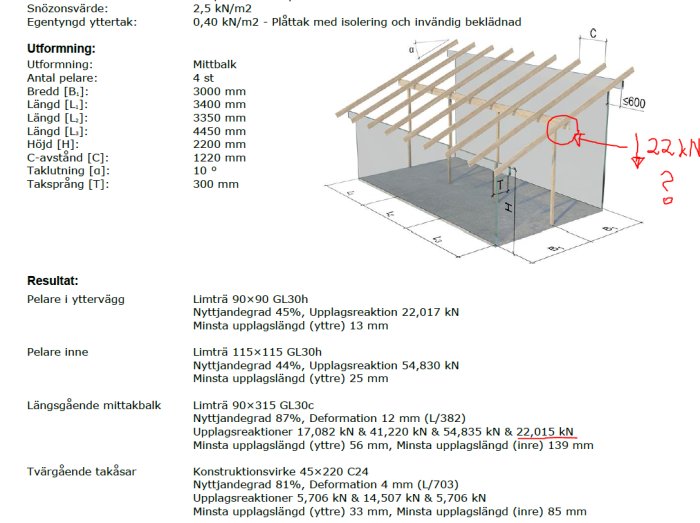
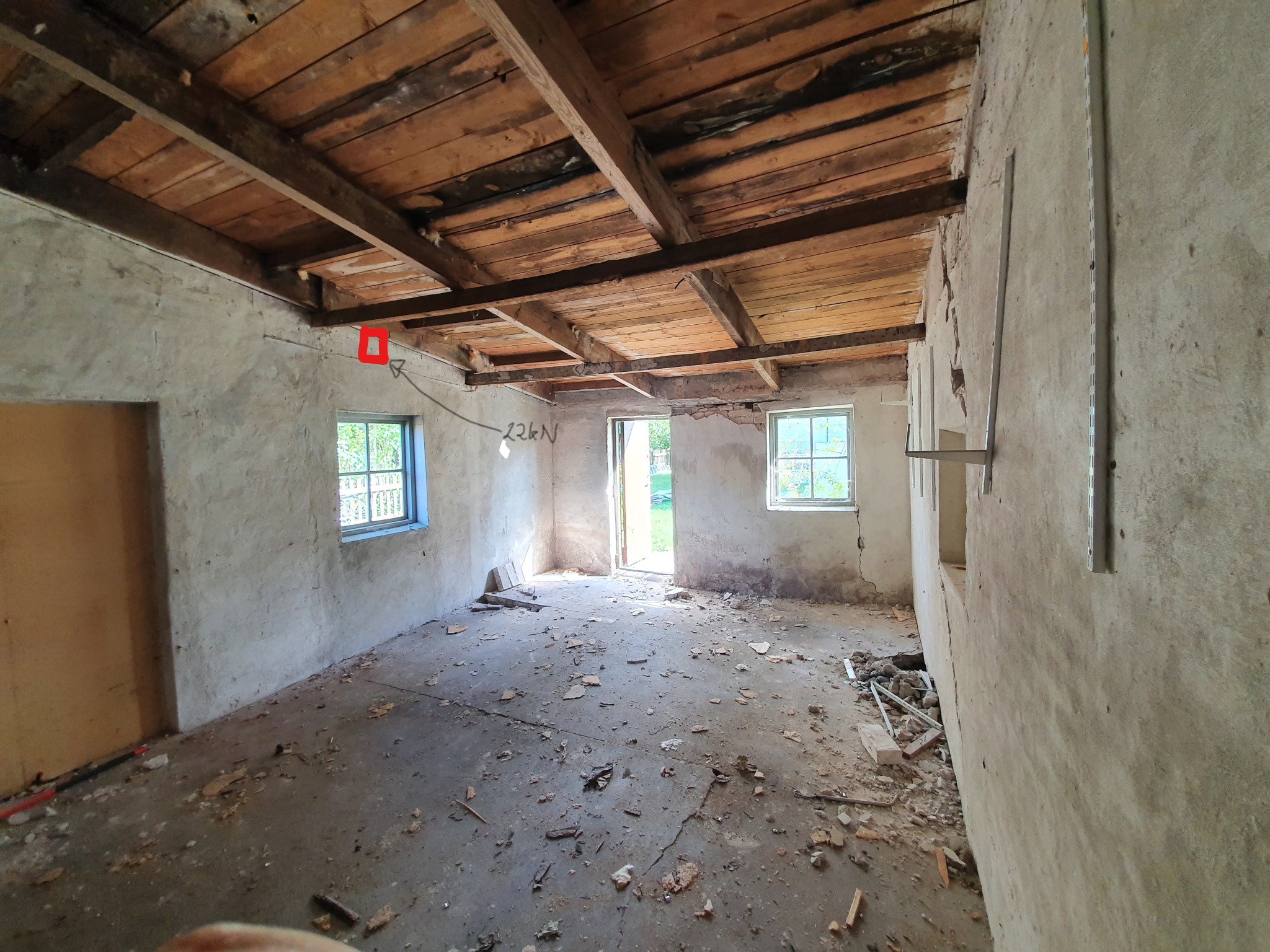
I want to check if the existing brick wall can handle the loads from the longitudinal center beam (glulam beam) that is supported at a total of four points, two columns in the middle, and two outer walls.
The vertical load is 22 kN. Will the wall made of lime sandstone from 1935 be able to handle this? The wall is about 25 cm thick and about 2.5 meters high. There is a steel U-beam embedded above the window. The glulam beam will land almost exactly in the middle above the window, which is 80 cm wide.
I have no idea if it's reasonable, but according to the calculation, it's that much with snow load zone 2.5.
The total load on the roof seems to be about 3 kN/m2. The whole load for 12 sqm would then be 36kN, which should then be distributed down to the foundation via a number of pillars and walls. Hard to see how it would be exactly 22 kN at the specific point?
Soon a designer will probably show up who knows more
The total load on the roof seems to be about 3 kN/m2. The whole load for 12 sqm would then be 36kN, which should then be distributed down to the foundation through a number of pillars and walls. Hard to see how it should become exactly 22 kN at the point in question?
Soon a designer who knows more will probably show up
Where does 12 sqm come from? The total roof area is 67 sqm.
22 kN seems to fit quite well regarding the point load on the brick wall. However, saying something about what the brick wall can withstand is difficult. The strength of a brick wall depends, besides its geometry, on the strength of the bricks and mortar. The strength of the bricks can vary a lot depending on the type. Limestone bricks are among those that withstand the least. The strength of the mortar depends on its composition. In this case, it is up to the steel beam to do the trick. Without it, the wall can withstand nothing. It probably can if it is sufficiently robust and has sufficiently long supports on the sides of the window. Saying something definite about that is, however, precarious.
22 kN seems to align quite well regarding the point load on the brick wall. However, it's difficult to say what the brick wall can withstand. The strength of a brick wall depends, in addition to its geometry, on the strength of the bricks and the mortar. The strength of the bricks can vary greatly depending on the type. Kalksandsten is among those that withstand the least. The strength of the mortar depends on its composition. In this case, it's up to the steel beam to do the trick. Without it, the wall can withstand nothing. It probably can if it is sufficiently robust and has sufficiently long bearings on either side of the window. However, making a definite statement about it is tricky.
@justusandersson The steel beam directly above the window only has bearings about 15 cm on each side. I read somewhere that 25 cm is generally recommended. The steel beam itself has a lying U-profile and is about 8 cm high and about 8 cm deep. The old construction consists of two beams, as you can see in the first picture, meaning the load is distributed at two points, not directly above the pane. The question is how I should proceed...
You can always reduce the snow load if it's possible to shovel the roof in extreme weather. I agree with the previous speaker that there are uncertainties that cannot be calculated.
You can always count down the snow load if it is possible to shovel the roof in extreme weather. I agree with the previous speaker that there are uncertainties that can't be calculated.
Yes, I understand that it is impossible to calculate theoretically since the wall is old and the mortar has passed its prime. But maybe there are some tips on how I can solve it in the best way. In the worst case, I can keep the two old beams and skip the glued laminated beam there.
The steel beam is probably just intended to support the brick above the window. I would opt for a steel frame inside the brick wall that the glulam beam rests on. With such a limited span, a VKR profile is sufficient. Dimension depends on the measurements.
How fixed are the pillar positions? If you increase the length of the middle section, the load on the wall decreases. If it works with the floor plan, you can find a position where the point load on the wall is zero. However, one should be a bit cautious so that the reaction does not flip over, causing the beam to lift from the wall.
Vi vill skicka notiser för ämnen du bevakar och händelser som berör dig.


Ulltand said:
The total load on the roof seems to be about 3 kN/m2. The whole load for 12 sqm would then be 36kN, which should then be distributed down to the foundation through a number of pillars and walls. Hard to see how it should become exactly 22 kN at the point in question?