
Hello!
I have a house from the early 50s.
Right now, I'm renovating my "master bedroom," and will thereby rafter the ceiling and install short planks and plaster all the walls, replace windows and patio door, etc. etc. etc...
But, should I install a vapor barrier on the exterior walls and ceiling or not?
Can you explain why I should/shouldn't do it?
And if I should do it, is there a good site where I can read about exactly HOW to install a vapor barrier?
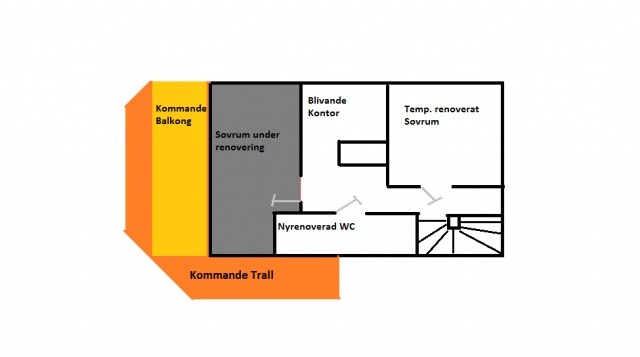
(attaching a simple drawing map of the house's plans...)
Very grateful for a response!
Best regards
Simon
I have a house from the early 50s.
Right now, I'm renovating my "master bedroom," and will thereby rafter the ceiling and install short planks and plaster all the walls, replace windows and patio door, etc. etc. etc...
But, should I install a vapor barrier on the exterior walls and ceiling or not?
Can you explain why I should/shouldn't do it?
And if I should do it, is there a good site where I can read about exactly HOW to install a vapor barrier?
(attaching a simple drawing map of the house's plans...)
Very grateful for a response!
Best regards
Simon
Plastic prevents the humid indoor air from entering the walls and reaching the attic, thus preventing mold attacks on insulation, etc. So far, so good. But if you ONLY insulate the bedroom, it won't be of much use. However, if you plan to continue renovating the rest of the house as well, I would insulate. Then, you also need to figure out how to effectively remove the moist air from the room (probably improved ventilation of some kind).
I would seal the ceiling, but not the walls and at the same time make sure that the walls were vapor permeable (is that what it's called?) and not moisture sensitive.
I can't really explain why and I am absolutely no expert, but sealing the house/trapping the moisture obviously could cause problems.
The best insurance is a cheap weather station with some external measurement points that indicate humidity.
I can't really explain why and I am absolutely no expert, but sealing the house/trapping the moisture obviously could cause problems.
The best insurance is a cheap weather station with some external measurement points that indicate humidity.
Nope, it's not obvious. It's a common misconception that you "trap moisture," but that's not what it's about at all. Warm air can contain more moisture than cold air. If this warm air can penetrate the insulation, it eventually reaches the point where it's cold enough for the moisture to condense. This in turn results in wet insulation. If it's cold enough, it becomes frozen insulation.sblixten said:
A weather station is fun, but it has no role to play in this context.sblixten said:
Thank you for your answers!
Andersmc seems more confident, no offense to the others!
As mentioned, the house is from the early 50s, what would you recommend? (I'd love to hear so-called "expert advice")
I'm thinking, it's not plasticized today, the house doesn’t seem to be in bad condition, so why start using plastic?
The only reasonable place I can think of is perhaps towards the attic... but at the same time, why?
The roof is constructed like this:
Boards->Joists with sawdust as insulation->boards->attic
In other words, there are boards as the floor in the attic....
Shit, I don't know what to do...
Disadvantages of PLASTICIZING?
"Trapping moisture" I can kind of buy to a small extent, but at the same time, the house is self-ventilated... shouldn't the moisture just go out then?
hmm....
Andersmc seems more confident, no offense to the others!
As mentioned, the house is from the early 50s, what would you recommend? (I'd love to hear so-called "expert advice")
I'm thinking, it's not plasticized today, the house doesn’t seem to be in bad condition, so why start using plastic?
The only reasonable place I can think of is perhaps towards the attic... but at the same time, why?
The roof is constructed like this:
Boards->Joists with sawdust as insulation->boards->attic
In other words, there are boards as the floor in the attic....
Shit, I don't know what to do...
Disadvantages of PLASTICIZING?
"Trapping moisture" I can kind of buy to a small extent, but at the same time, the house is self-ventilated... shouldn't the moisture just go out then?
hmm....
No, I'm not an expert (no offense taken), but most people today have a more humid indoor climate in their old houses than when the houses were built. Some reasons:
- We use the bathroom more frequently
- We have more moisture-generating appliances (dishwasher, etc.)
- We have switched heating systems from wood or oil to electric boilers or heat pumps.
- We have made the house more airtight with sealing strips, new windows, additional insulation, etc.
As long as the humid air can be ventilated away and not allowed to condense in the insulation, it evidently works well without plastic.
- We use the bathroom more frequently
- We have more moisture-generating appliances (dishwasher, etc.)
- We have switched heating systems from wood or oil to electric boilers or heat pumps.
- We have made the house more airtight with sealing strips, new windows, additional insulation, etc.
As long as the humid air can be ventilated away and not allowed to condense in the insulation, it evidently works well without plastic.
That should mean that the best way is to use plastic and check the ventilation.andersmc said:Nope, it doesn't go without saying. It's a common misconception that you "trap moisture," but that's not what it's about at all. Warm air can contain more moisture than cold. If this warm air can enter the insulation, it eventually reaches the point where it's cold enough for the moisture to condense. This, in turn, leads to wet insulation. If it's cold enough, it becomes deep-frozen insulation.
You want to avoid having to check the ventilation and rely on the basic construction, but maybe you can't escape that part?
What I meant was that one could have measuring points inside the wall between the layers of insulation, but I'm now unsure if it would provide a warning or not?andersmc said:
Starting to use plastic in constructions that haven't had it before is something I've been thinking about and have received different advice on. My old builder never uses plastic nowadays for extensions and renovations, only for new builds. He argues that it's more important for the walls to be airtight, and during my latest renovation, we skipped the plastic completely and used fiberglass insulation, OSB, wind barrier, and finally gypsum board. I can mention that I have exhaust ventilation with fresh air vents in the windows.
I've been a little worried about what might happen and have tried to find information.
for example http://www.ekofiber.se/images/stories/eva_sikander_pa_sveriges_provnings.doc
Ekofiber speaks a bit in its own interests, so I don't know if they are only highlighting things that favor their product; they also refer to BBR "In the new BBR, the requirement is that the inner layer should be five times tighter than the outer in walls and ten times tighter in the roof"
http://www.ekofiber.se/images/stories/utbyte_plastfolie.pdf
However, I haven't found this in BBR myself.
I've been a little worried about what might happen and have tried to find information.
for example http://www.ekofiber.se/images/stories/eva_sikander_pa_sveriges_provnings.doc
Ekofiber speaks a bit in its own interests, so I don't know if they are only highlighting things that favor their product; they also refer to BBR "In the new BBR, the requirement is that the inner layer should be five times tighter than the outer in walls and ten times tighter in the roof"
http://www.ekofiber.se/images/stories/utbyte_plastfolie.pdf
However, I haven't found this in BBR myself.
If I'm being honest, I'm just getting more and more confused =/
But I think I'll just ditch the plastic...
is there something in between? something that's not 100% moisture-proof?
Because the way I see it, if I use plastic and replace windows (which is the plan), there's a pretty big risk that the house will be too sealed from the inside...
Which might end up needing more ventilation and so on...
which will lead to more costs and more work...
or am I wrong?
But I think I'll just ditch the plastic...
is there something in between? something that's not 100% moisture-proof?
Because the way I see it, if I use plastic and replace windows (which is the plan), there's a pretty big risk that the house will be too sealed from the inside...
Which might end up needing more ventilation and so on...
which will lead to more costs and more work...
or am I wrong?

Your question is one of those typical "difficult situations."
Skipping plastic, well that's not good...
Placing plastic, but not getting it everywhere + tightly sealed, well that's not good either.
Personally, I probably wouldn't use plastic unless I cover absolutely everything.
I'm building new, and then it’s easy to get the plastic everywhere and really tight, I will probably even buy a tightness measurement to check that I've done a good job. You blow in air to create overpressure in the entire house and then measure how much leaks out with that overpressure.
Your house can probably manage quite well without plastic if you make sure to have proper ventilation and negative pressure in all parts of the house. The upper floor is usually the hardest to get negative pressure in.
So install mechanical ventilation, e.g., PAX fans in the bathrooms, kitchen, and laundry room, or some other system that extracts air from the house.
Skipping plastic, well that's not good...
Placing plastic, but not getting it everywhere + tightly sealed, well that's not good either.
Personally, I probably wouldn't use plastic unless I cover absolutely everything.
I'm building new, and then it’s easy to get the plastic everywhere and really tight, I will probably even buy a tightness measurement to check that I've done a good job. You blow in air to create overpressure in the entire house and then measure how much leaks out with that overpressure.
Your house can probably manage quite well without plastic if you make sure to have proper ventilation and negative pressure in all parts of the house. The upper floor is usually the hardest to get negative pressure in.
So install mechanical ventilation, e.g., PAX fans in the bathrooms, kitchen, and laundry room, or some other system that extracts air from the house.
You just said what I needed to hear! Thank you!
There will be no plastic, but I have a pax fan/extraction fan in the bathroom on the second floor....
then I also have vents in one more room that are extraction, going into the chimney...
I have intake in every room in the basement plus 2 on the first floor...
might open up for my portable AC that I will have in the bedroom so it blows OUT the hot air during the summer (on during ALL sleeping hours well into the fall and very early spring)
Do you think it helps to install vents up to the attic? So that it goes with natural draft up there? Because up there, there are vents in every end of the house for ventilation...?
There will be no plastic, but I have a pax fan/extraction fan in the bathroom on the second floor....
then I also have vents in one more room that are extraction, going into the chimney...
I have intake in every room in the basement plus 2 on the first floor...
might open up for my portable AC that I will have in the bedroom so it blows OUT the hot air during the summer (on during ALL sleeping hours well into the fall and very early spring)
Do you think it helps to install vents up to the attic? So that it goes with natural draft up there? Because up there, there are vents in every end of the house for ventilation...?
Click here to reply