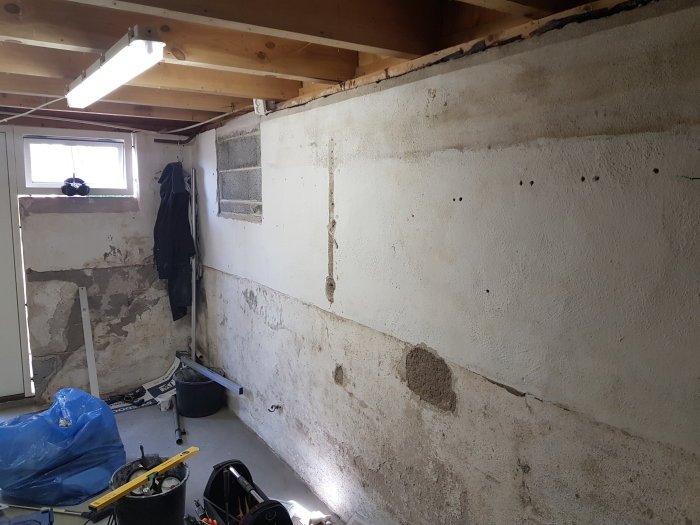
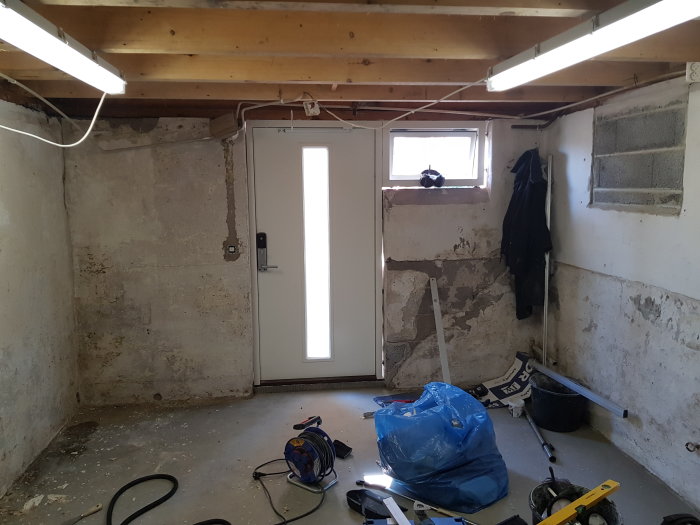
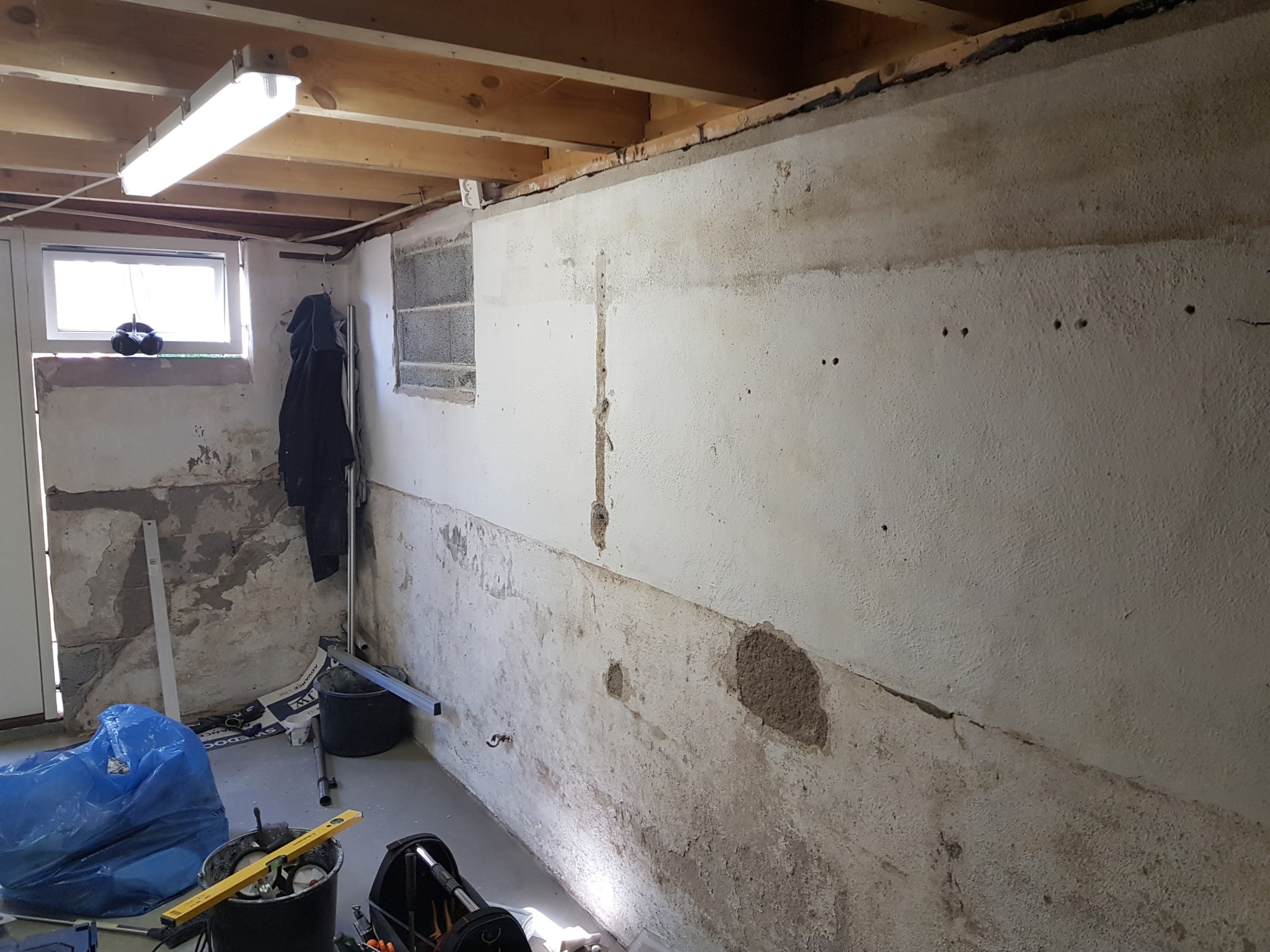
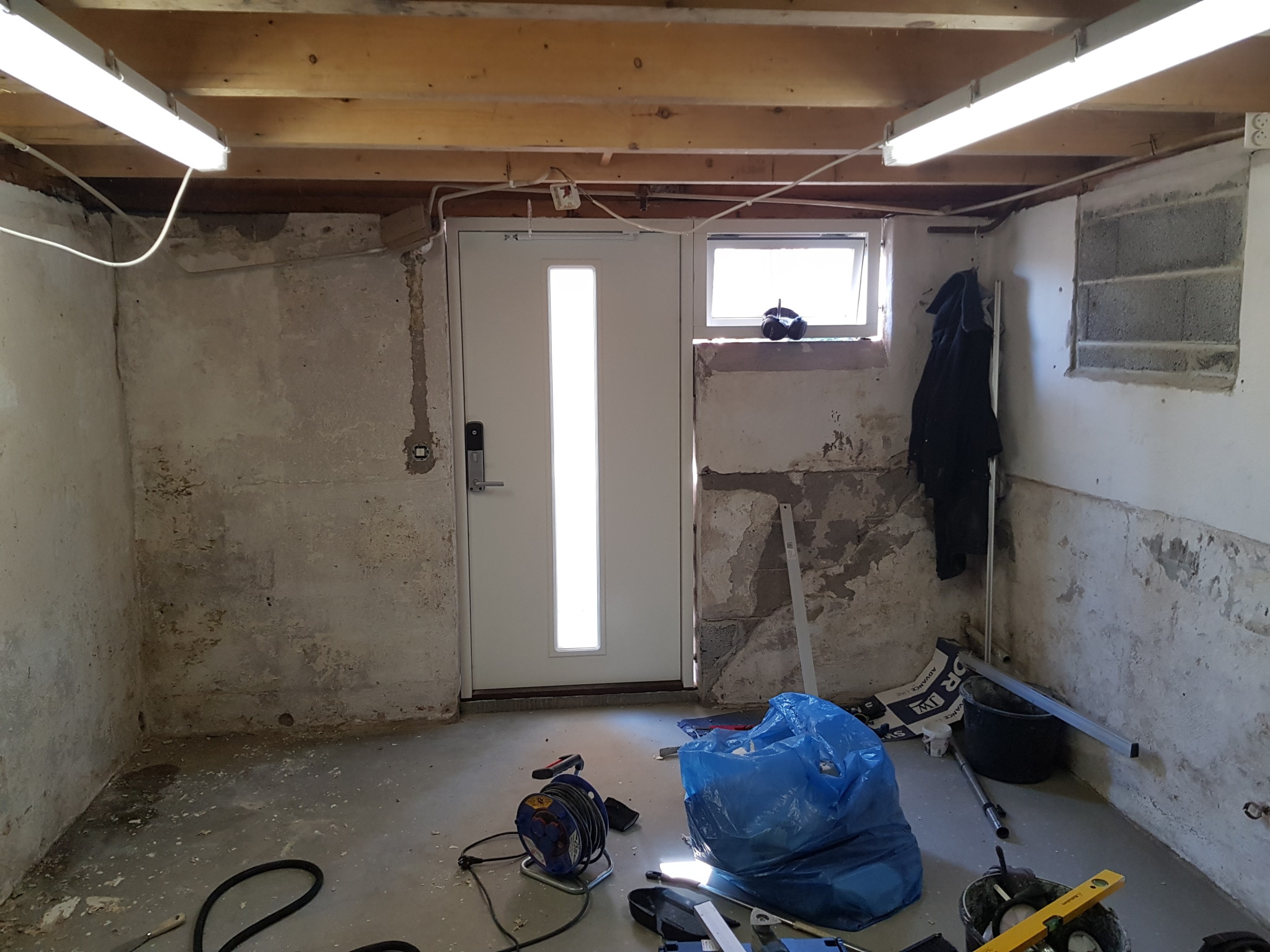
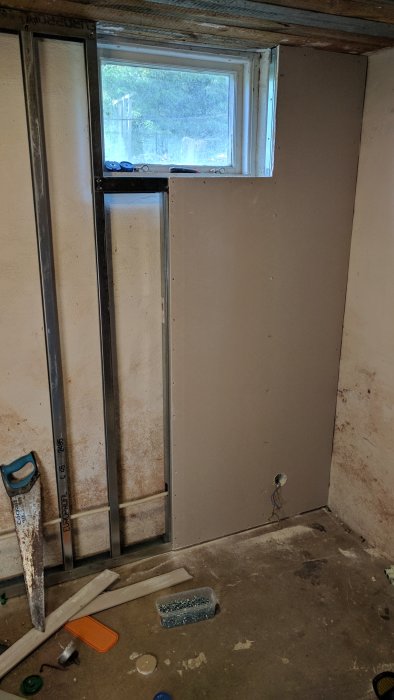
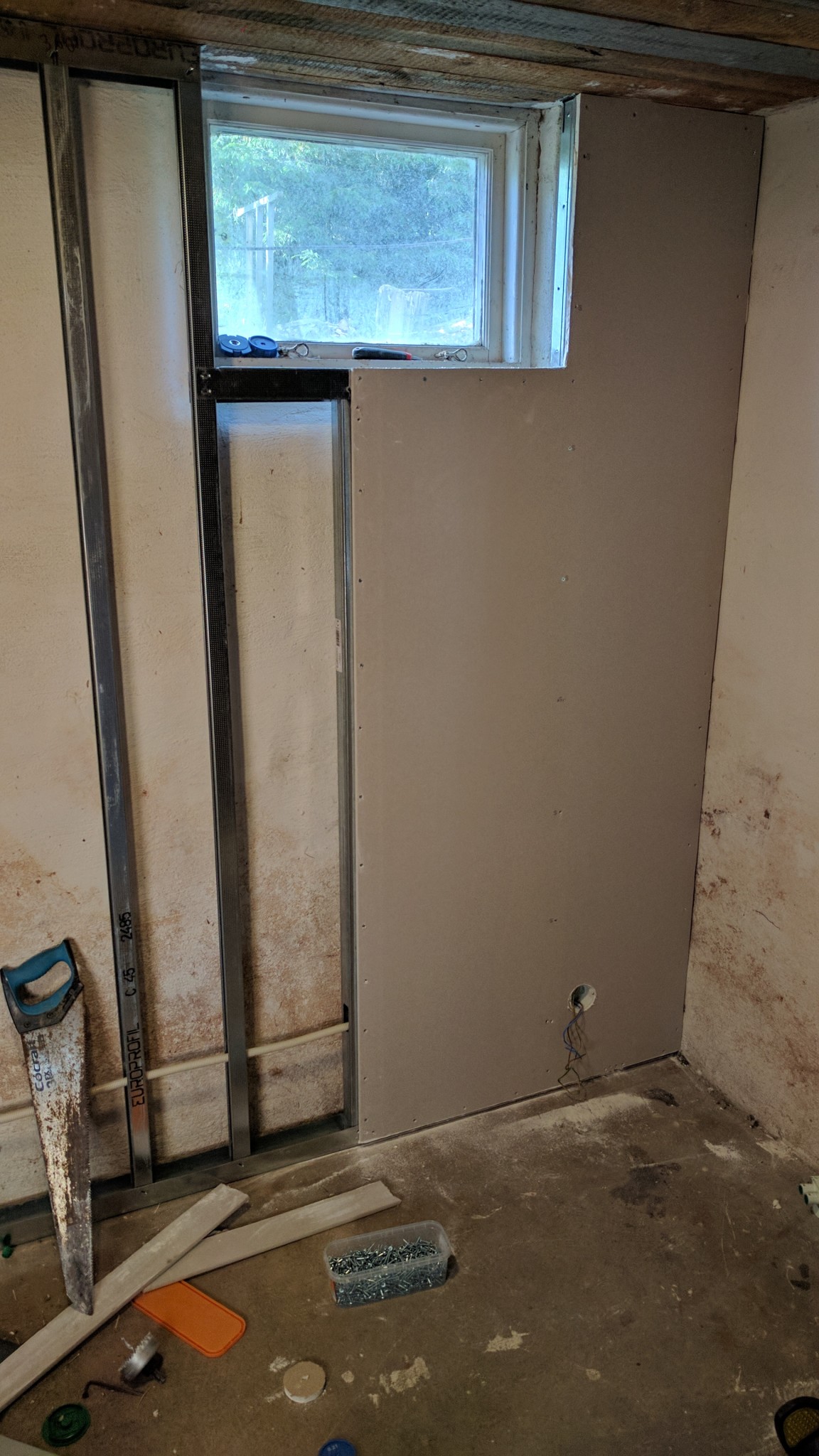
I have read quite a bit here among old posts on byggahus.se, but I still can't decide how to best repair my plastered basement walls. The house in question was built in 1943, and the basement walls are made of concrete hollow blocks. The walls are dry, and the existing plaster adheres very strongly to the substrate. The plaster is hard, so I think it's some type of lime-cement/cement plaster. If I scrape hard with the mason's hammer along the plaster, it just glides along the substrate. There are some damages I need to fix after removing a previous coating that went up about 1m on the wall, and I have also bricked up a couple of the windows and replaced the other windows and the outer door. Besides that, the existing plaster is in good condition as far as I can assess.
I'm currently considering the following two options:
Option 1: Replaster the entire walls with C-mortar (Weber 224).
As I understand it, all paint must be removed if I am to plaster over the old plaster? Knocking off the existing plaster does not seem like an option. In that case, I was thinking of renting a rehabilitation grinder with a diamond blade and a heavy-duty vacuum cleaner to grind down the whole wall. Then plaster on that. My thought is that I don't need to remove all the old plaster but just the plaster that is loose and all paint. Since the existing plaster layer is hard, it should be OK to plaster with C-mortar on it, right? Should I mesh the wall before plastering?
Option 2: Repair the damages first and then sand the entire wall
First, repair the damages with plastering mortar C. Then, after the repairs have dried for a week, sand the entire wall with a flex machine/rehabilitation grinder. Is this a reasonable option? I've tried using a rehabilitation grinder before and know it's easy to make nicks in the surface if you're not very careful/focused. If nicks were to occur, is the best option to make the nick a bit larger (about 1cm deep) and plaster with C-mortar again after I'm done sanding?
In both cases, I was thinking of priming with Weber 103 red primer or diluted 224. I read somewhere that red primer is an A-mortar, is that correct, then maybe it's not suitable to use it on the old plaster if I choose option 1 above?
When it's plastered and finished, I plan to paint everything with a breathable paint, such as silicate or lime paint.
Which option do you think will give me the best and most durable end result?
If it is real paint and not lime paint on the walls and it is stuck, there is primer that makes the new plaster adhere to the old one (should be wire brushed) and on the old paint, repair all holes, then you can smooth out the surface with wet room filler and paint on it. I believe this will require the least amount of work.
I don't know what color it is. However, I would guess it might be some kind of lime paint.
It feels important to me that the walls can "breathe," so I'm a bit skeptical of filler products, leaning more towards using plaster only. Even if it means more work. I've considered slamming over the entire surface with a brush after I've repaired the damage and then painting it. I think the wall can have a little texture.
As seen in the photos, there are signs of moisture in some areas, dark surfaces; have you done external drainage or are you planning to do so? Because if you don't, there is a risk that the moisture will come through again in the future. The wet room filler is not waterproof, just moisture resistant; when repairing and patching, there will be a seam that will be visible even if you apply a structural slurry. To make it even and good, you probably need to skim coat the entire wall.
As can be seen in the photos there are moisture penetrations in some places, dark areas, have you re-drained on the outside or are you going to do it, because if you don't, there is a risk in the future that the moisture will come through again. The wet room compound is not waterproof, only moisture resistant. When repairing and plastering, there will be a seam that will be visible even if you plaster it structurally. To get it even and good, it probably needs a full plastering of the wall
Those are probably not moisture penetrations you see. I suspect you are thinking of the wallpaper remnants on the left side? That wall was previously wallpapered, with several layers of newspaper under the wallpaper. I haven't removed all the newspaper remnants yet, hoping they will "come off" when I remove the paint. I can't detect any moisture penetrations in any case. The basement is drained and insulated with pordrän and the house is on a hill and sits on quite sandy soil (I have excavated and insulated and poured a new floor, so I have dug down about 50 cm, it was very dry).
Okay, need to think a bit more about what to do. I'll start by fixing the damages at least.
The thing with old wallpapers, the painters mix a paste with wallpaper glue, just wet enough, spread it on the wall with plastic wrap tight, no evaporation, it sits for about a day then you just remove the wallpapers, they soak, and the glue comes off, try it on a piece.
I sanded off paint/plaster putty on 25 sqm with a quality machine from Best tools with a diamond grinding disc. It generally worked well with the cover I built with a vacuum cleaner connection. Today, I would probably hire someone to sandblast it. It took quite a long time. I smoothed it relatively evenly with plaster mortar b. But never got the surface smooth enough. So I skim-coated the entire wall with tile adhesive, which I then rolled with silicate paint. Probably not the right solution, but it has worked for 10 years.
I don't know what they're called, but it's a screw intended for concrete. I pre-drilled holes in the rule and concrete slab then hammered the screw (which has a plastic plug on it) in. It's rock solid. Then you can unscrew it if you want.
Or do you mean the horizontal one by the window? It's clamped with a special tool used to attach metal studs. No screws needed. Edit: it's called a "stuknittång."
Click here to reply
Vi vill skicka notiser för ämnen du bevakar och händelser som berör dig.