
Hi, I have a wall that I'm planning to render this spring or do it myself, I'm a bit unsure if it can be done on my own. The wall is built with concrete blocks, the wall is 30 meters long and 1.40 high, the idea is to render it and then paint it white. Does anyone have experience with this?


Hi, it's bricked, tried to attach an image but it didn't work
Last edited:
Got a tip to mix plaster myself, mix a "rich" concrete 1 part cement 3 parts sand and water into a loose slop and then just smear it on with a lime brush. Is it that simple ??
If you are fairly handy, you can do it yourself. 30 meters x 1.4 may take some time for a beginner, but since it's plastering, it's okay to plaster a section, wait until the next day, and plaster another section, and so on. The seams will probably be slightly visible depending on how well you manage to finesse it with the brush.
Make sure the wall is clean.
Apply a thin layer of primer mortar a in consistency like porridge or slightly thicker. This can be done with a sword (decolit board), plastering trowel, steel float, trowel, or whatever you like. Over the entire wall.
Once the primer has dried, you can plaster with "plaster and masonry mortar B" or "plaster and masonry mortar C" or "KC masonry and plaster mortar B". Apply a centimeter-thick layer on an area you feel you can handle before it dries too much. (You will have to experiment and maybe start with two to three meters of the wall and increase the next section if you feel you can handle it.) Remember to press quite hard to compress the mortar as much as possible.
When a section is applied, take a lime brush or ceiling brush and a bucket of water, dip the brush in the water and apply it to the mortar across the entire surface, shake out the tool and dip in water when needed. Here you can make straight movements from bottom to top or curved movements, whatever you think looks nice. However, avoid pulling downward due to gravity. When you are satisfied, begin plastering the next section or wait until the next day.
When the entire wall is plastered, wait a month until you paint it, then with silicate paint or kc paint or base paint or something.
Make sure the wall is clean.
Apply a thin layer of primer mortar a in consistency like porridge or slightly thicker. This can be done with a sword (decolit board), plastering trowel, steel float, trowel, or whatever you like. Over the entire wall.
Once the primer has dried, you can plaster with "plaster and masonry mortar B" or "plaster and masonry mortar C" or "KC masonry and plaster mortar B". Apply a centimeter-thick layer on an area you feel you can handle before it dries too much. (You will have to experiment and maybe start with two to three meters of the wall and increase the next section if you feel you can handle it.) Remember to press quite hard to compress the mortar as much as possible.
When a section is applied, take a lime brush or ceiling brush and a bucket of water, dip the brush in the water and apply it to the mortar across the entire surface, shake out the tool and dip in water when needed. Here you can make straight movements from bottom to top or curved movements, whatever you think looks nice. However, avoid pulling downward due to gravity. When you are satisfied, begin plastering the next section or wait until the next day.
When the entire wall is plastered, wait a month until you paint it, then with silicate paint or kc paint or base paint or something.
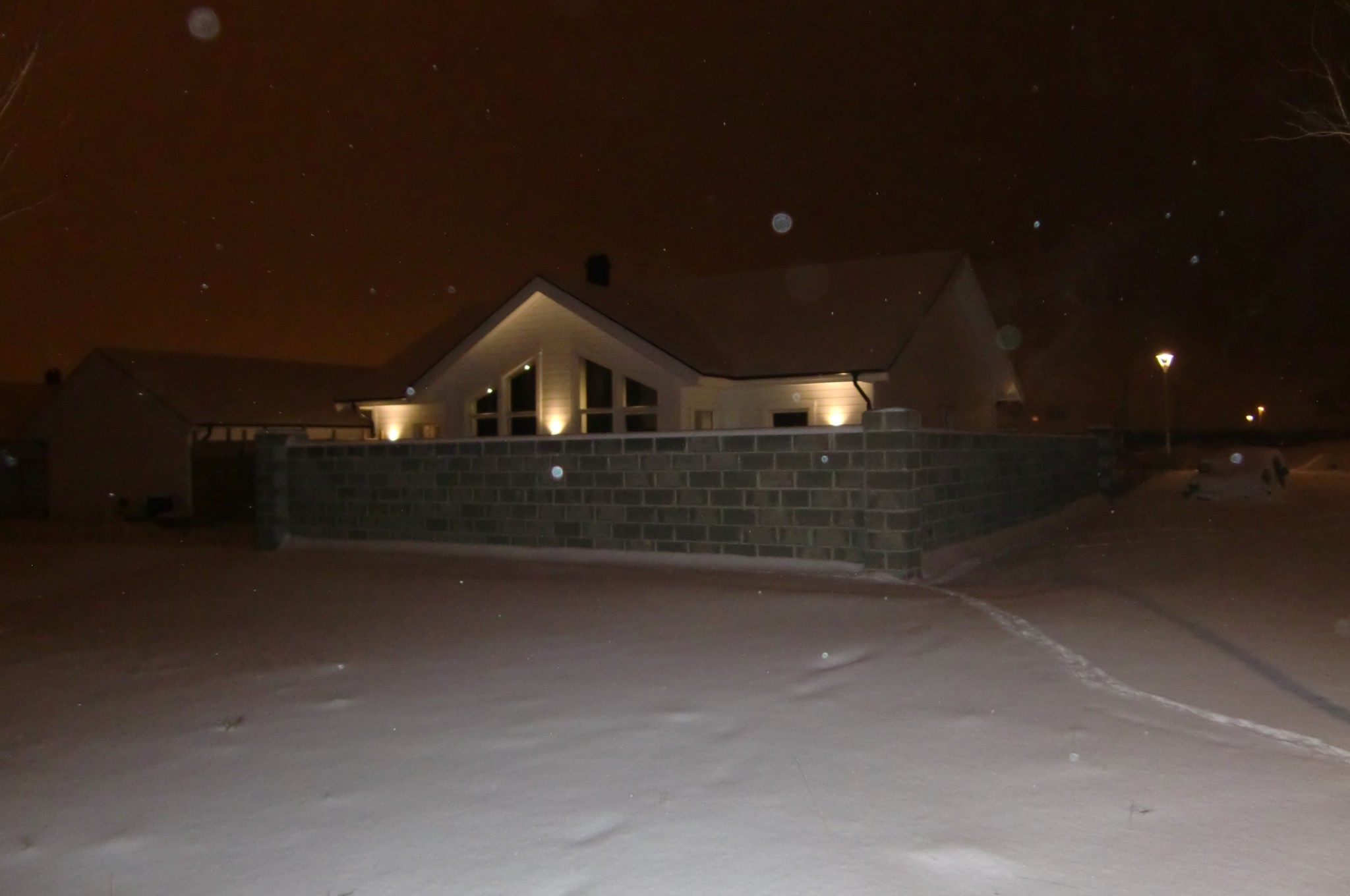
Here is the wall, hope the picture is visible.
Mnjaa, it will only be a base layer, probably the joints will show through when the wall gets damp. Just smearing on concrete mix with a brush will be very tricky and hardly neat as far as I know, at least apply something.Roger i Halmstad said:
Hello MaxPax and thank you for the answer, I have access to cement and casting sand, is it okay to mix it myself or is there a difference compared to buying, for example, mortar b ??
Regards
Roger
Regards
Roger
Yes, from a distance it's nice, but closer it looks a bit "worse".
Yes, there is a difference. With only cement, it becomes very hard mortar, can crack easily, what kind of mortar is the wall built with? Casting sand has too large gravel in it and becomes cumbersome, I would rather use bricklaying sand or plaster sand.Roger i Halmstad said:
Ok and thanks for the answers, I'll buy some bags of rödgrund and apply it, then murbruk b and try it on a piece and we'll see how it turns out, alternatively, hire some concrete guys.
Click here to reply